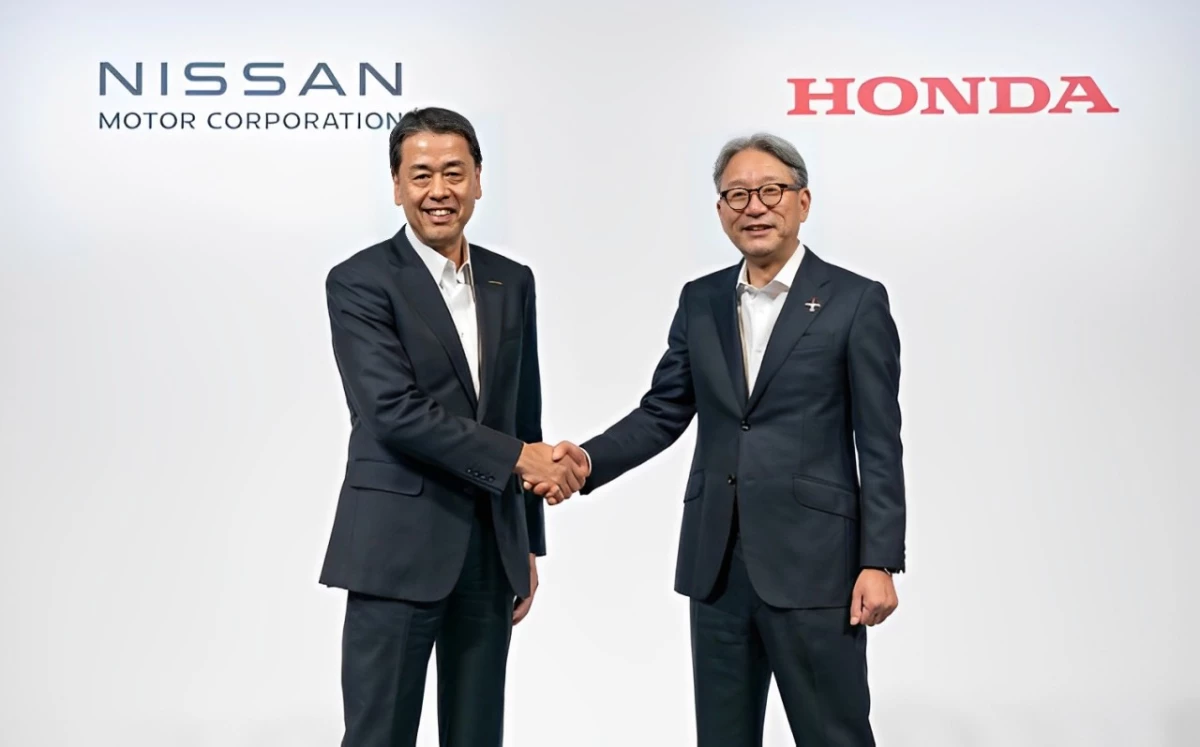

Key Takeaways:
- The $190 billion merger will create the third-largest global auto group if finalized.
- Mitsubishi Motors may join the new group, with a decision expected by January 2025.
- Honda’s stock surged 17% after the merger news, signaling strong investor confidence.
- If approved, the merger would be the largest in the auto industry since the Fiat-Chrysler-PSA deal in 2021.
Honda and Nissan have announced a merger on the cards by 2026, signifying a historic pivot for Japan’s auto industry.
The marriage between Japan's second and third-largest automakers could create a company with sales revenue exceeding 30 trillion yen ($190.9 billion) and over 3 trillion yen ($19 billion) in operating profit — making it the third-largest global auto group after Toyota and Volkswagen.
The two companies signed a memorandum of understanding (MOU) earlier this year, aiming to achieve a carbon-neutral society and a zero-traffic-fatality society.
Ever since its split with Renault, Nissan has been battling financial turmoil, leaving the company in dire need of a stronger merger partner to survive.
If the deal goes through, it will be the biggest merger in the industry since the Fiat Chrysler Automobiles and PSA marriage in 2021.
The announcement was made shortly after the world’s largest global advertising agency, the Omnicom Group, and Interpublic signed a historic $30 billion merger — amidst a slew of industry changes worldwide.
View this post on Instagram
Under the current proposal, a new holding company would be the parent entity for both Honda and Nissan and be listed on the Tokyo Stock Exchange.
As the larger entity, Honda will appoint the majority of the board members for the unified company.
According to a company statement, both Honda and Nissan plan to collaborate on fundamental technologies for next-generation software-defined vehicles (SDVs), focusing on intelligence and electrification.
This includes combining their management resources as well as expertise and talent to adapt to market shifts and enhance long-term value.
More importantly, by integrating Nissan's and Honda's four-wheel-vehicle and Honda's motorcycle and power products businesses, the merger will establish Japan’s industrial base as a “leading global mobility company,” ultimately developing more attractive and innovative products.
Mitsubishi Motors, in which Nissan is the top shareholder, has also been invited to join the new group and is set to decide by the end of January 2025.
Driving Toward a Bold, New Future
Nissan Director, President, CEO, and Representative Executive Officer Makoto Uchida marked the MOU signing as a “pivotal moment” in the business integration plans.
“If realized, I believe that by uniting the strengths of both companies, we can deliver unparalleled value to customers worldwide who appreciate our respective brands.
Together, we can create a unique way for them to enjoy cars that neither company could achieve alone.”
As seen with Omnicom and Interpublic’s merger, agencies seek strategic partnerships or mergers to enhance their competitiveness. For example, this MOU would better position Honda and Nissan to scale against Tesla and other rivals.
Notably, Honda’s stock surged by as much as 17% when local markets opened Tuesday, following news of its discussions with Nissan.
In terms of other merger-related benefits, Honda and Nissan hope to:
- Standardize their vehicle platforms across various product segments
- Increase sales and operational volumes, which would allow them to reduce development costs per vehicle and maximize profits
- Facilitate more integrated collaboration across all R&D functions
- Optimize their manufacturing plants and energy service facilities to improve capacity and decrease costs
- Boost competitiveness by improving and streamlining purchasing operations
- Source common parts from the same supply chain and business partners
- Increase employee exchanges and technical collaboration between the companies to promote further skills development
- Provide a range of solutions, including new financial service throughout the vehicle lifecycle
Toshihiro Mibe, Honda’s Director and Representative Executive Officer, said the merger is “essential to overcome challenging environmental shifts” in the auto industry.
“Honda and Nissan are two companies with distinctive strengths.
We are still at the stage of starting our review, and we have not decided on a business integration yet, but in order to find a direction for the possibility of business integration by the end of January 2025, we strive to be the one and only leading company that creates new mobility value through a chemical reaction that can only be driven through a synthesis of the two teams.”
Weathering “environmental shifts” is something other industries have also had to do over the past year. Several announced major layoffs, restructuring, and new office mandates globally.