
Google Finance’s AI Deep Search: Key Findings
- Deep Search executes hundreds of simultaneous queries and produces fully cited financial research, reshaping what users now expect.
- Kalshi and Polymarket dominate prediction-market activity, reflecting rising demand for probability-based financial signals.
- Unified earnings analysis tools push fintech platforms toward more consolidated, AI-supported research workflows.
Google Finance’s latest upgrade is marking a major turning point in how users conduct financial research.
Its newly launched Deep Search can issue “up to hundreds of simultaneous searches.”
You can ask it questions like why a stock is moving against its peers or what a new macro trend means for its outlook, and it will generate fully cited, multi-step financial answers in mere minutes.
Users can also watch the research plan unfold in real time, understand how each conclusion is formed, and quickly probe deeper through follow-ups or linked sources.
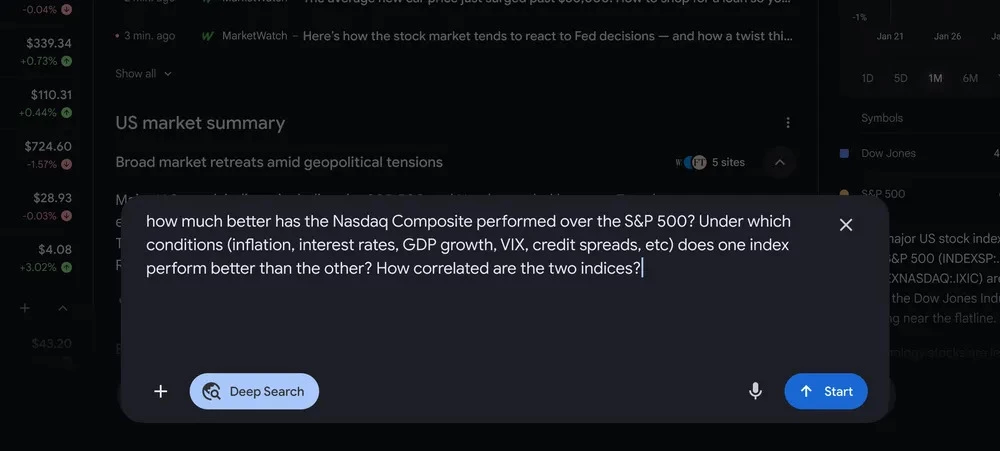
To keep up with the change, financial platforms must now deliver depth, citations, and transparent reasoning as standard.
“Users increasingly expect to understand how an AI reaches a conclusion,” said Anton Zenkov, VP of Software Development at Kanda Software.
“If fintech tools can’t show their steps, users will move to platforms that can.”
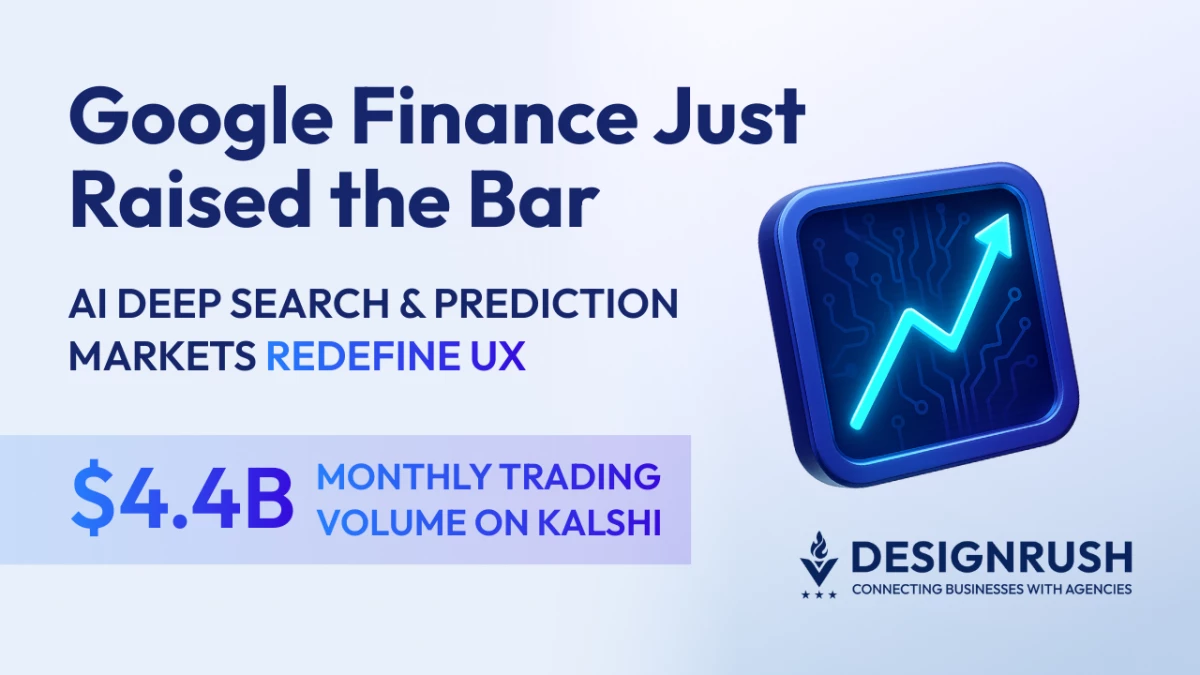
The update also integrates prediction-market data from Kalshi and Polymarket, which have seen significant trading traction.
Kalshi recently captured 62% of total on-chain prediction-market volume, with a $4.4 billion in monthly trading volume, and $500 million in weekly trading volume.
Meanwhile, Polymarket recorded $3.02 billion in monthly trading volume and nearly 478,000 monthly active users.
Overall, these reveal a trend toward consolidating financial research into one platform, eliminating the need for users to switch between multiple tools.
From Dashboards to Dialogue
Fintech research is entering a new phase where rigid dashboards are giving way to adaptive, conversational systems.
Below are the three shifts redefining how professionals gather and interpret financial information.
1. Conversational Research is Becoming the Default
Deep Search is built to handle multi-layered questions that previously required hours of manual research across filings, news, and analyst reports.
Apart from that, users also see a “research plan” while the AI generates answers.
“Five years ago, companies needed dashboards. Now they need dialogue,” Zenkov said.
For custom software development experts like Kanda Software, the platforms that win are the ones that will make “research feel like a conversation.”
This belief is supported by wider AI adoption trends.
Platforms that can synthesize multiple data sources and provide explainable reasoning are quickly becoming the standard, especially for professional users who want more than a static chart or table.
Because of this, fintech developers now need to design interfaces that combine transparency, multi-step reasoning, and conversational UX.
2. Prediction-Market Data Is Entering the Mainstream
Kalshi and Polymarket bring probability-based forecasting into everyday financial research.
In the new Google Finance, users can type questions like “What will GDP growth be in 2025?” and immediately see market-implied probabilities, along with historical trends.
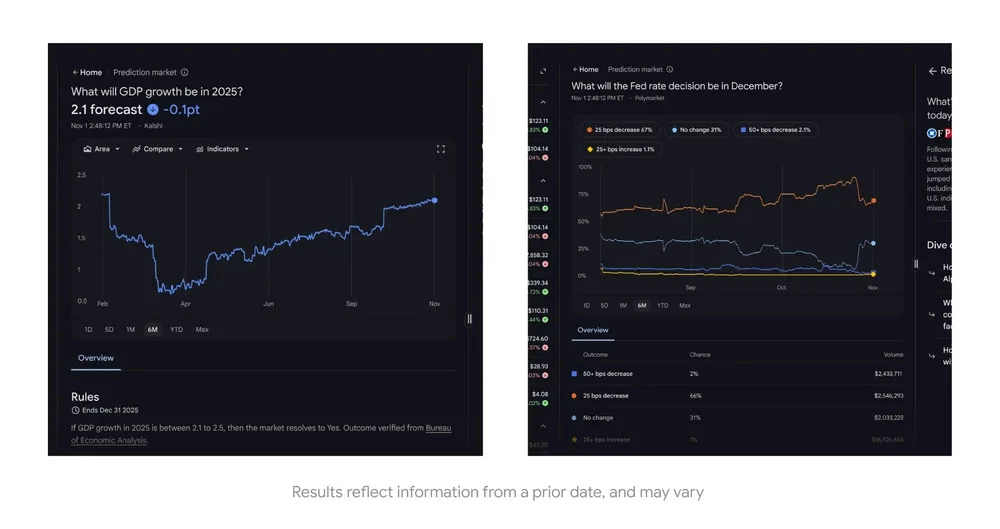
Zenkov believes that this next frontier will be about “connecting historical patterns, event probabilities, and user intent in one place.”
“Prediction engines will become a core feature, not an add-on,” he added.
Fintech firms building predictive engines can deliver real-time probability insights that complement traditional analytics.
3. Unified Research Workflows Are Becoming Table Stakes
Google’s Earnings interface is also having a glow-up, consolidating live call audio, real-time transcripts, AI-generated summaries, and analyst reactions in one platform.
Users no longer need multiple tabs, enabling faster, more reliable decision-making.
Custom fintech platforms now need low-latency pipelines, clean data integration, and AI-powered summarization to meet these rising expectations.
“Latency kills trust,” Zenkov shared. “If insights populate too slowly or inconsistently, users won’t tolerate friction.”
Overall, it’s these streamlined platforms that merge data, AI insights, and real-time updates that allow professionals to make faster, more confident decisions.
What This Means for Fintech Builders in 2026
With all that’s been said, it’s clear Google Finance is redefining intelligent research.
Users now expect AI that explains reasoning, integrates prediction-market insights, and unifies multiple data sources.
To stay competitive, development teams must evolve platforms from passive dashboards into active research companions.
Investing in explainability, low-latency pipelines, and conversational intelligence will be essential to meet rising user expectations and remain relevant and visible in the fintech space.
Fintech research has changed, and the platforms that deliver AI-driven, unified insights will be the ones setting the new standard.