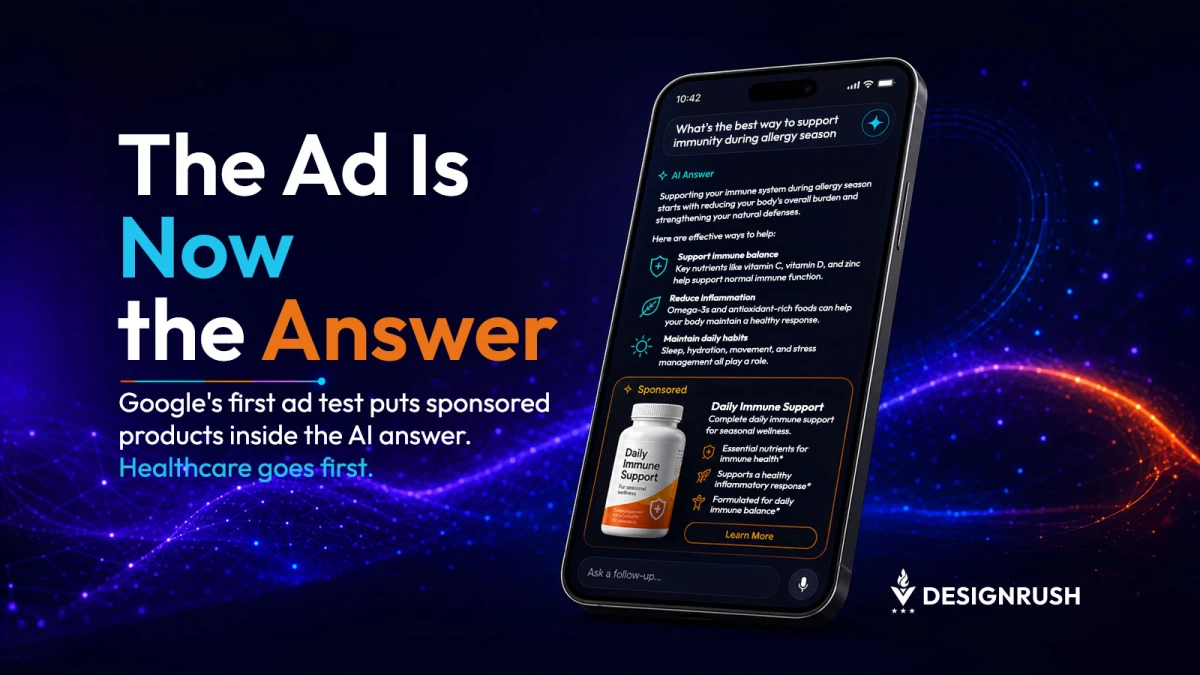

Google confirmed it is running a limited test of healthcare ads inside AI Mode, restricted to U.S. advertisers on English-language queries.
Google Ads Liaison Ginny Marvin confirmed the test on LinkedIn after weeks of industry speculation.
Eligible campaign types include Performance Max, AI Max with search term matching, Shopping, and broad match.
That means most advertisers already running these campaigns can enter the test without rebuilding anything.
The first phase excludes ads with pinned assets or text disclaimers, which sidelines most compliance-heavy healthcare creatives.
Healthcare Is the Test Case for a Much Larger Rollout
Healthcare is the first vertical the ad platform chose to stress-test its new AI Mode ad infrastructure against, and the choice is deliberate.
It carries stricter rules around claims, disclaimers, and targeting than almost any other advertising category on the platform.
Those rules also shape how the ads themselves look, and at its annual marketing conference, Google detailed two AI Mode formats built with Gemini.
- Conversational Discovery ads answer a user's specific query with tailored creative.
- Highlighted Answers surface relevant ads within AI-generated recommendation lists.
Both carry a visible "Sponsored" label and include an independent AI explainer alongside the advertiser's creative, per the Google Ads & Commerce Blog.
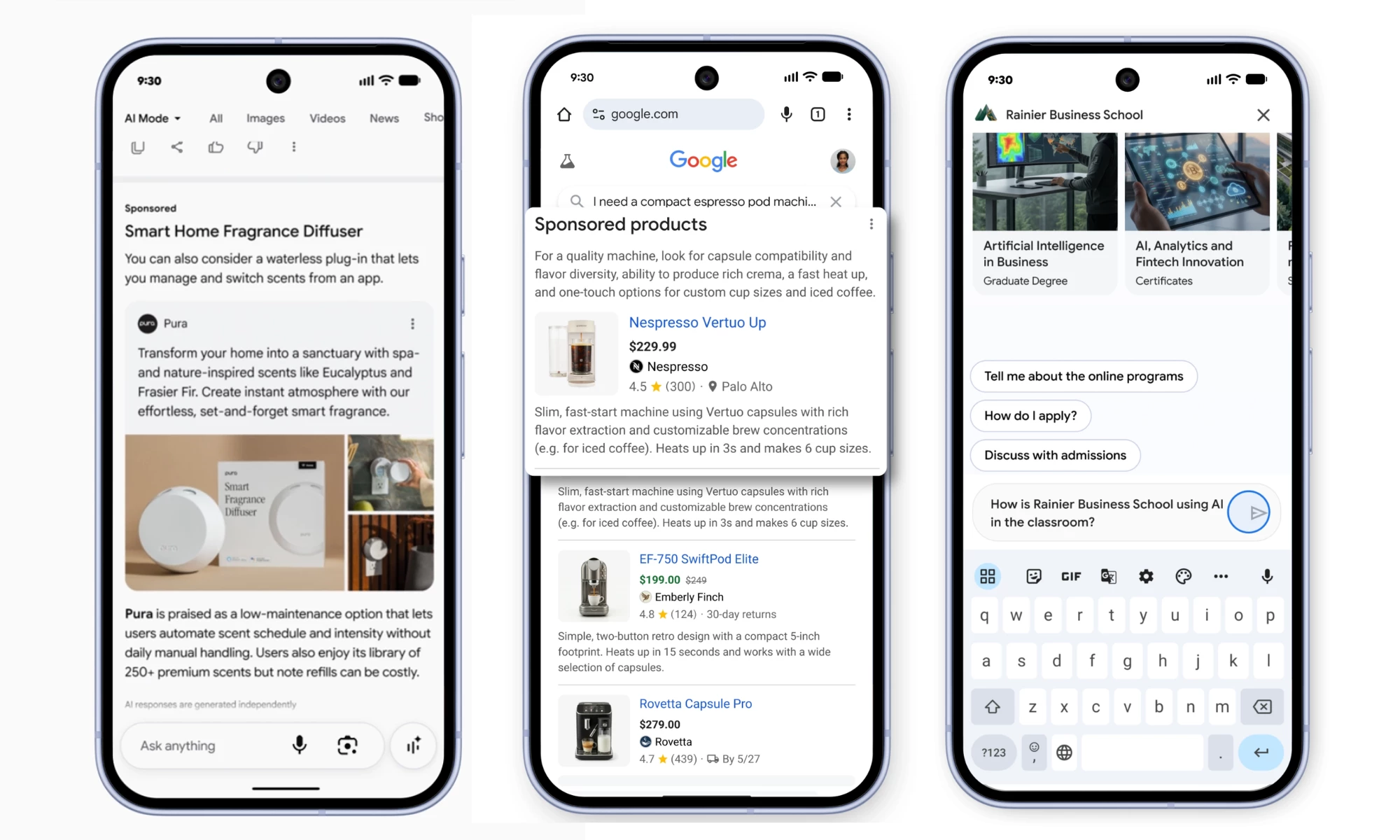
Sponsored placements inside Google AI Mode, each labeled and paired with an independent AI explainer | Source: Google
Neil Welsh, founder and CEO of Silverback Strategies, a performance marketing agency specializing in paid media and measurement, sees the healthcare test as a deliberate sequencing decision.
"Google is starting with healthcare because getting ads right in a regulated environment proves the infrastructure works under pressure," he says.
"Legal, financial services, and insurance are watching this test closely. What Google learns here determines how fast those verticals open."
The Disclaimer Ban Reveals What Is Still Missing
The exclusion of pinned assets and text disclaimers tells advertisers where AI Mode ad infrastructure currently stands.
Healthcare requires disclaimers and pinned claims by law, and the first phase sidelines exactly those formats while the compliance layer is still being built.
"The disclaimer exclusion is telling you that the platform is still building out the compliance layer for regulated formats," Welsh adds.
"Advertisers who wait for full parity before testing will be optimizing without a baseline when it arrives."
Formats that carry their compliance inside the ad will be better positioned than those that bolt a disclaimer onto the end.
That means building the required claims and context into the creative itself, so the ad stays compliant even where AI Mode does not yet support a separate disclaimer line.
What Regulated Advertisers Should Do Now
Before the inventory opens, regulated advertisers should lock in measurement, because that is the one thing they cannot build after the fact.
"The brands that capture AI Mode early are the ones building their measurement frameworks now, before the inventory is available at scale," Welsh says.
"That means incrementality testing, clean conversion tracking, and feed data that machines can actually read. You cannot build that baseline retroactively."
So what should regulated advertisers actually do before the inventory opens? The upside is the work is not a rebuild.
These are three separate moves, and each one solves a different problem AI Mode creates.
Run Incrementality Tests Before Inventory Opens
Incrementality testing isolates the conversions a campaign caused on its own, separating them from sales that would have happened anyway.
Standard tracking cannot draw that line in AI Mode, where the answer absorbs the research a buyer used to do on the brand's own site. The brand looks responsible for a decision the AI answer has already shaped.
Silverback Strategies ran this test for home services provider CroppMetcalfe, which was putting 10% of its budget into branded search.
The brand did not know if those ads won new jobs or just claimed credit for visits that would have happened anyway.
The agency kept ads on in some matched markets and off in others, then measured the lift. It reports the channel came back 100% incremental, driving new revenue rather than clicks.
That is why the timing matters. Run the test before inventory opens, and you can separate the campaigns that add revenue from the ones riding on demand that already existed.
Tie Every Conversion Back to Spend
Clean conversion tracking connects a qualified lead or sale to the campaign that earned it.
Without it, a brand testing AI Mode early still collects activity but cannot tell which campaign drove what. That uncertainty reads the same as no measurement at all.
Track it properly, and a rising cost per lead points to the exact campaign to fix instead of a number with no source.
Make Product Data Machine-Readable
When an answer is assembled instead of listed, the system reads structured data to decide whether to surface a brand at all.
That turns accurate, complete feeds from a hygiene task into an eligibility signal.
A brand with messy or incomplete data risks being left out of the answer entirely, no matter how much it spends.
Clean the feed now, and the system has what it needs to surface you when the answer is built.
Advertisers who waited for AI Overviews to stabilize before building measurement lost the data that would have told them whether it was working. AI Mode is the same decision, arriving earlier.
A Billion Users Make Measurement the Real Preparation
AI Mode already serves more than a billion people a month, and Google says its queries more than double every quarter.
At that scale, a healthcare test is never just about healthcare. It is a preview of how ads will work everywhere else.
It changes what an ad placement is. When a page of results collapses into one answer, there are fewer slots to win, so each one costs more to earn.
Paying more for fewer placements raises the stakes on a question most teams still cannot answer, which is whether the spend works at all.
In a zero-click answer, rankings and traffic stop telling you much.
The brands that move now will know whether AI Mode spend pays before competitors even have a number to point to.
Those who wait will be bidding on a more expensive surface with no way to know whether it works.