
Customers have multiple intentions when they provide feedback to businesses.
However, in 53% of the cases, they’re giving businesses a valuable opportunity to enhance their customer experience.
This suggests that companies should listen to customer feedback and rely on data-driven insights rather than assumptions to guide their decisions and drive business growth.
In this interview, experience management platform DropThought Head of Sales Ankit Kedia discusses:
- The key benefits of real-time customer feedback over traditional feedback
- How businesses can identify the most effective feedback channels
- Advantages of multi-channel feedback

Who Is Ankit Kedia?
Ankit has over 20 years of experience in leading sales teams and developing new business opportunities in SaaS, technology, and data analytics across North America, APAC, and EMEA markets. He's a former VP of premier European business school INSEAD’s alumni board and a Gallup-Certified strengths coach and mentor. Ankit now leads the DropThought sales team globally, building a solid customer base and coaching a fast-growing team of account executives.
According to Ankit, collecting customer feedback serves as a direct line of communication between a company and its customers. The feedback entails actionable and valuable insights into customer needs, preferences, and pain points.
All of these help businesses understand what they’re doing right and where they need to improve, as well as identify new product opportunities or market gaps.
"When businesses listen to their customers and make changes based on their input, they can improve customer satisfaction and build loyalty,” he says.
Ankit stresses that companies actively using customer feedback to guide their strategy and address specific concerns see an increase in customer retention rates and revenue growth, outperforming their competitors.
Why Real-Time Feedback Beats Traditional Methods
While it’s important to collect customer feedback, it’s also beneficial for a business to know what’s the best way to go about it to drive better results.
This poses the question of what’s more advantageous:
- Real-time feedback collection which involves gathering insights from customers immediately after an interaction or
- Traditional feedback methods which often rely on delayed or periodic surveys
“The primary difference lies in the timing; real-time feedback provides instant insights, allowing businesses to respond quickly to customer needs. This immediacy offers several advantages in a fast-paced market.
For example, companies using real-time feedback can identify and address customer complaints before they escalate, resulting in a 25% reduction in negative customer reviews,” Ankit explains.
He believes that real-time feedback tends to have higher response rates because it captures customer impressions while the experience is still fresh.
This enables businesses to be agile and responsive, adapting to changing consumer behavior and market conditions with greater speed.
In contrast, traditional methods may miss the mark by being too slow to capture evolving customer sentiments and preferences, he says.
Additionally, Ankit believes that real-time feedback collection can significantly improve a business' ability to create personalized customer experiences.
“When businesses receive immediate feedback, they can quickly identify individual customer preferences, behaviors, and needs, which allows them to tailor interactions more effectively,” he says.
Real-time feedback also helps businesses adjust their communication strategies on the fly.
“Suppose a customer indicates dissatisfaction during a service interaction. In that case, the business can immediately take steps to rectify the issue, whether by offering personalized solutions, discounts, or targeted content,” Anik notes.
He believes that this improves customer experience and helps build loyalty by making customers feel understood and valued.
Identifying the Most Effective Feedback Channels
Ankit highlights that the most effective channels for collecting customer feedback vary depending on the business type and customer base.
“Some proven methods include email surveys, live chat, social media, in-app feedback, and customer service calls, each channel offering unique benefits.
Email surveys are excellent for in-depth feedback after a purchase, while live chat and in-app feedback are ideal for gathering real-time insights during an interaction,” he says.
However, businesses that use a multi-channel approach to collect feedback can capture a broader range of customer experiences and sentiments. For instance, last year, DesignRush found that podcast is the best platform for winning consumer trust.
“To make the most out of these channels, businesses should ensure that feedback collection is easy, non-intrusive, and incentivized where appropriate.
Additionally, they should integrate feedback from all channels to create a comprehensive view of the customer experience, which can then be analyzed to identify patterns and areas for improvement,” he points out.
What Makes Feedback Management Effective in Business
Ankit and I also discussed the key factors that differentiate successful feedback management strategies from less effective ones.
According to him, successful strategies are distinguished by five key factors:
- Actionability: Strategies should focus on collecting specific, relevant feedback that can drive concrete changes
- Timelessness: Collecting and acting on feedback quickly ensures relevance and freshness
- Responsiveness: Companies that respond to feedback within 24 hours have significantly higher customer satisfaction rates. Being responsive shows customers that their voices are heard and valued, which also encourages engagement
- Integration: Integration across multiple channels provides a holistic view of the customer experience
- Continuous improvement: Businesses should regularly refine feedback processes to keep pace with changing customer needs and expectations
Previously, DesignRush spoke with Christine Pizzo, head of design & creative and managing director at Designit, to discuss why consumers identify with brands that fulfill their promise. Watch below to learn more:
To derive actionable insights from feedback data, Ankit advises businesses to follow these four best practices:
- Segment data for more precise analysis and tailored solutions: Break down the data by customer demographics, journey stages, or product categories to identify specific areas for improvement.
- Leverage text analytics tools to discover hidden patterns and sentiments: Advanced text analytics tools can help decode large volumes of qualitative feedback, revealing underlying patterns and sentiments that might not be immediately obvious.
- Focus on key metrics to prioritize actions: Key metrics like net promoter score (NPS), customer satisfaction (CSAT), and customer effort score (CES) can help prioritize actions that will have the most significant impact on the customer experience.
- Utilize data visualization to make feedback more accessible: Visualize feedback data through dashboards or other visual tools to make it more accessible for decision-makers, enabling quicker, data-driven decisions.
Analyzing customer feedback data is one thing, but measuring it is another, especially when different metrics come into play.
“Measuring customer experience requires a mix of quantitative and qualitative metrics to provide a comprehensive view,” Ankit says.
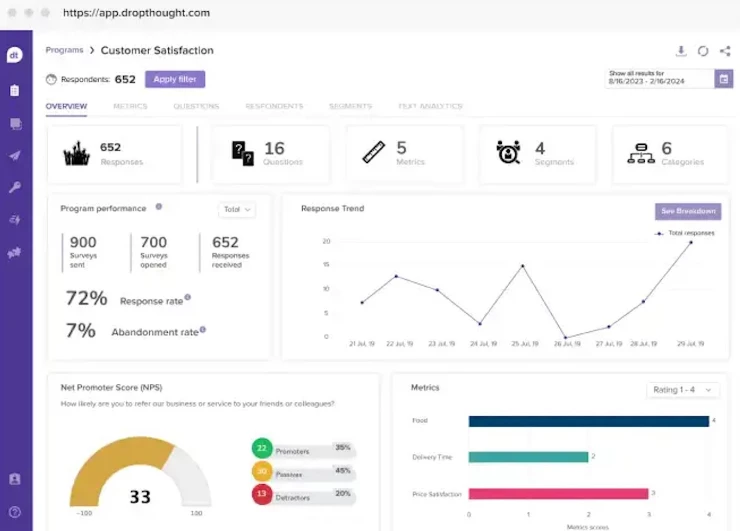
Additional metrics like churn rate, customer lifetime value (CLV), and first contact resolution (FCR) provide further insights into customer retention, value, and service efficiency.
“According to the books, combining these metrics with qualitative feedback, such as open-ended survey responses or social media comments, can provide a more nuanced understanding of customer sentiments and areas needing improvement.
For example, a business tracking NPS alongside open-text feedback could identify not just how loyal their customers are, but why they feel that way, allowing for more targeted improvements,” Ankit explains.
He also shares a case study of a client, a leading online bookseller with a catalog of over one million products which faced several critical challenges and needed:
- A rapid deployment of a feedback solution before the high-stakes holiday season
- An effective way to measure customer journeys across six key website touchpoints
- To demonstrate a direct correlation between customer feedback and revenue to justify investments in customer experience improvements
DropThought managed to deploy a solution in two weeks by gathering 50,000 responses by employing "listening posts," identifying issues like slow page loading and checkout difficulties, and prioritizing improvements by segment through data analytics.
The project resulted in a 23% increase in NPS, leading to optimized merchandising, operations, marketing for better engagement and profitability, and revenue growth.
This is proof that customer feedback matters in growing your business.
By leveraging real-time feedback, segmenting data for precision, and integrating insights from multiple channels businesses can spot issues and identify opportunities that not only improve customer satisfaction but also build brand loyalty.