
LinkedIn Outreach Conversion Drivers: Key Findings
- LinkedIn dominates B2B outreach, however most campaigns underperform due to poor execution
- Outreach fails due to misaligned targeting and generic messaging, therefore prospects ignore or disengage quickly
- Conversion improves with precise targeting and structured multi-touch strategies, enabling consistent and scalable results
LinkedIn outreach has become one of the most effective ways to generate leads today. It is direct, scalable, and sits exactly where business conversations are already happening.
It works best when scaled across multiple touchpoints, allowing teams to stay visible, build familiarity, and engage prospects over time.
And that’s exactly why it has become so saturated.
Open your inbox, and it is hard to miss. The same opening lines. The same vague promises. The same messages that feel like they were sent to a list, not a person.
Petr Kaliuzhny, co-founder and CRO of GetSales, an outreach automation platform, says that people have adjusted accordingly - they skim, ignore, and move on quickly.
“The interesting part is that the data shows that LinkedIn outreach still works. But the gap between what works and what most teams are doing is getting wider.”
As outreach scales, so do the risks tied to account restrictions and platform compliance.
Teams investing in outreach need to balance performance with safety, especially as LinkedIn continues to tighten enforcement of safety practices.
The video below shows how outreach campaigns can be scaled in practice:
Editor's Note: This is a sponsored article created in partnership with GetSales.
LinkedIn Outreach Stats Driving B2B Leads and Growth
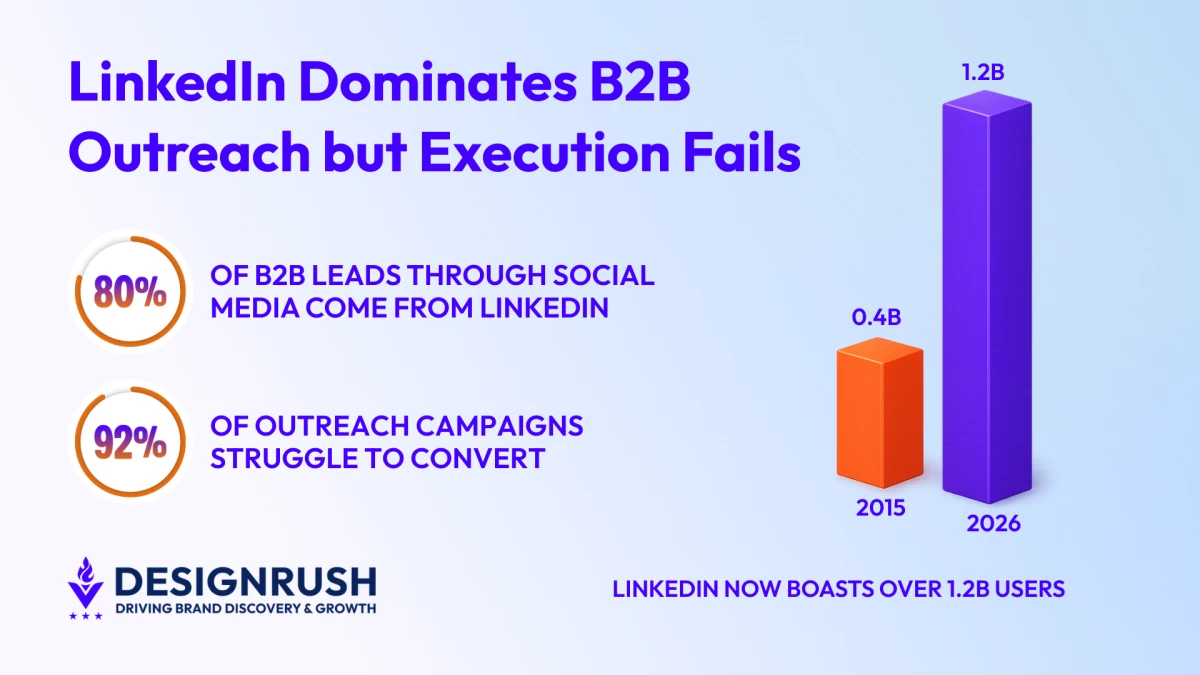
The reason LinkedIn dominates outreach is not just perception. Its growth tells a much bigger story.
LinkedIn’s user base grew from around 400 million in late 2015 to 500 million by 2017, according to company data reported by Mashable. Today, it exceeds one billion registered users globally.
Research continues to show just how central LinkedIn has become to modern sales pipelines, with 80% of B2B leads generated through social media coming from the platform.
At the same time, the Content Marketing Institute reports that 85% of B2B marketers say LinkedIn delivers the most value among organic social channels.
And yet, the results achieved by outreach initiatives tell a very different story.
For all its scale and proven effectiveness, 92% of outreach campaigns still struggle to convert.
These figures prove that the gap is not in the platform’s potential, but in how that potential is being used.
Top Reasons Your LinkedIn Outreach Isn’t Converting
There are several reasons why your LinkedIn outreach might not be getting the results you expected, and most of them come down to a few common mistakes that are easy to overlook but costly to ignore.
Kaliuzhny breaks down the four most common outreach failpoints and provides solutions to mitigate these:
1. Incorrectly Defined ICP
The first thing to do when planning an outreach endeavor is to determine who you are sending it to. At this stage, many may face a similar problem: a lack of understanding as to who their ICP is.
An Ideal Customer Profile (ICP) details who in a company benefits most and is likely to purchase your product or service. It is identified by analyzing data on location, company size, age, revenue, industry, technology, department, and budget.
The reality is that the messages we send heavily depend on the ICP we choose. If we are targeting a company's CEO, we will write about what their competitors are using and what solutions we offer to help them pull ahead.
“However, if we are targeting a CMO, CTO, or other department heads, we will tailor our messages to their specific pain points,” Kaliuzhny says.
“If you miss the mark with your targeting, your proposal will go to people who have no interest in your offer, making the outreach campaign ineffective.”
It is therefore crucial to carefully analyze your audience and select those to whom your offer is most relevant. That is when your conversion rates will increase.
Kaliuzhny notes that these insights are based on managing large-scale outreach campaigns across multiple LinkedIn accounts, where even small targeting misalignments can significantly impact performance.
How to solve this issue?
Carefully analyze your audience data (location, company size, revenue, industry, technology, and budget) to define your ICP. Then, segment your messaging based on the persona.
For a CEO, focus on what competitors are using and how your solution offers a competitive edge. For department heads (like CMOs or CTOs), tailor the message to their specific daily pain points.
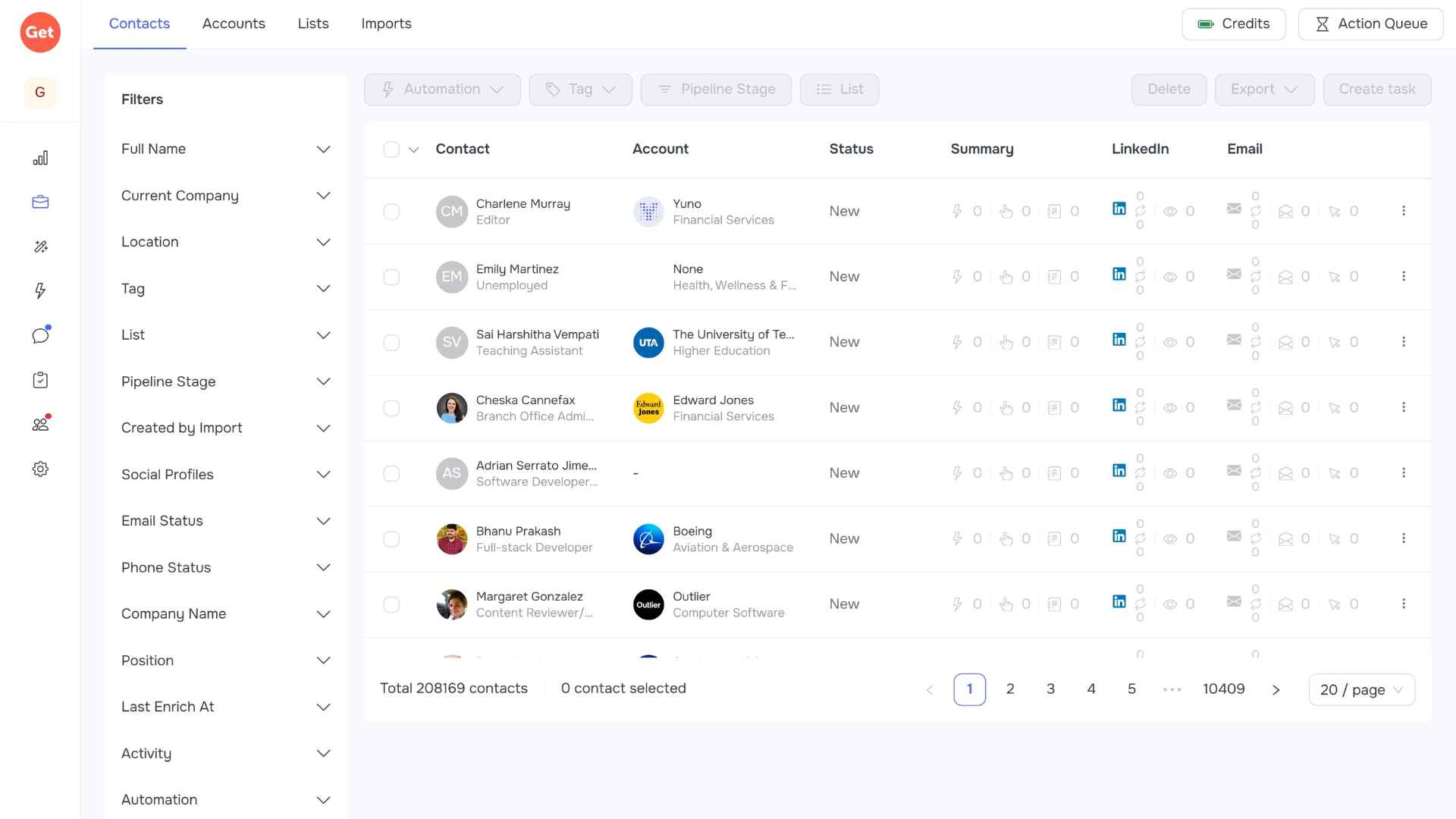
“With our outreach automation tool, users can source accounts that perfectly match their Ideal Customer Profile (ICP) directly from LinkedIn and store them in our built-in CRM,” Kaliuzhny says.
“From there, you can easily filter prospects and launch highly targeted automations, allowing you to test distinct pipelines and customized offers for different segments of your audience.”
2. Poorly Written Messages
There are several issues when it comes to message copywriting. One of them is a weak and irrelevant offer.
You need to explain how you solve a pain point and how you can help, rather than just stating what you do.
If you only talk about what your company does without presenting a Unique Selling Proposition (USP), the lead will receive thousands of identical messages from different companies, and you won't stand out.
What should you do?
Kaliuzhny advises that A/B tests should be run on your offers, including writing different icebreakers, pitched offers, and jokes.
He adds that structured testing environments make it easier for teams to quickly identify which messaging variations drive responses, especially when managing multiple campaigns simultaneously.
“You need to test them to find out what gets the best response. This can be done in GetSales by adding an A/B testing node and tweaking the copy based on reactions,” he says.
Kaliuzhny points to other bad habits in messaging, including the use of generic messaging.
Senders frequently rely on overused, impersonal opening lines such as "I came across your profile" or "Let’s explore some synergies."
Sending a wall of text about what your company does is another mistake. In reality, you need to keep it brief.
When launching outreach sequences, you should clarify the client's pain points based on what we know about them.
For example, if you know the company has a large sales department (or another specific department), ask if there is a need for our product and explain the exact results they will achieve.
You can state specifically how much time or money they will save annually by using our solution. You shouldn't recount your company’s history or tell them everything about yourselves; you need to get straight to the point.
Also, never drop a booking link in the very first message, as we don't yet know if there is any interest.
“It's much better to ask open-ended questions to find out how relevant your offer is and whether they are open to connecting,” Kaliuzhny says.
“This way, you can gather more information about the person.”
One way to reduce the perceived aggressiveness of cold outreach is to use personalization. You can mention something specific about the person such as where they have traveled or what their hobbies are.
The goal of outreach is to make the prospect believe you are a real person, not a bot running automated variables.
Another personalization tactic is to use info from their recent posts, news about events they attended, or their LinkedIn profile description. You can pull details from their status, where they studied, or their "About" section. The goal is to strike up small talk.
You can skip personalization entirely if the offer is already incredibly relevant to them. Alternatively, personalization can be replaced with a joke. To make the communication feel more natural, you should wait a bit before immediately pitching your product.
How to solve this issue?
Get straight to the point and focus on the prospect.
- Run A/B Tests while also highlighting specific ROI such as exactly how much time or money they will save annually.
- Ask open-ended questions instead of pushing a meeting link to uncover their core needs and gauge if they are open to connecting.
- Personalize the message by mentioning their recent posts, events they attended, or hobbies. If personalization isn't possible, use a highly relevant offer or a well-placed joke to make the communication feel human.
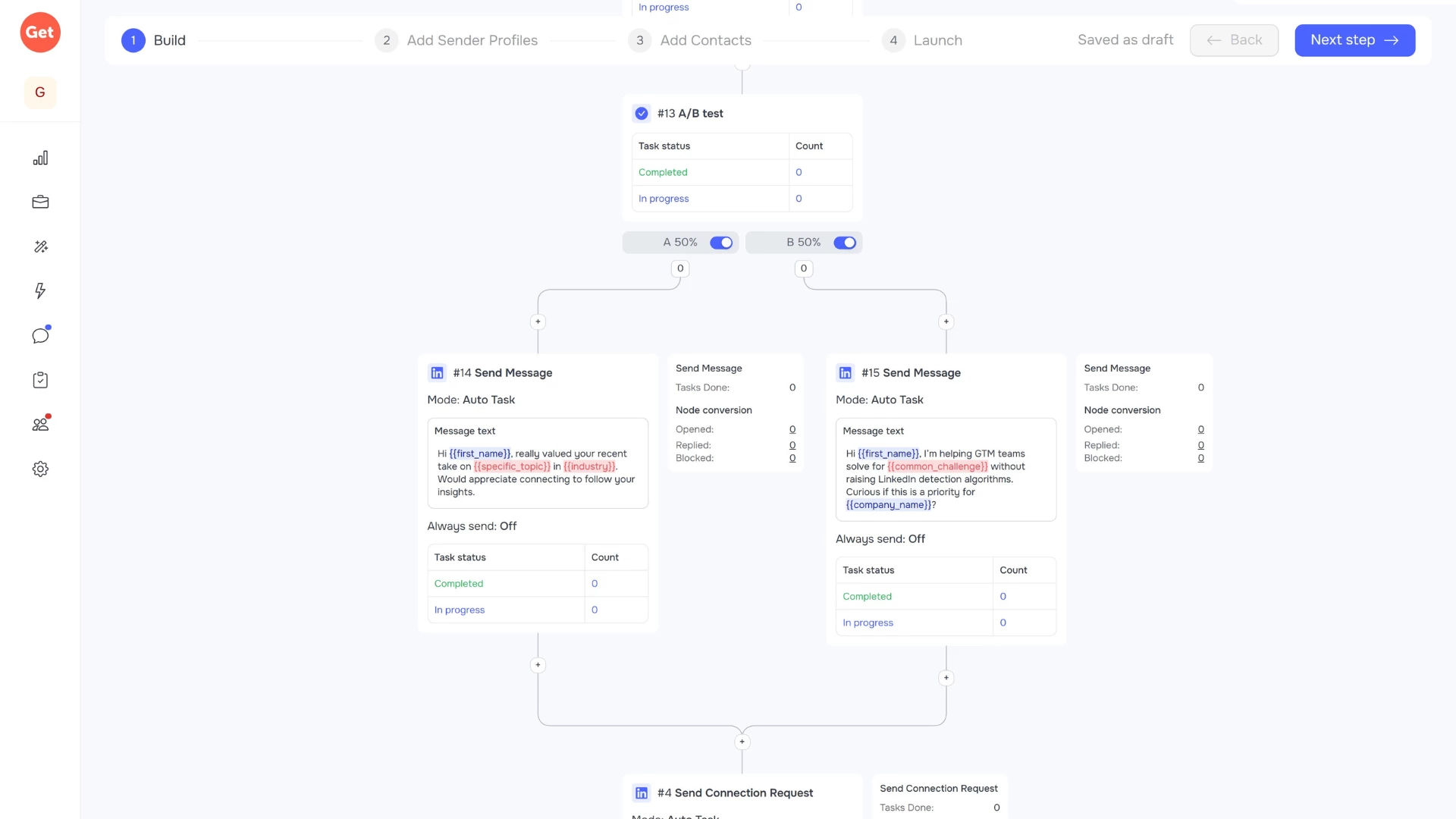
“GetSales makes it easy to test different messages and offers to see what truly resonates with your prospects,” Kaliuzhny said. “Using our visual automation builder, you can map out and automate your outreach logic step-by-step to drive maximum effectiveness.”
“By leveraging our built-in A/B testing nodes, you can continuously experiment with different approaches to pinpoint exactly what works best.”
3. No Follow-Ups
It’s a mistake to send a connection invite and follow it up with just a single message containing your offer. This in mind, it's essential to send follow-ups a couple of days apart; around two to three messages in total.
Each follow-up acts as a reminder while introducing a new, important detail. For instance, the first message could be a joke, the second your proposal, and the third a case study (or other combinations).
The key is to constantly share something new. A sequence of up to four follow-ups is perfectly fine.
The main goal is to establish contact; once they reply, it's much easier to make your offer. In the initial messages, you can drop some important industry information, like a recent event, someone getting banned, or a major shift in the market, and start the dialogue from there.
“For example, we recently started a dialogue by discussing how to buy LinkedIn Sales Navigator at half price,” Kaliuzhny said. “People were interested, which made it much easier to pitch to them.”
“Furthermore, the LinkedIn account of a popular app was recently banned, and we used that news as an icebreaker. You have the highest probability of getting a reply on the 1st or 2nd follow-up. However, the further down the sequence you go, the lower the chances.”
How to solve this issue?
- Build a structured sequence of two to four follow-ups spaced a few days apart.
- Add value every time: Don't just check in. Make the first message a joke or an observation, the second your proposal, and the third a relevant case study.
- Use industry news: Start a dialogue based on recent market shifts or gossip (e.g., "Did you see that popular app got banned?").
- Use a manual touch: Make the very first message in the sequence a manual one, written by a human who has actually reviewed the prospect's profile for authentic personalization.
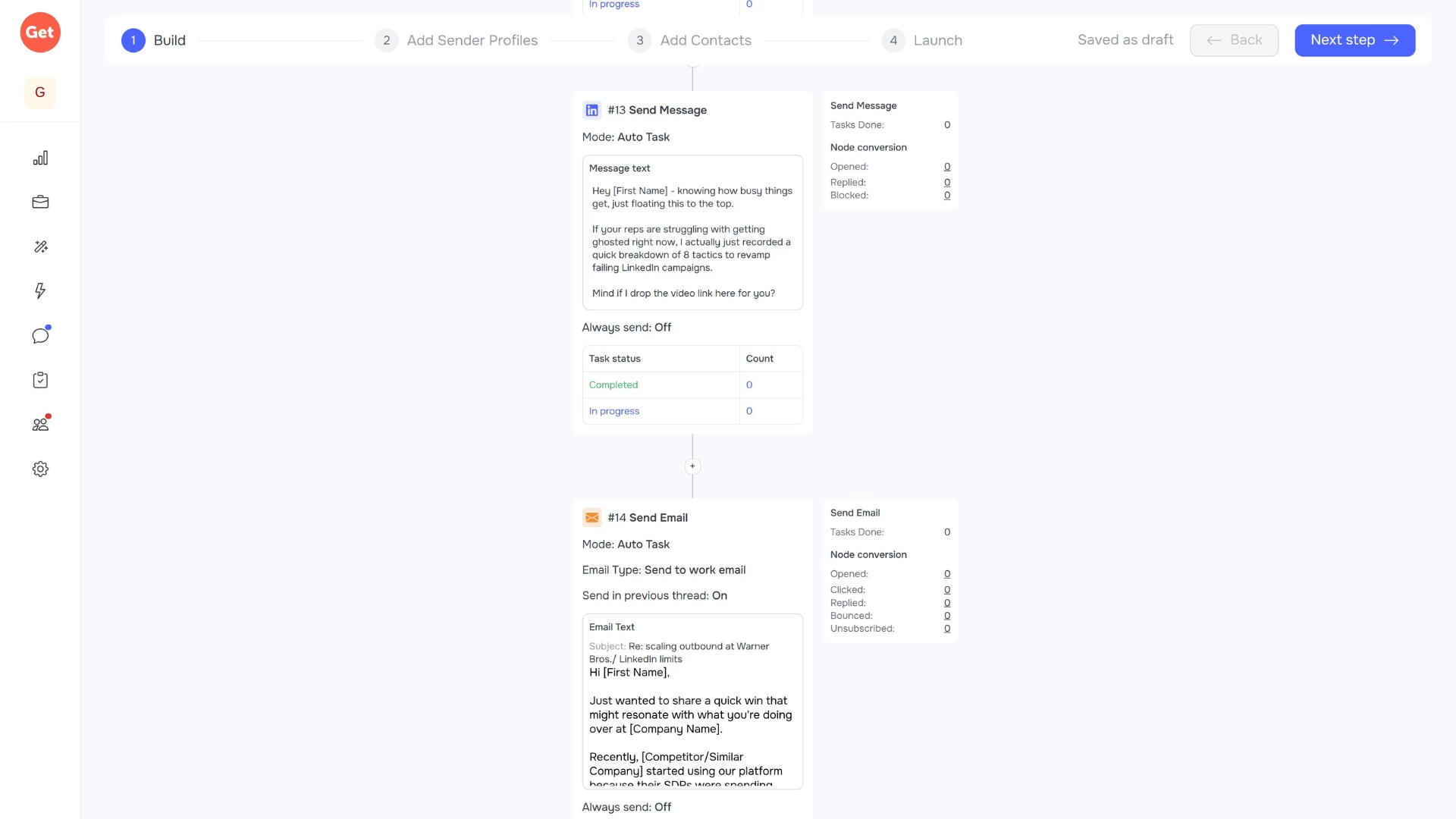
“At GetSales, we built our platform specifically to overcome these challenges,” Kaliuzhny said.
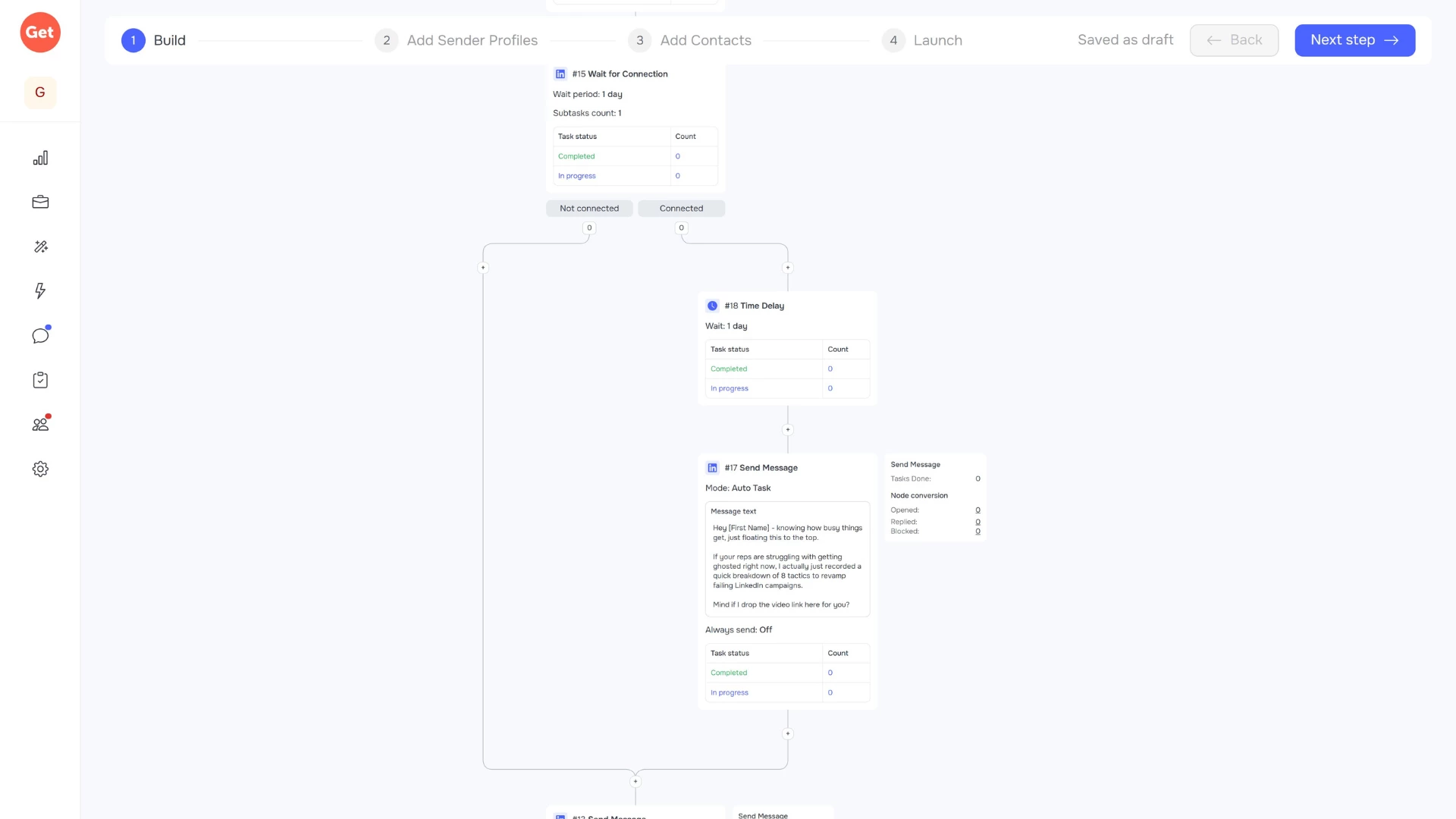
“Users can easily sequence multiple LinkedIn follow-ups, seamlessly integrate email outreach, and even insert manual tasks to ensure each message remains hyper-personalized.”
“GetSales also supports campaign logic, such as triggering a natural time delay after a connection request is accepted, so your outreach always feels authentic, and never pushy,” he adds.
4. Relying on a Single Channel
LinkedIn is a conversational platform. Therefore, simply copying and pasting what you send via email might not be relevant; you need to come up with different approaches.
It’s recommended to make the very first message in the sequence a manual one, written by a human. This is because a human can review the prospect's profile to find specific details to build true personalization upon.
LinkedIn is an expensive channel, whereas email is simpler and cheaper. They work incredibly well when used together. LinkedIn pays off if your annual revenue from that client is roughly $3,000 to $6,000. Otherwise, the channel won't justify its cost.
A lot of resources go into managing dialogues, as they consume a lot of time.
You might have to wait up to 10 days for a reply, and our sequence can run for a single lead for up to a month. The real results will be visible at the end of the 3rd month.
“Ultimately, you need to constantly test different offers, angles, and ICPs,” Kaliuzhny says.
“You also need a strong BDR (Business Development Representative) who can expertly handle objections, personalize messages, and dig down to the core of the client's needs in their responses.”
The trick is to figure out exactly what they need help with so the person is motivated to start a dialogue with you.
How to solve this issue?
Adapt your approach to fit the platform.
- Combine channels: Use LinkedIn and email together for the best results.
- Ensure high LTV: Reserve intensive LinkedIn outreach for clients with an annual value of roughly $3,000 to $6,000.
- Hire a strong BDR: You need a skilled Business Development Representative who can expertly handle objections, personalize replies, and dig down to the core of the client's needs to keep the dialogue going.
- Be patient: Expect to wait up to 10 days for a reply. A sequence can run for a month, and real ROI is usually visible by the end of the third month.
This video shows how to leverage AI for personalized outreach on the GetSales platform:
The Problem With The Outreach Tool You Choose
The tools behind your outreach do more than send messages for you. They shape how your brand shows up at scale.
Kaliuzhny notes that teams running outreach at scale often encounter infrastructure limitations early, particularly when managing multiple accounts or coordinating cross-channel sequences.
When infrastructure is weak, it does not matter how strong your targeting or messaging is.
Campaigns become inconsistent, accounts get restricted, and momentum breaks before results compound.
Many platforms still rely on per-account pricing and fragmented systems, which makes scaling both expensive and difficult to manage.
“Switch to a tool with better infrastructure and fairer pricing,” Kaliuzhny said. “The GetSales platform allows users to connect multiple accounts under a flat rate, while operating within a single session for each account.”
He explains that stability is often overlooked but critical.
“This secure campaign architecture mimics natural human behavior and removes the need to constantly reconnect or warm up new accounts,” he said.
At the same time, he cautions against shortcuts.
“Buying or renting accounts is often unreliable. Many providers offer low-quality accounts that don’t perform or get flagged quickly.”
Ultimately, tools should not just help you scale outreach. They should help you do it in a way that feels consistent, controlled, and sustainable.
Because in a channel as competitive as LinkedIn, execution is no longer just about what you say. It is about how reliably you can deliver it.
The teams that win on LinkedIn are not the ones sending more messages. They are the ones executing better.
Want to know more about LinkedIn outreach?
Take a look at our list of the Top Social Media Marketing Agencies for 2026.