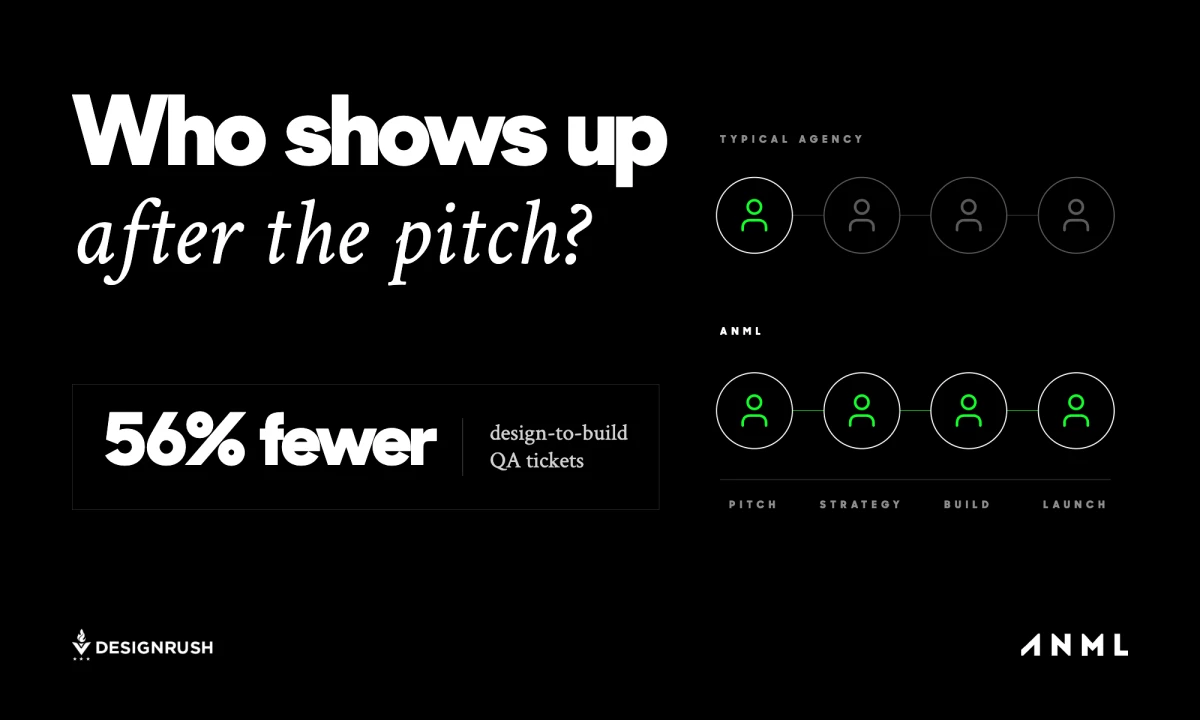

Twelve years of enterprise launches with clients including Panasonic, ServiceNow, Zoom, and Logitech taught all of us at ANML something we didn't expect going in.
The design system was never what held those projects together. The people who stayed on them, from the first strategy session to launch, were.
That distinction matters for any company deciding which agency to trust with a major launch.
Every Brief Hides an Unwritten Reason
A design system records what got decided. It does not record why, and that omission matters the moment a project changes hands.
Whoever inherits the documentation reads it literally.
A literal reading can follow every rule in the brief and still produce the wrong result, because the brief was never built to carry judgment, only instructions.
That gap rarely shows up during a pitch, when everyone in the room still remembers why each choice was made.
A client sees the risk later, mid-project, in a decision that technically follows the brief and still misses the point.
A Homepage Decision, Undone by a Handoff
The failure has a specific shape. Why a direction got chosen. What got rejected along the way. Where the real risk sits. None of that survives a handoff, no matter how detailed the brief.
A junior team can execute the brief perfectly and still miss the call that only makes sense if you were in the room when the strategy was set.
Say a client's strategy called for a conservative visual system on the homepage and an aggressive one on product pages, a deliberate contrast decided in week one.
A junior executor picking up the project in month three sees the inconsistency in the documentation and fixes it, flattening the exact tension the strategy was built around.
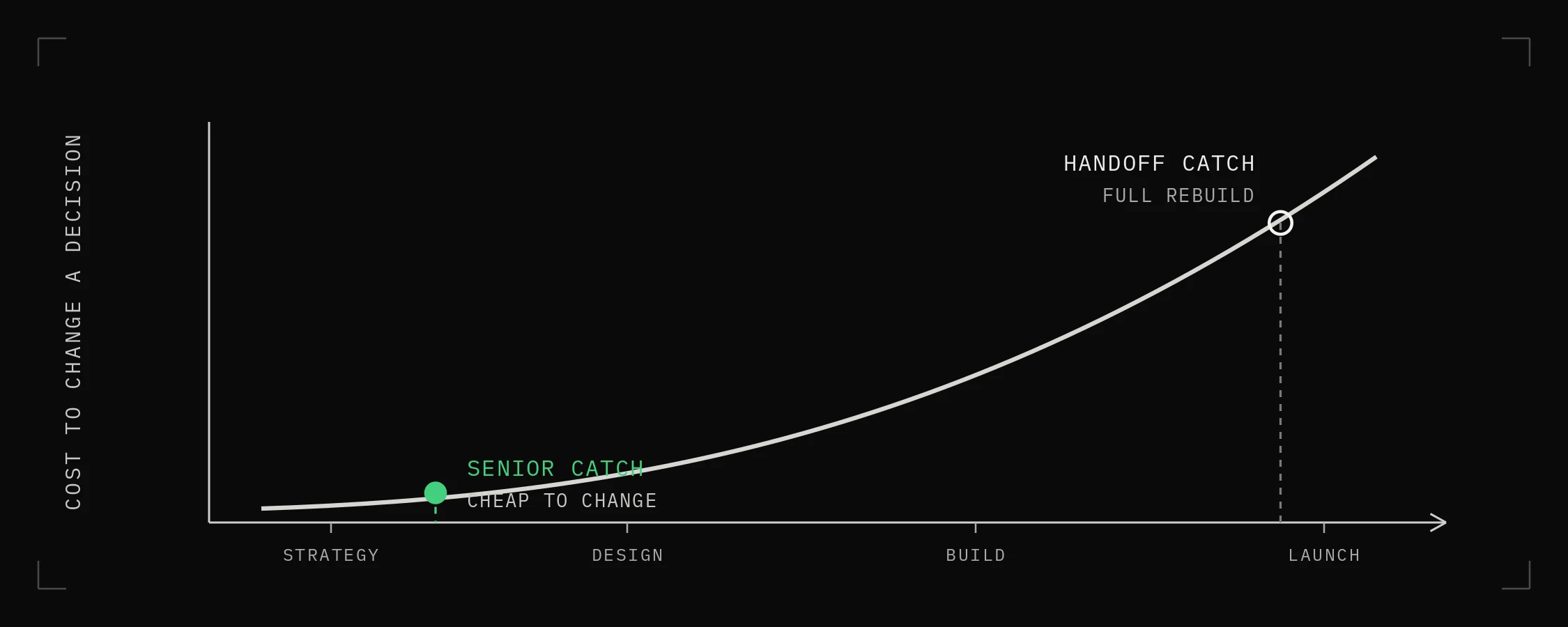
That is the moment when continuity is actually tested, not the pitch, not the kickoff. And the later that moment arrives, the more it costs to undo.
The same failure shows up on the client side. Too many layers between the people who decide and the people who execute produce the same flattening effect.
It happens whether those layers sit inside an agency or inside a client's own organization. That is exactly why the fix has to start on the agency's own side first.
The Rebuild Senior Teams Prevent
Experienced strategists catch the pattern early, often before it looks like a problem at all.
A junior executor working from documentation has little reason to question a decision that looks settled on paper.
Nothing in the file signals that it's about to break, because the person who wrote it down never questioned it either.
That early catch, the one that saves a client from an expensive rebuild later, depends entirely on the same strategist staying on the project.
Lose that continuity, and the warning sign disappears along with the person who would have noticed it.
The Salesloft rebrand is where this held up at enterprise scale.
The same senior team carried the work from the first strategy session through launch, with no handoff to a separate delivery group in the middle.
Because that team stayed on, they designed the experience in code instead of writing a specification for someone else to interpret, and the functional prototype became the spec.
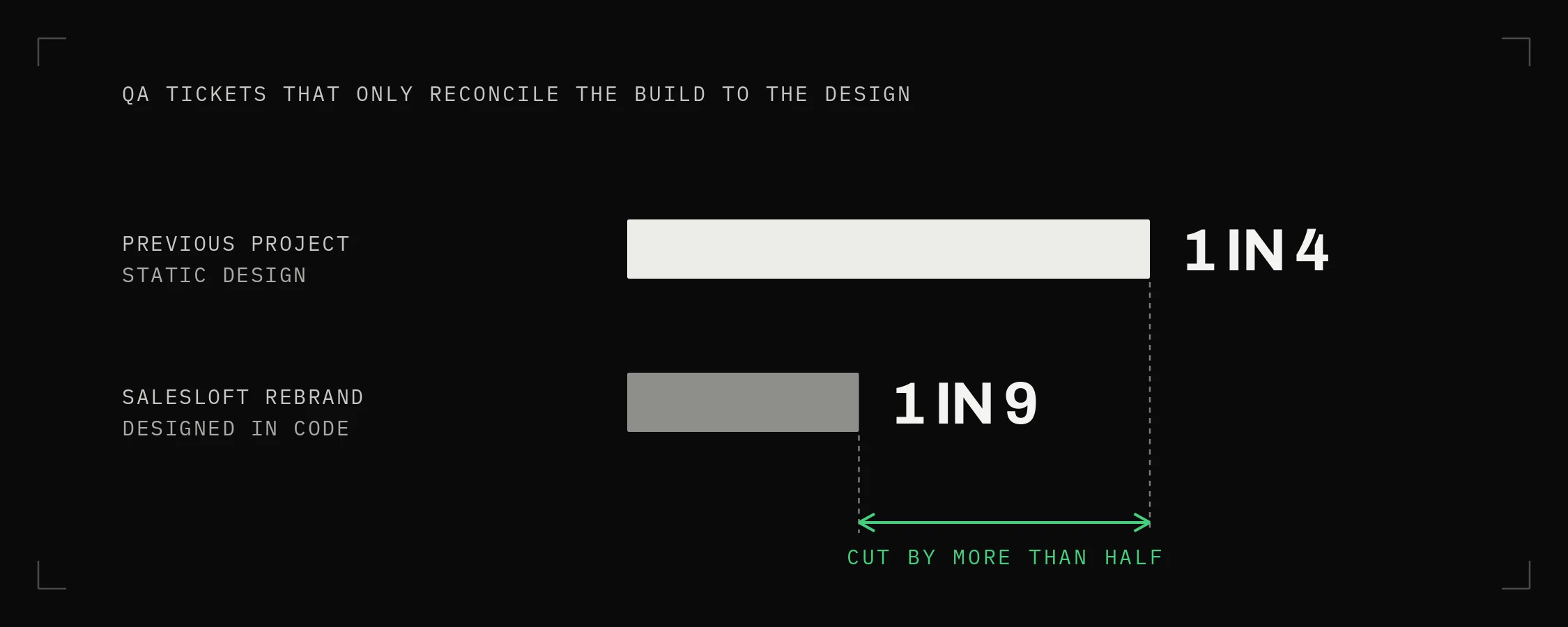
The payoff was measurable. On our previous static-design project, 1 in 4 QA tickets existed only to make the build match the design.
On Salesloft, that dropped to 1 in 9. Those reconciliation tickets are exactly what a handoff produces: hours spent getting an implementation back to a decision that was already made.
Keeping the senior team on the work, and resolving the experience in the medium it would ship in, cut them by more than half.
What Launch Day Reveals About Continuity
Clients rarely notice continuity while a project is running well. It becomes visible only in its absence.
A launch surfaces a decision nobody remembers making, or a direction that quietly drifted from what was originally agreed.
That drift matters because it shows up in front of the client's own customers, at the worst possible moment to discover it.
A senior team staying on end to end catches that drift before it reaches launch.
The person reviewing the work in month six is the same person who made the call in month one, so there is no translation layer where intent gets lost along the way.
A Senior-Led Model Built for Continuity
Many agencies scale by separating the people who win and shape the work from the teams responsible for delivering it. ANML is structured differently.
The senior strategists, designers, and creative leaders who establish the direction remain actively involved through delivery.
As projects move from strategy to design, prototyping, development, and launch, the team expands around that core rather than replacing it.
That structure is intentional. It preserves the context behind key decisions while giving complex enterprise programs the depth of expertise they need at each stage.
Over 12 years of enterprise UX/UI launches with companies like Panasonic, ServiceNow, Zoom, and Logitech, we've seen the advantage repeatedly.
The people responsible for the original direction are still there when the hardest decisions have to be made.
For clients, that means less translation between teams, less strategic drift, and a much lower likelihood that work needs to be revisited months into the project.
What to Ask Before You Sign
Senior continuity is invisible until a contract is already signed, which means the questions have to happen before that point, not after.
- Ask who's actually in the room after the pitch.
- Ask whether the senior people who scoped the work will still be on it at launch, or whether it moves to a delivery team.
- Ask what happens when a hard call comes up in month four, and who makes it.
The answers tell you whether the senior team is real or just part of the pitch. That distinction decides whether a project holds together or quietly drifts for months before anyone notices.