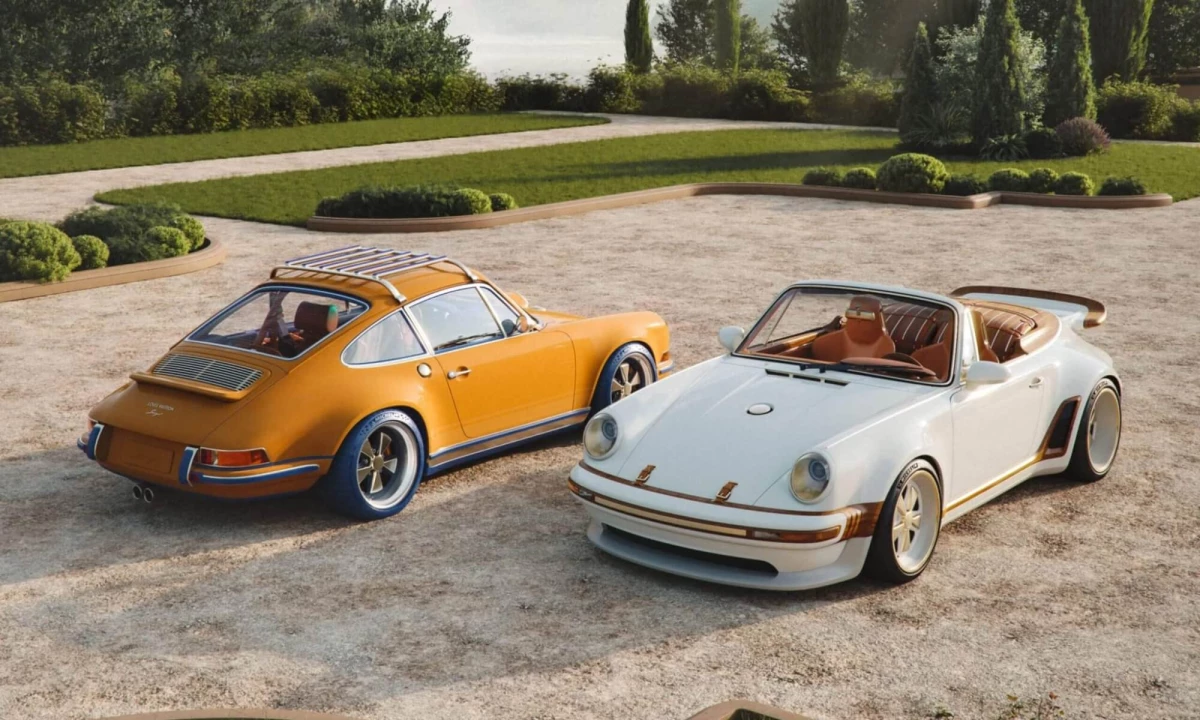

Louis Vuitton and Singer Vehicle Design unveiled two custom Porsche 911s at Monterey Car Week, and both companies broke a long streak to do it.
Singer has reimagined Porsche 911s for 17 years without ever putting another name on a build.
Meanwhile, Louis Vuitton has gone 172 years without a co-branded automotive project.
The two cars debuted on August 12 at a private gathering in Pebble Beach, California.
The project pairs Louis Vuitton's leatherwork and watchmaking with Singer's restoration and engineering.
It also gives Louis Vuitton one more entry point into the automotive world.
The collaboration began with a modest request for a detachable dashboard clock inspired by Louis Vuitton's Tambour watch.
This request grew into custom work on nearly every functional element across two cars.
Nicolas Ghesquière, Louis Vuitton's artistic director of women's collections, framed the project as a return to a lifelong interest.
"Automotive design is a passion that has always lived within me," he told WWD.
"My collaboration with Singer has been a chance to reconnect with this fascinating world — a magnificent opportunity to explore truly exceptional automobiles."
Ghesquière designed the Classic Turbo cabriolet in ivory white with precious-wood trim, taking cues from classic motorboats.
The second car is a Classic Coupe in Louis Vuitton's saffron, cobalt blue, and yellow livery, with the colors running onto the tire sidewalls.
Both sit on 964-generation Porsche 911s that Singer re-engineered with bespoke interiors.
Neither company has disclosed a price, and both say the pair is a two-off with no planned production run behind it.
The cars follow the fifth World Cup trophy trunk that Louis Vuitton delivered in July, a commission it has held since 2010.
Two One-Offs and Capsule Wardrobes
The Classic Coupe wears Louis Vuitton detailing across its leather interior and technical components.
And it ships with bespoke luggage and travel accessories.
Notably, its roof rack is made to carry a trunk, as well as a surfboard or a pair of skis.
The Classic Turbo follows a different visual direction.
Nautical references run through its wood and leather treatment, and the removable Tambour dashboard clock ties the car to Louis Vuitton's watchmaking.
Each car also comes with its own capsule collection.
The Turbo includes a made-to-measure parachute-silk suit and driving accessories.
The Coupe, on the other hand, comes with a racing jacket and a Keepall bag.
Every object in both capsules came out of a Louis Vuitton atelier, the same way the engineering came out of Singer's shop.
"The specifications chosen by Louis Vuitton exposed us to techniques and methods developed over decades of experience," Singer Executive Chairman and Founder Rob Dickinson said in a release.
"They trusted us with their esteemed brand, their traditions and their vision and it was a joy to bring our two worlds together."
Both names sit on the car because both teams did the physical work, which is the co-branding that buyers actually credit.
A First Co-Brand in 172 Years
Louis Vuitton has made automotive trunks since 1897, when Georges Vuitton designed the first ones at the Asnières workshop.
The Singer cars extend this history at a time when luxury houses keep looking outside fashion and accessories for growth.
The project offers several lessons for marketers:
- Put the identity into the materials. Stitching, edge-dyeing, and hardware finishes give a brand a signature on products far outside its category.
- Surround the hero product with a full kit. Luggage, clothing, watches, and equipment give buyers more surface area to live with the brand.
- Let heritage unlock the category. A brand with real history in one space can enter an adjacent one and be taken seriously on arrival.
All three depend on the same thing, which is a brand extension that the audience already believes in before it launches.
Our Take: Can a Car Become a Luxury Brand's Newest Flagship?
Hermès dressed a Bugatti Veyron in 2008, and Iris van Herpen reworked a Rolls-Royce Phantom in 2023.
So fashion has been riding along the automotive industry for a while.
We see that the car does qualify as a flagship here, though only because Louis Vuitton put its entire house into it.
Watches, trunks, leather goods, and ready-to-wear all fed one commission, and the capsule wardrobes came out of the same brief.
The catch is that only two people will ever own one.
Louis Vuitton reaches far more people through Formula 1, where it made a trophy trunk for all 24 races last season.
We think the Singer cars work as proof of range, and the F1 partnership does the volume.
The next test is whether Louis Vuitton can make a version that a customer can order and buy.
Looking to build campaigns that don’t rely on starting from scratch?
Explore these top brand strategy agencies in our directory to turn existing equity into something that still lands.