
Domino's just named a pizza after itself, and it's built for exactly one person.
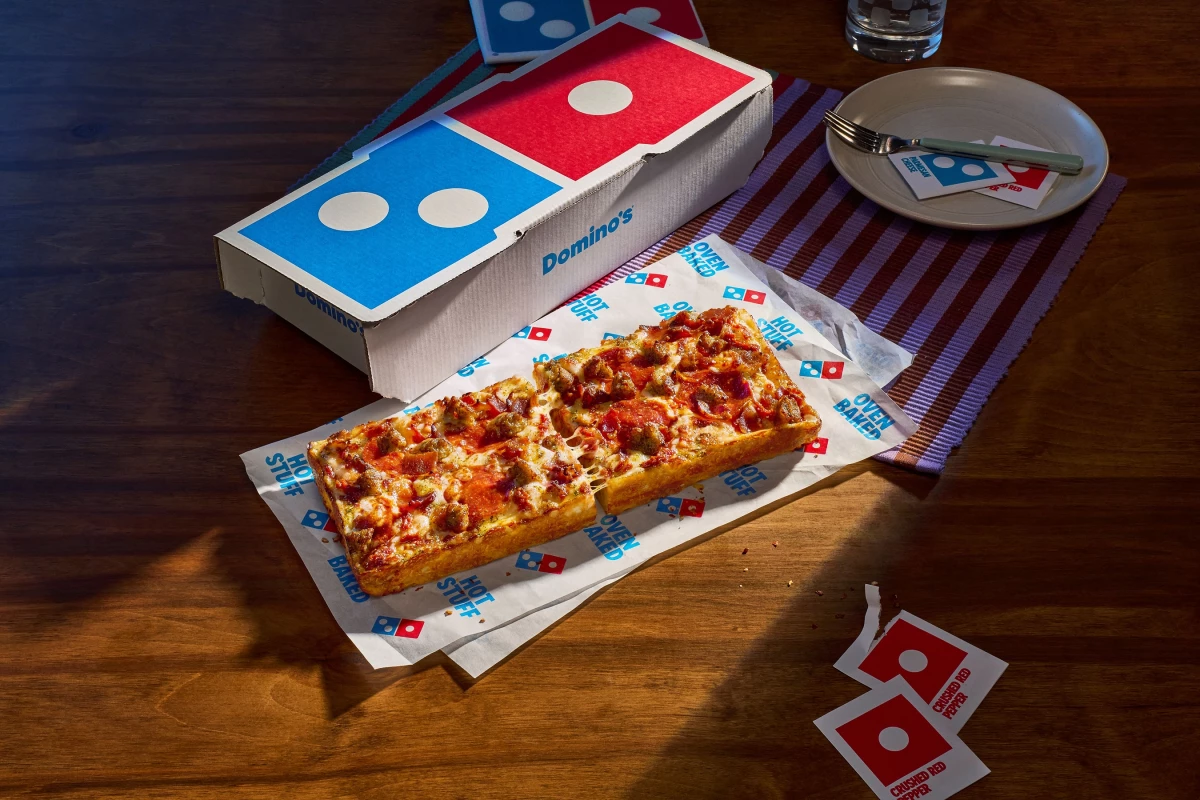
The chain is calling it the "Domino," a Detroit-style pizza cut into two slices and shaped like Domino's own logo.
It launches on August 31, ending more than 65 years without a single product named after the company.
The timing is the interesting part.
U.S. same-store sales grew 0.1% in Q2 2026, the chain's weakest showing in more than a year.
Domino's says the pizza targets customers who would otherwise order from a different restaurant.
Joe Jordan, chief operating officer and president of Domino's U.S. and the brand's incoming CEO, sees the new pizza as a fix for a gap its menu never closed.
"When everyone wants something different, traditional pizza falls short.
The Domino lets every person build the exact pizza they want," Jordan said in a press release.
The pizza is handmade with buttery pan dough coated in real Parmesan cheese and baked in a rectangular pan.
It bakes up with a crisp, Parmesan-edged Detroit-style crust.
Two layers of cheese sit underneath a choice of sauce and up to three toppings, finished with a drizzle of Domino's signature garlic seasoning.
In independent testing, the company said the "Domino" was rated as one of the most delicious products it has ever introduced.
Domino's pitches the launch as a fix for a familiar lunch-table problem, where one shared pizza has to please everyone at once.
The Domino removes this negotiation by giving each customer their own pie and their own toppings.
Portioning for one is a product design decision as much as a menu decision, since it changes who a single order is priced and built for.
A Pizza You Don't Share
Customers can add a two-topping Domino to the Mix and Match Deal, which lets you pick any two or more items for $6.99 each.
This folds the new rectangular pizza into a promotion that customers already use.
It also sets the ceiling on what the product can earn per order before a single one sells.
Domino's ran the same play with its Best Deal Ever promo, using a flat online price to pull orders onto its own platforms.
The chain has also paired product news with a discount hook before this year.
Earlier this month, it offered customers $5 off a future order for testing its redesigned app.
Agency of record WorkInProgress handled the campaign, which runs through August 30.
The Domino applies the same logic to the menu, using a discount to pull first orders in the door.
Availability starts on August 31 at participating locations nationwide, through dominos.com or its mobile app.
Cheap trial is the point, and order counts are the metric Domino's has told investors it cares about most.
Yum Brands found 68% of solo diners skip deals and discounts entirely.
And most spend $10 to $30 a visit, which makes a $6.99 bundle an odd door to hold open for them.
Domino's is pricing for volume and hoping the check catches up later, which is the trade every value-led product launch makes.
Non-Pizza Days Set the Target
Putting the name and the logo on a single item is a confident call for a brand this recognizable.
This confidence comes from scale. Domino's had global retail sales of over $20.6 billion in the trailing four quarters ending June 14, 2026.
At this size, the brand can gamble a signature product on something as literal as its own logo, but the occasion behind it took more work.
Outgoing CEO Russell Weiner shared that Domino's studied what fans order on the days they skip pizza before designing the product to sit within this gap.
"[W]e believe this new product will address an unmet consumer need, but this time with a pizza that is unique to Domino's," he said during the FY2026 earnings call.
"This signature product will give customers a delicious new reason to come to Domino's while protecting the core pizza occasions that have been key to our success."
Domino's identifies lunch on the go and late-night snacking as the occasions it wants, and both currently sit with drive-thrus and convenience stores.
A logo-shaped pan pizza gives Domino's something rivals can't copy without looking like followers.
This ownability is the durable piece of the brand strategy here, and it outlasts whatever the pizza sells in its first month.
Three ideas sit underneath The Domino launch:
- Make the category entry proprietary. A format that exists everywhere becomes ownable the second a brand attaches its own name and identity to it.
- Attach launches to an offer people already use. Trial gets cheaper when a new item rides a promotion customers trust, and the deal price also caps what that launch can earn.
- Design for demand you can already measure. Waiting for a preference to peak means arriving after competitors have priced it in.
In short, Domino's made a product for a demographic that was already in its early stages before the pizza existed.
Our Take: What Does a Namesake Flop Cost?
Domino's spent more than 65 years keeping its name off the food while selling billions of pizzas without it.
We think that the cost of failure here is smaller than the setup suggests.
A logo-shaped pizza that underperforms gets quietly cut, and the logo goes back to doing what it always did.
McDonald's launched the Arch Deluxe in 1996 behind the largest promotional budget fast food had seen, then killed it in 2000.
Almost nobody remembers it as damage to the golden arches, and the brand kept growing.
What Domino's actually risks is the marketing calendar, since the second half of the year now hangs on one product while comps sit flat.
The name is the cheapest thing that Domino's put on the table.
Find the teams driving growth and engagement across every platform. Check out these top digital marketing agencies in our directory.