
Hellmann’s is entering its sixth consecutive football season with the same occasion and a new game plan.
Its 2026 "Call for Hellmann’s" campaign puts Real Mayonnaise, Chipotle, and Spicy varieties into football-style play calls across national TV, streaming, social, and live stadium activations.
The brand is also returning to partnerships spanning the Big Ten Conference, five college programs, and five NFL teams.
Six seasons raises a harder marketing question.
How long can one cultural platform keep doing commercial work before familiarity starts looking like repetition?
In 2025, its football activity was tied to double-digit sales growth and a household penetration increase from 17.3% to 17.9%, MediaPost reported.
Brent Lukowski, senior marketing director for the Condiments U.S. business at Unilever, puts the challenge simply.
"There’s an important difference between consistency and repetition," Lukowski tells DesignRush.
In this DesignRush interview, he explains why Hellmann’s keeps returning to football, how targeted rights and product variety keep it fresh, and why brands need room to react to culture.

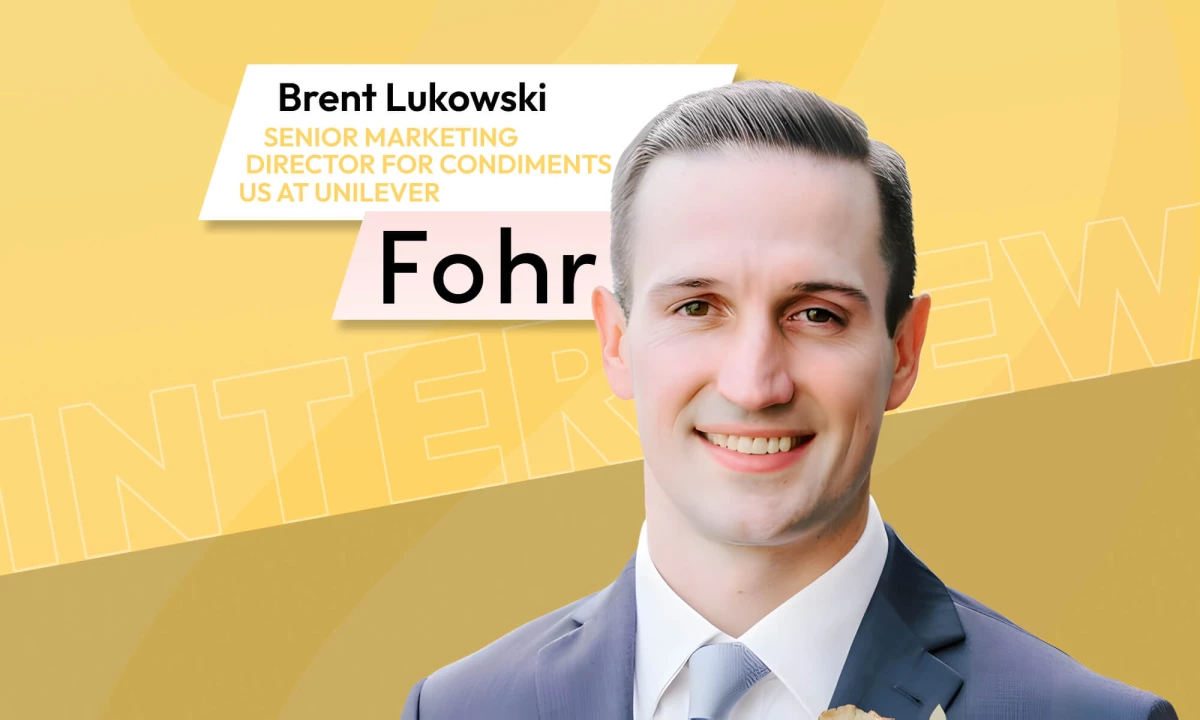
Who Is Brent Lukowski?
Brent Lukowski is senior marketing director for Unilever's Condiments U.S. business, where he oversees Hellmann's, Sir Kensington's and Maille.
He has more than 18 years of experience in brand marketing and strategy, with previous leadership roles on Dove Men+Care and Vaseline.
Lukowski leads Hellmann's end-to-end marketing team, responsible for new products, demand creation, and performance marketing.
Keep the Occasion, Change the Play
Football keeps earning its place because it brings passionate fans and food together during an important selling period for the condiment category.
The wider game-day food occasion carries serious spending power.
SNAC International, using Circana data, found savory snack sales reached $742 million during Super Bowl week in 2025, accounting for more than half of the week’s $1.3 billion in total snack sales.
"Whether it’s a watch party, tailgate or meal at home, Hellmann’s has a natural role in those occasions," Lukowski says.
The occasion provides continuity. Creative, products, partnerships, and cultural references give each season a new expression.
This year, "Call for Hellmann’s" takes language fans already know from the game and applies it to food.
"Make the Call" sends Real Mayonnaise onto a burger, while "Chicky Tenders" assigns Chipotle and Spicy mayo to chicken tenders.
Lukowski says the brand monitors whether football is still reaching consumers, generating conversation, and producing business impact.
ROI, impressions, and engagement rates are central measures, alongside the broader goal of getting more people to buy Hellmann’s.
"As long as consumers continue to engage with us and we can find fresh, relevant ways to show up, there’s value in the platform," he says.
"If that connection or engagement starts to decline, that’s when we would reassess."
The six-year commitment therefore has a practical test. Football has to keep selling mayonnaise and keep giving the marketing team somewhere new to go.
Build Rights Around Fan Communities
Hellmann’s has built its U.S. football presence without buying NFL league-level rights.
Its structure runs through teams, players, universities, and the Big Ten Conference, according to Big Ten Sports.
The 2026 roster includes the New York Giants, New England Patriots, Tennessee Titans, Philadelphia Eagles, and New York Jets, alongside Alabama, Florida, Arkansas, Texas, Georgia, and the Big Ten.
The Big Ten counts 44.6 million fans and 9.4 million alumni across its 18 universities, according to Big Ten Sports.
For Lukowski, specificity is the advantage.
"Team, player, and conference partnerships allow us to be more targeted and create programs that feel authentic to specific fan bases, markets and cultural moments," he says.
The structure gives Hellmann’s different entry points throughout the season.
A college partnership can speak to one market and ritual. An NFL team can serve another. Player partnerships create personality and earned conversation around individual moments.
Hellmann’s first Will Levis activation shows how an individual athlete can give the brand a much more specific cultural entry point.
"We’ve built the structure around where we believe we can create the strongest consumer connection and get the most impact from our investment," Lukowski explains.
A collection of specific partnerships can still deliver scale while giving the creative team clearer audiences, local relevance, and more room to adjust the work.
Let the Product Take the Spotlight
Hellmann’s has previously used celebrity and athlete talent including Will Levis, Kayvon Thibodeaux, Meg Ryan, and Andy Samberg.
"Call for Hellmann’s" takes another route.
"Celebrity talent has to do more than bring a recognizable name," Lukowski says.
"It has to make the idea bigger, create conversation and give Hellmann’s an authentic way into culture."
"When Sally Met Hellmann’s" shows the kind of role celebrity talent can play when the cultural reference makes the product idea bigger.
For the 2026 campaign, the football language carried enough recognition on its own.
"With 'Call for Hellmann’s,' the idea was strong enough to stand on its own," he says.
"The language and rituals of football are instantly recognizable, and Hellmann’s already has a natural role in game day food."
The decision also creates room for the product portfolio.
"Chicky Tenders" gives Chipotle and Spicy mayo national exposure alongside Real Mayonnaise.
Hellmann’s said in 2025 that Chipotle was the strongest performer across its flavored mayo launches, while this year’s campaign connects both flavored products with an immediately recognizable food use.
Lukowski sees bolder flavors as a recruitment opportunity, particularly with Gen Z and younger consumers looking for more flavor in everyday meals.
Adjacent condiment data supports the appetite for heat. Circana found 51% of Gen Z respondents considered themselves "hot sauce connoisseurs," while 62% of Americans said they were more likely to buy something advertised as hot or spicy.
"Our Chipotle and Spicy varieties give us a way to meet that demand, recruit new consumers into the Hellmann’s brand and show that there’s more to Hellmann’s than the classic jar," he says.
Football gives those products a familiar consumption setting.
Chicken tenders, burgers, and sandwiches already belong at game-day gatherings, so the advertising can demonstrate the product use immediately.
"Mayotivations" also kept the product use visible, linking Hellmann’s directly to Buffalo Chicken Dip and the football occasion.
The football investment supports two goals. It keeps the established brand culturally visible and gives newer products a high-frequency occasion where trial makes sense.
Keep One Center Across Every Agency
A football platform running across markets, media, creators, commerce, and sponsorships brings another challenge.
Multiple agencies need enough consistency to protect the brand and enough freedom to make the idea work in their discipline.
Hellmann’s works with several partners across the broader model, including Ogilvy on global creative stewardship, VML on U.S. creative, WPP Unite across media and commerce, and SAMY on influencer strategy across 13 markets.
Lukowski explains the starting point is a clearly defined brand and strategic platform.
"Our agency partners each bring different areas of expertise, but we’re very deliberate about establishing a clear brand and strategic platform at the center so that everyone is working from the same foundation," he says.
"With a model that spans that many partners and markets, the challenge isn’t necessarily keeping the idea consistent, it’s making sure consistency doesn’t become rigidity."
Hellmann’s 2026 Big Game rollout shows how one central creative idea can give different partners distinct jobs across advertising, experiential, retail, and commerce.
A creator should not sound like a media placement. A commerce execution has a different job from a TV spot. A local market may need different cultural references.
The recognizable Hellmann’s idea stays fixed enough to travel, while execution changes across online and offline touchpoints.
The value of coordinating one idea across formats is measurable.
Shoppers reached across multiple formats converted 96% more than those reached through a single format, and conversion rose 5.2 times among audiences hit by three or more touchpoints, according to Amazon Ads.
Clear strategic ownership gives specialists room to contribute without pulling the brand in competing directions.
Stop Trying to Control Every Brand Move
Lukowski’s biggest lesson from marketing at this scale is about control.
"One of the biggest mistakes is trying to control every part of the brand," he says.
Large organizations can build extensive systems for planning, approvals, and consistency. Culture rarely works on the same timetable.
Hellmann’s relationship with Will Levis shows what can happen when a team is prepared to respond.
Levis drew attention after putting mayonnaise in coffee.
Hellmann’s reacted to the viral moment with a lifetime supply of mayonnaise and a mock sports press conference before the relationship developed further.
The original partnership leaned directly into Levis’ viral mayo-in-coffee reputation instead of trying to manufacture a new behavior around him.
"We never planned for someone to put mayo in their coffee, but the team recognized an authentic cultural moment and leaned in," Lukowski says.
"That one moment ultimately grew into a multi-year partnership and opened up entirely new ways for the brand to show up."
The response produced measurable business results.
Edelman reports the original partnership generated 4.7 billion impressions and more than 600 media placements, while Hellmann’s sales in Kentucky and Tennessee rose 16% year over year.
The example explains why flexibility matters across the rest of Hellmann’s football strategy.
A six-season platform needs room for cultural moments no team can predict in advance.
It needs a clear enough brand role for the team to recognize a good opportunity when one appears.
The same willingness to stretch the brand has appeared elsewhere, including 2024’s Mayo Cat, which made a simple product cue the center of the cultural idea.
Hellmann’s approach leaves marketers with three useful moves:
- Keep the occasion stable. Football and food provide the memory structure, while creative, products, and partnerships give each season new material.
- Put rights where the connection is strongest. Specific teams, players, and conferences can provide more useful access to fan communities than reach alone.
- Give the platform room to react. Clear brand principles help agencies and internal teams move quickly when culture produces an opportunity worth following.
Six seasons in, Hellmann’s is still using the same game-day occasion.
The food connection provides continuity, and everything around it keeps moving.