
Key Findings:
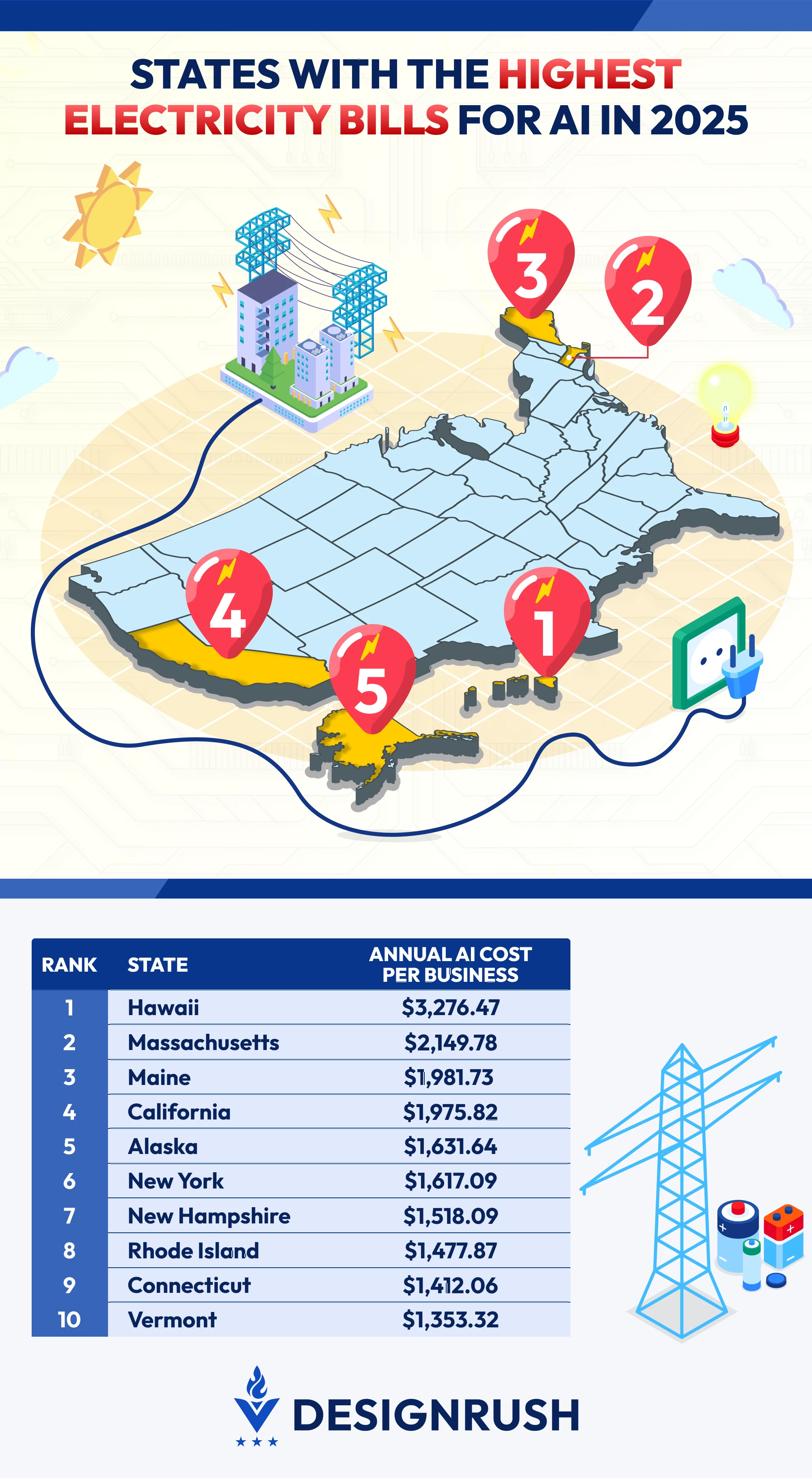
- From under $500 to over $3,200, annual electricity costs per AI-using business vary significantly by state.
- South Dakota, North Dakota, and Nebraska offer the lowest operating costs for AI-driven businesses.
- States like Texas and Utah support widespread AI usage while keeping power bills below $700 per business.
AI is no longer optional in most modern offices.
Yet in certain states, powering AI tools adds a substantial burden to annual operational expenses.
Businesses in Hawaii, Massachusetts, and Maine are paying over $1,800 per year just for electricity.
This is nearly four times what companies in South Dakota spend for the same use.
To uncover how location affects AI operating expenses, DesignRush analyzed AI adoption rates, average workforce size, and state electricity prices.
After determining the annual energy cost per AI-using business, we ranked all 50 states from most to least expensive.
Where AI Costs the Most: State-by-State Business Impact
These are the states where it costs the most for a business to use AI tools, mainly due to higher electricity prices:
 Access Full Dataset
1. Hawaii
- Annual Cost per Business: $3,276.47
- Avg Electricity Rate: $0.40/kWh
Hawaii tops the list due to electricity rates that are nearly double the national average.
Fuel imports and distance from mainland grids leave businesses with few alternatives.
Even companies with modest AI usage feel the impact. Many rely on solar, but it doesn’t offset costs during peak hours or when storage is limited.
2. Massachusetts
- Annual Cost per Business: $2,149.78
- Rate: $0.27/kWh
Massachusetts has a deep bench of AI users, including hospitals, financial firms, and universities.
However, it also has some of the priciest commercial energy in the Northeast.
The state’s grid struggles with age and capacity, making it harder for businesses to scale AI systems without seeing a noticeable jump in utility bills.
3. Maine
- Annual Cost per Business: $1,981.73
- Rate: $0.23/kWh
Maine doesn’t have the same volume of AI use as its neighbors, but its older grid infrastructure still pushes costs up.
Many areas rely on imported power and lack competitive supply.
Even with smaller teams or lighter use, businesses report high per-unit electricity costs when trying to run data-intensive applications.
4. California
- Annual Cost per Business: $1,975.82
- Rate: $0.27/kWh
California’s AI footprint is huge, and so are its electricity bills.
Surcharges for wildfire mitigation, time-of-use pricing, and grid congestion all factor in the high costs.
For startups and large firms alike, running training models or high-volume analytics in-state often means taking a hit to margins.
5. Alaska
- Annual Cost per Business: $1,631.64
- Rate: $0.20/kWh
Energy delivery across Alaska is inconsistent and expensive.
AI isn’t widely deployed yet, but firms using it in logistics or resource extraction are paying more than expected.
Fuel transport and limited grid access outside cities makes commercial electricity costly, even when usage stays low.
6. New York
- Annual Cost per Business: $1,617.09
- Rate: $0.22/kWh
The state’s AI sector is strong, particularly in finance and media. But commercial power rates are far from stable, especially in New York City.
Upstate regions are cheaper, but most firms using AI at scale operate in or near dense metro areas.
Transmission congestion and recent tariffs are also raising costs for companies already operating on thin margins.
7. New Hampshire
- Annual Cost per Business: $1,518.09
- Rate: $0.22/kWh
New Hampshire depends heavily on out-of-state energy and still relies on fossil fuels in many areas. With limited competition among suppliers, rates have stayed high.
Businesses using AI tools only have a few options to bring costs down. It also doesn’t help that regional grid reforms have been slow to materialize.
8. Rhode Island
- Annual Cost per Business: $1,477.87
- Rate: $0.25/kWh
Rhode Island’s commercial users pay more per kWh than many larger states. Small-scale infrastructure and regulatory overhead inflate delivery charges.
Despite growth in marine and biotech sectors, AI expansion is slower here, partly because energy costs leave firms little budget to experiment.
9. Connecticut
- Annual Cost per Business: $1,412.06
- Rate: $0.26/kWh
Connecticut’s energy market has some of the highest average commercial rates in the country. The problem isn’t usage, but system capacity and cost of service.
AI use is increasing in the insurance and education industries, but companies are actively shifting workloads to co-location centers in nearby states to avoid rising costs.
10. Vermont
- Annual Cost per Business: $1,353.32
- Rate: $0.21/kWh
Vermont produces clean power at high rates (over 99% comes from renewables), but the grid wasn’t built for industrial use. This keeps commercial prices higher than expected.
Subsidies have favored residential and small-scale solar adoption. As a result, businesses running AI workloads face steep per-unit costs, even in a state known for sustainability.
How Energy Costs Define AI ROI
The rising operational cost of AI, driven largely by electricity rates, exposes a new competitive gap between states.
Businesses in high-cost regions must now consider geography as a critical factor in their AI investment strategy.
To stay profitable, executives should explore relocating compute loads, leveraging renewables, or renegotiating energy terms.
As AI adoption accelerates, energy-smart deployment will be key to sustaining growth.
Methodology
To calculate the average annual electricity cost per AI-using business, DesignRush combined three key data points for each U.S. state:
- AI Adoption Rates (Jan–May 2025): Estimated percentage of businesses using AI tools, based on regional tech adoption surveys.
- Average Employees per Business: Sourced from the U.S. Census Bureau to estimate energy usage based on workforce size.
- Commercial Electricity Prices: Average state-level rates obtained from ElectricChoice.com (March 2025).
Each AI-using employee was estimated to consume 754 kWh per year, based on findings from MIT Technology Review.
Total energy use per business was calculated by multiplying the number of AI-using employees by this consumption figure.
This total was then multiplied by the state's commercial electricity rate to determine annual AI energy costs per business.
Looking to integrate AI into your business strategy? These firms help you plan and execute with clarity: