


Key Findings:
- The annual electricity cost per AI-using business ranges from under $500 to more than $3,200, depending on location.
- South Dakota, North Dakota, and Nebraska offer the lowest operating costs for AI-driven businesses.
- States like Texas and Utah support widespread AI usage while keeping power bills below $700 per business.
AI assistants have become an everyday part of office life.
They help employees summarize documents, write emails, and manage schedules.
These tools run quietly in the background, but their energy demands vary significantly depending on location.
To help businesses minimize their overhead costs, DesignRush analyzed where they can spend the least to operate these tools.
Using state electricity prices, AI adoption rates, and workforce data, we calculated the average annual energy cost per AI-using business.
Top 5 States with the Lowest AI Power Costs
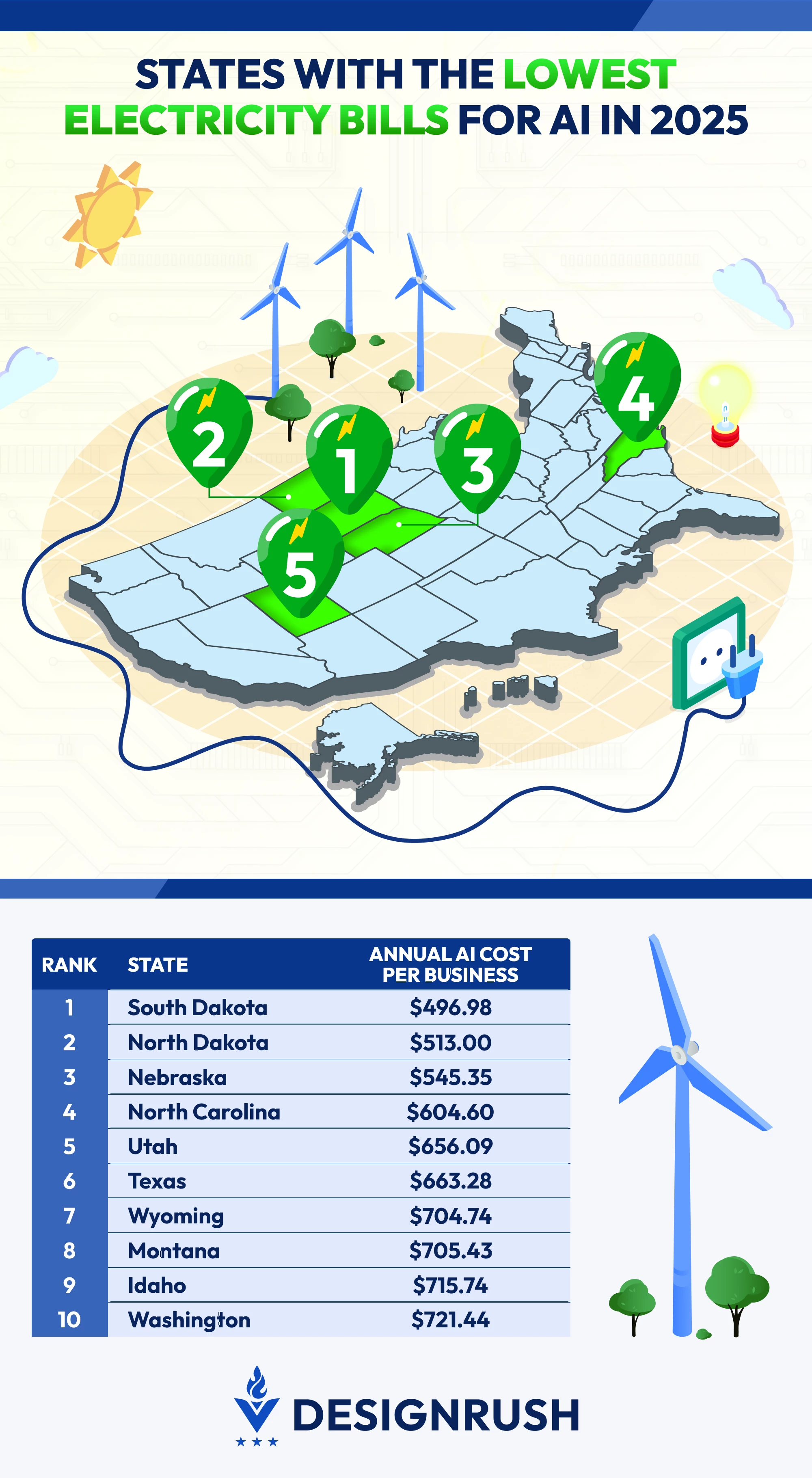
These five states consistently deliver the lowest energy bills for companies running AI assistants.
 See Full Ranking
1. South Dakota
- Annual AI Energy Cost per Business: $496.98
- Average Electricity Rate: $0.12/kWh
South Dakota is the most affordable for running AI assistants, with no other state coming in under $500.
It sits at the top of this list due to low commercial rates and manageable business sizes.
Each of the state’s roughly 2,000 AI-using businesses consumes just over 4300 kWh, nearly 50% less than what companies utilize in Hawaii.
2. North Dakota
- Annual AI Energy Cost per Business: $513.00
- Average Electricity Rate: $0.09/kWh
North Dakota’s commercial power rates are among the lowest in the country. While fewer businesses use AI here, those that do benefit from consistent, low energy costs.
The state’s AI adoption rate stands at 3.1%, which places it among the bottom third of states. This lower uptake means fewer companies are consuming AI-related energy.
In one year, businesses in North Dakota collectively consume almost 24 million kWh, staying well within reasonable operating budgets, especially for small businesses.
3. Nebraska
- Annual AI Energy Cost per Business: $545.35
- Average Electricity Rate: $0.09/kWh
Nebraska offers a reliable, low-cost energy environment for businesses using AI assistants.
This supports cost-efficient AI use in industries such as transportation, agriculture, and logistics.
As the only state fully powered by public utilities, Nebraska keeps rates predictable, making it easier for businesses to plan energy spending.
4. North Carolina
- Annual AI Energy Cost per Business: $604.60
- Average Electricity Rate: $0.12/kWh
North Carolina stands out for combining affordability with a growing tech workforce. Many businesses here are expanding AI integration while keeping overhead low, thanks to stable power costs.
With an AI adoption rate of 8.75%, the state continues to attract major AI-related infrastructure investment.
In June 2025, Amazon announced a $10 billion planto expand its AWS data center footprint in Richmond County.
This development will increase local cloud capacity and support more businesses deploying AI assistants in high-demand sectors.
5. Utah
- Annual AI Energy Cost per Business: $656.09
- Average Electricity Rate: $0.09/kWh
With Salt Lake City tagged as the most AI-ready city and Utah topping the list of AI-ready states, it’s no surprise that the region remains a strong draw for companies working in tech.
Despite relatively high per-business consumption, the state’s low energy prices keep operating costs below $700 per year for most businesses using AI assistants.
Utah's mix of cloud infrastructure, workforce training, and inexpensive power has made it a competitive destination for firms deploying these tools across customer service, analytics, and backend systems.
Where AI Assistants Are Widely Used and Still Cost-Efficient
Some states support tens of thousands of AI-powered businesses while maintaining moderate energy costs:
- Texas counts over 148,000 businesses using AI, with an average annual energy bill of just $663 per business.
- Florida supports more than 178,000 AI-powered businesses, averaging $815 annually in electricity costs.
- Utah and North Carolina appear on affordability and adoption lists, indicating strong potential for efficient AI growth.
These states show that it is possible to scale AI adoption while managing infrastructure and energy expenses efficiently.
Why Energy Costs Matter
Some states are significantly more expensive when it comes to running AI tools.
In Hawaii, for example, the average annual AI-related energy bill for a business exceeds $3,200, more than six times the cost in South Dakota.
Electricity is becoming a fixed cost of digital work. For companies deploying AI across teams, the location of operations now plays a direct role in profitability.
Selecting a state with lower commercial energy rates can reduce AI-related expenses by as much as 80%.
This allows more flexibility for growth, hiring, and long-term investment.
Methodology
- Business Count and AI Adoption
We started with the number of businesses in each state and applied reported AI adoption rates (January–May 2025) to estimate how many use AI. - Workforce Estimates
We used state-level data on employees per business from the U.S. Census Bureau to estimate how many employees work at AI-using businesses. - Energy Use Per Employee
Based on findings published by MIT Technology Review in May 2025, we estimated that each employee using AI consumes about 2.9 kilowatt-hours of electricity per workday. - Annual Use
We assumed 260 working days per year, resulting in an annual energy consumption of 754 kWh per employee. - Cost Calculations
We multiplied total energy use by the average commercial electricity rate in each state (sourced from ElectricChoice.com, March 2025) to calculate yearly costs. - Per-Business Estimate
Final values reflect the average annual electricity cost per AI-using business in each state.
If your next move depends on clarity, these teams give you the data to back it up. Find expert market research firms here:






-Stressful-States-for-Male-Employees-in-2024-V2---details-preview-webp.webp)
-preview-webp.webp)
-preview-webp.webp)