
Design-Led SEO in a GEO-First World: Key Findings
- SEO leads convert at 14.6% (vs. 1.7% for outbound), showing how organic search delivers stronger B2B lead quality.
- Traffic drops can signal success, proving that lower volume often means higher intent and better-fit inquiries.
- Foundational SEO translates across platforms, demonstrating how UX, structure, and copy built for Google also perform on ChatGPT, Claude, and Perplexity.
SEO leads close at nearly 14.6%, according to inbound lead generation benchmarks reported by Digital Silk.
That’s almost nine times more than traditional outbound leads, which convert at just 1.7%.
As AI-powered search and zero-click results reshape discovery, traditional SEO metrics are losing relevance.
Rankings and clicks alone no longer indicate whether SEO is working, especially for B2B organizations focused on relevance, intent, and qualified demand.
For marketers, this means volume can no longer substitute for alignment.
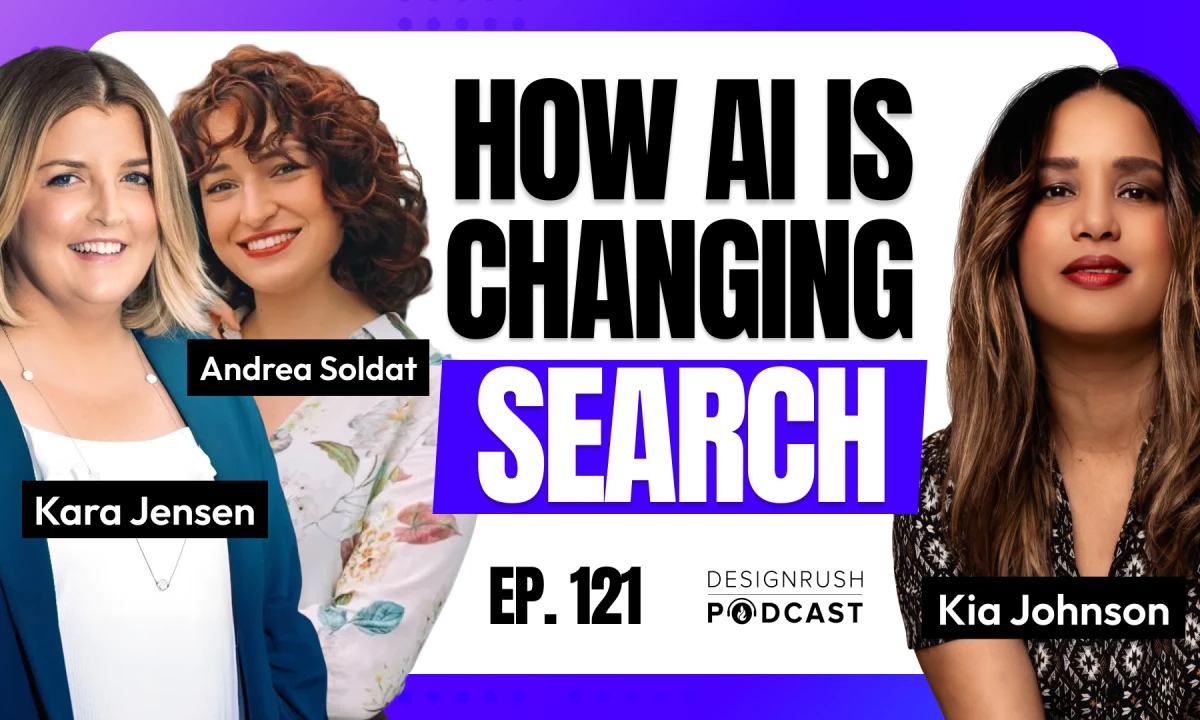
Kara Jensen, Co-Founder and Creative Principal at Bop Design, and Andrea Soldat, SEO Specialist at DesignRush, see this shift playing out daily.
These changes touch everything, from client work to platform data and internal collaboration.
In episode No. 121 of the DesignRush Podcast, they discuss how SEO performance now depends less on chasing traffic.
The focus is on building the right foundation early, collaboratively, and with business outcomes in mind.
This informative episode covers a range of topics, including:
- Why traffic drops can signal stronger SEO performance
- How design-led foundations shape visibility before launch
- Why GEO and AI search reward fundamentals, not panic optimization
- How collaboration reduces rework and improves lead quality
Struggling to decipher what SEO success really looks like? This podcast convo is for you.
Watch it now on YouTube or listen on Spotify.
For a quick rundown of their insights, keep reading. We’ve broken their advice into five key areas that cover what to avoid, what to build, and how to align SEO with long-term performance.
1. Mistake: Treating Traffic as the Goal
More clicks don’t equal better outcomes.
Jensen explains that many B2B brands still equate SEO success with traffic volume, even when that traffic attracts the wrong audience.
“It’s not just about traffic,” she says. “It’s about lead quality.”
In one example, a specialty paper manufacturer saw traffic decline after a website redesign.
But by correcting a misaligned keyword strategy, lead relevance increased dramatically.
“Our B2B clients actually still Google terms like best SEO agency quite often,” Soldat says.
“Even though the trends are indicating that people will be using the conversational approach and talking with AI, while that's definitely true in some regard, I believe that it's still not the primary way people search, especially for some B2B terms.”
The takeaway? Traffic and rankings are indicators, not objectives. When SEO attracts the wrong audience, volume becomes noise instead of value.
2. Strategy: Build SEO Into the Foundation
SEO doesn’t begin at launch.
Jensen reframes SEO as something shaped long before a site is indexed: inside UX decisions, site architecture, copy, and structure.
“If you don’t have the right foundation,” she explains, “traffic doesn’t really matter.”
When those foundations are solid, performance holds up across environments.
As Google organic traffic fluctuates, Jensen notes that many brands are seeing compensatory discovery from platforms like ChatGPT, Claude, and Perplexity.
It’s proof that strong SEO fundamentals translate into GEO visibility.
3. Signal: When Lead Quality Improves as Traffic Declines
One of the clearest signs that SEO is working today is precision.
For Bop Design’s B2B clients, reduced traffic paired with improved inquiry relevance often marks the moment SEO starts doing its job.
“That’s a great indicator,” Jensen says, “that what we did what we did foundationally from an SEO standpoint is translating to GEO.”
Instead of chasing recovery to pre-AI traffic levels, the focus shifts to who is finding the brand and why.
4. Belief: SEO Works Best as a Shared Responsibility
SEO outcomes reflect how teams work together, or don’t.
“At Bop Design, we kind of have this thing where SEO is everyone’s responsibility,” Jensen explains.
But across many organizations, SEO remains siloed, placing unrealistic expectations on one role to manage design, development, and content execution alone.
Soldat echoes this from the DesignRush side, noting that closer collaboration between SEO and content teams has made the work more intuitive and effective.
“The whole company really should know about SEO because it’s really that important,” Soldat says.
“The content and SEO teams and the design teams should work as one team and spend a lot of time working together.”
Bop Design brings that same alignment to planning, focusing on channel ROI over volume to support a quality-over-quantity SEO strategy:
5. Discipline: Progress Over Panic in the GEO Era
Despite widespread fear around AI-powered search, both speakers reject panic-driven optimization.
Instead, they frame GEO as an extension of discovery behavior, not a replacement for SEO.
"I don't think it's being oversold," Jensen says.
"I think it's something that is equally as important. The best practices for GEO are still evolving at a very rapid pace."
Strong fundamentals already translate across Google and AI platforms. Brands that stay grounded in user value are better positioned than those chasing every new signal.
Soldat reinforces this by emphasizing user-first optimization.
“We should be optimizing for the user first,” Soldat adds. “Optimizing for any one platform will potentially not give you the results you want.”

About the Guests
Kara Jensen
Co-Founder & Creative Principal, Bop Design
Jensen leads brand strategy, creative direction, and design-led website work for B2B organizations at Bop Design. She focuses on building clear, confident brand foundations that support long-term growth, lead quality, and cross-platform visibility.
Andrea Soldat
SEO Specialist, DesignRush
Soldat leads content optimization and search strategy at DesignRush. Working at the intersection of SEO and editorial, she focuses on making search performance intuitive, collaborative, and aligned with evolving discovery behavior.
Why Foundations Are the New SEO Advantage
SEO today is more disciplined.
It’s built through collaboration, early alignment, and a willingness to prioritize relevance over volume.
As GEO and AI-powered discovery reshape where visibility happens, brands that invest in strong foundations are the ones that continue to surface.
As Soldat puts it:
“I really think as long as you’re focused on the right things, you will actually be able to get through all these changes.”
If you’re a marketing leader rethinking SEO success in the GEO era, this episode offers a grounded, business-first framework.
Watch on YouTube or listen on Spotify.
Want to ensure your SEO stays strategic and aligned with lead‑quality goals?
Check out DesignRush’s Top SEO Agencies to find expert partners.