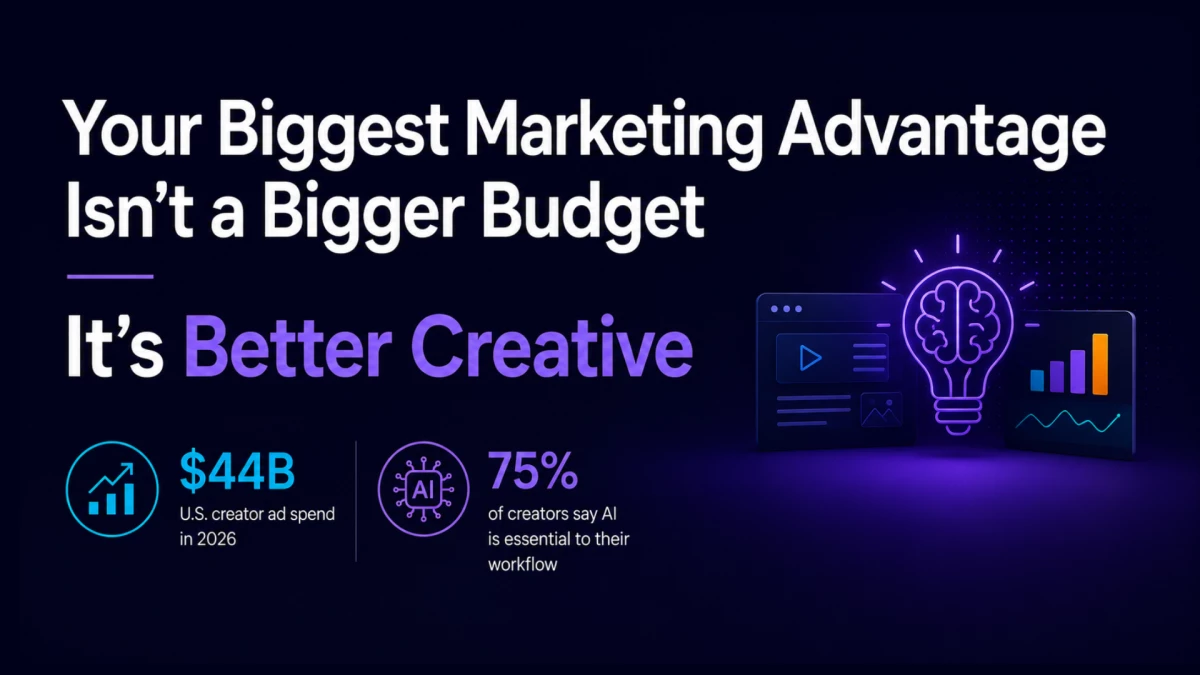

The art of media buying has become more and more automated as platforms such as Meta and TikTok take over the decision making role when it comes to bidding, targeting, and placement.
This leaves brands with fewer opportunities to outperform competitors through media buying, and makes creative one of the biggest competitive advantages that marketers still control.
That's the view of inBeat Agency, a performance marketing agency specializing in creator-led campaigns and influencer marketing.
The agency's Co-Founder and CEO, David Morneau, explains that the brands seeing the strongest results improve creatives before increasing media investment.
"Given that media buying is now more automated, it's definitely become a commodity, where platforms take care of most bidding, targeting, and placement decisions," Morneau says.
"But you can't just buy more media if people ignore your ads. To succeed, brands must test new hooks, creators, formats, and messages faster than others."

Who Is David Morneau?
David Morneau is the CEO and co-founder of inBeat Agency, a leading Montreal-based performance-forward creator content marketing agency, which focuses on UGC, paid media, influencer marketing, performance branding, growth marketing and research.
With nearly a decade of industry experience, David helps performance-driven marketers lower their CPAs through creative growth, while generating first-class organic content campaigns on a massive scale, driving engagement and performance for his clients.
Why Bigger Budgets Can't Fix Weak Creative
Media ad spend is the first place most marketing teams look at when campaign performance slips.
In the hopes of improving results, they tend to increase budgets, adjust frequency, or move investment between platforms.
But for Morneau, those changes often leave the real problem untouched.
"The biggest mistake I see is that teams increase spend and frequency and reallocate budget between Meta and TikTok while keeping the same weak message," he says.
Take a company that spends $1 million on advertising and gets a 3x return on ad spend for example. That's $3 million in revenue.
Now imagine customer acquisition costs increase by 25%. Return on ad spend falls to 2.4x, and revenue drops to $2.4 million.
That's a $600,000 hit, even though customer value hasn't changed.
That's why creative deserves closer attention before media plans change, and why increasing spend will just expose more people to the same ineffective ad.
This is why Morneau advises brands to identify which hooks, creators, formats, and messages consistently influence buying decisions.
Only then should they invest in the combinations that are proven to attract customers.
And even though the approach may sound simple, it’s more difficult to put it into practice.
How Better Creative Cut Hurom's CPA by 70%
Morneau points to premium juicer manufacturer, Hurom, as an example of what happens when brands improve creative instead of reallocating advertising budgets.
Hurom's challenge was consistently attracting new customers willing to pay a premium price.
The company manufactures its products in South Korea using patented technology, backs them with a 15-year warranty, and even produces products for some competing brands.
And while those credentials support Hurom's premium positioning, they don't always come across in traditional advertising.
To do that, inBeat built the campaign around the experience of using the product by showing people why the product was worth the price instead of asking them to take the brand's word for it.
Creators sliced open brightly colored fruit, poured fresh juice, highlighted its texture, and made daily juicing feel healthy and satisfying.
That approach reduced cost per acquisition by 70% while increasing return on ad spend by 300%.
For Morneau, the campaign showed how creative can strengthen performance without changing where media spend goes.
"People needed to understand why Hurom was worth paying more for," Morneau says.
"Creator content allowed us to demonstrate that value naturally, so instead of telling people that the product was premium, we showed them what made it different and why that mattered."
How inBeat Tests Creative Before Increasing Ad Spend
It's important to keep in mind that producing more creative only adds value when teams understand why one piece outperforms another.
At inBeat, every testing cycle begins with a review of the previous seven to 14 days of campaign performance. Instead of changing everything at once, the team isolates a single variable to test.
One week, that might mean experimenting with different opening hooks. The next, they keep the winning hook and test creators, formats, or messaging instead.
Once a combination consistently performs, they build new variations around what they've learned.
Because the team only changes one variable at a time, each test answers a specific question and helps shape the next round of creative.
Before increasing spend, the team first looks at whether an ad captures attention. Metrics such as hook performance, hold rate, completion rate, and click-through rate all help explain how audiences respond.
But none of those determine whether a campaign deserves more budget.
"We start with whether an ad earns attention, but attention alone doesn't make something a winner," Morneau says.
"A high CTR can still lead to poor customers. Before we scale anything, we want to see that attention turning into the action the client actually pays for."
Customer acquisition cost, or whichever conversion metric matters most to the business, ultimately decides whether creative has earned the right to receive additional investment.
When Creator Content Beats Brand Advertising
Morneau doesn't see creator-led content and polished brand creative as competing approaches because each one solves a different problem.
Creator content works best when people hear from someone they can relate to and see how a product fits into everyday life.
Brand creative, on the other hand, is better suited to product launches, premium positioning, product education, retargeting campaigns, and situations where companies need greater control over the message.
The mistake is deciding which format to use before looking at the data, particularly when creator-led campaigns continue to attract more investment.
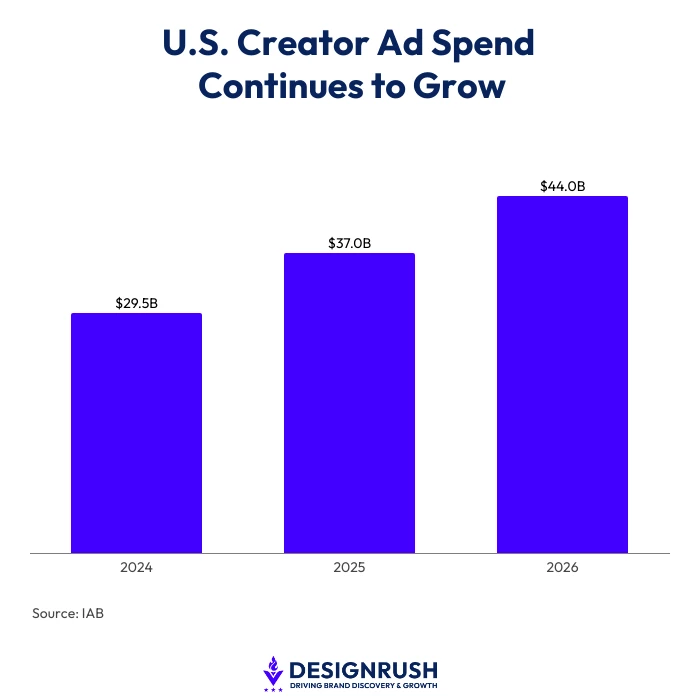
Projections estimate that U.S. creator ad spend will reach $44 billion this year, according to The Interactive Advertising Bureau's 2025 Creator Economy Ad Spend & Strategy Report.
That figure is up from $37 billion in 2025 and $29.5 billion in 2024.
"We use a mix of both creator-led content and brand creative because they solve different problems," Morneau says.
"Creator content is great when people need trust and demonstration, but polished creative works well when you need more control over the message. The decision should come from performance data, not personal preference."
The impact of AI is certainly changing how quickly marketers can produce creative.
About 87% of creators said that it has accelerated the growth of their business or audience, while 75% say that AI is essential to their workflow, per Adobe's findings.
But Morneau doesn't believe these numbers mean AI is replacing creators.
Instead, he sees AI speeding up production while creators continue providing the ideas, perspective, and audience understanding that shape stronger campaigns.
"We always say creators should become part of your marketing team, especially since they bring lived experience, cultural context, audience trust, and ideas that help you decide what deserves to be produced," Morneau says.
“But just as important, they help you understand why something worked and what to test next."
Why Learning Matters More Than Producing More Ads
As AI reduces the time and cost of producing creative, the challenge is moving from production to learning.
Morneau says production is often the first thing to break.
Teams suddenly need more concepts, more creators, and more iterations while still relying on approval processes built around a handful of polished campaigns each quarter.
The next problem is harder to recognize.
Creative keeps flowing, campaigns keep launching, but no one documents which hook, creator, format, or message actually drove performance.
Without that feedback loop, every campaign begins with the same assumptions instead of building on previous results.
For brands trying to make creative their competitive advantage, Morneau recommends starting with a stronger connection between media performance and creative production.
"Check which hooks, creators, messages, and formats are bringing in customers, then use AI to produce better versions based on what works," he says.
Morneau also believes that marketers should avoid one increasingly common mistake.
"Stop using AI to flood an account with more ads just because production is cheaper. More variations don't create more learning unless each one tests a clear idea," he adds.
Why Creative Alone Isn't Enough
The right approach towards creatives can improve performance, but it won't solve everything.
Media buying still decides how quickly campaigns scale, when audiences become saturated, and whether customer acquisition costs stay under control.
Despite your best efforts, a weak offer, poor tracking, or a slow landing page will still hold a campaign back.
And while AI can help produce more creative, it can't tell you why one version worked and another didn't.
The brands that keep improving aren’t splashing out and increasing their budgets, but learning what works and building on it.
So ask yourself. How quickly can your team figure that out?