

Many health organizations hear "direct-to-patient model" and skip straight to the customer experience.
They overlook the real-time data flow between pricing, inventory, prescriptions, and other operations needed to enable direct access in the first place.
But unified commerce is the result of a long-term roadmap, not a one-off website build.
In healthcare, for the front end to feel as seamless as it looks, organizations must prioritize significant behind-the-scenes integration and orchestration before touching automation or the customer experience.
At Codal, this has been foundational to an ongoing, major digital transformation initiative to modernize the digital ecosystem for Cost Plus Drugs, the D2C online pharmacy owned by Mark Cuban.
The revamp was intended to streamline operations and create a stronger foundation for long-term growth.
It started by mapping out the business’s operational needs to gain a holistic understanding of the unique challenges so that Codal could deliver a modern and scalable platform that improved both operational efficiency and customer experience.
“The challenge is not simply building a website,” says Rahul Yadav, Director of Product Innovation at Codal.
“It’s creating a connected ecosystem that can reliably support patients, providers, and operational teams at scale.”
Rather than just replacing a legacy platform, Codal redesigned the previously disconnected systems and workflows supporting Cost Plus Drugs as it continues to expand, without compromising pricing transparency or efficiency.
“Codal has been a valuable partner in enhancing our digital pharmacy platform, bringing deep technical expertise and a strategic, collaborative approach," says Paul Vasquez, COO and Head of Pharmacy at Cost Plus Drugs.
"Their commitment to innovation and industry best practices has helped us advance our mission of making medications more affordable and accessible.”
Lasting Modernization Starts with Solving Business Problems First
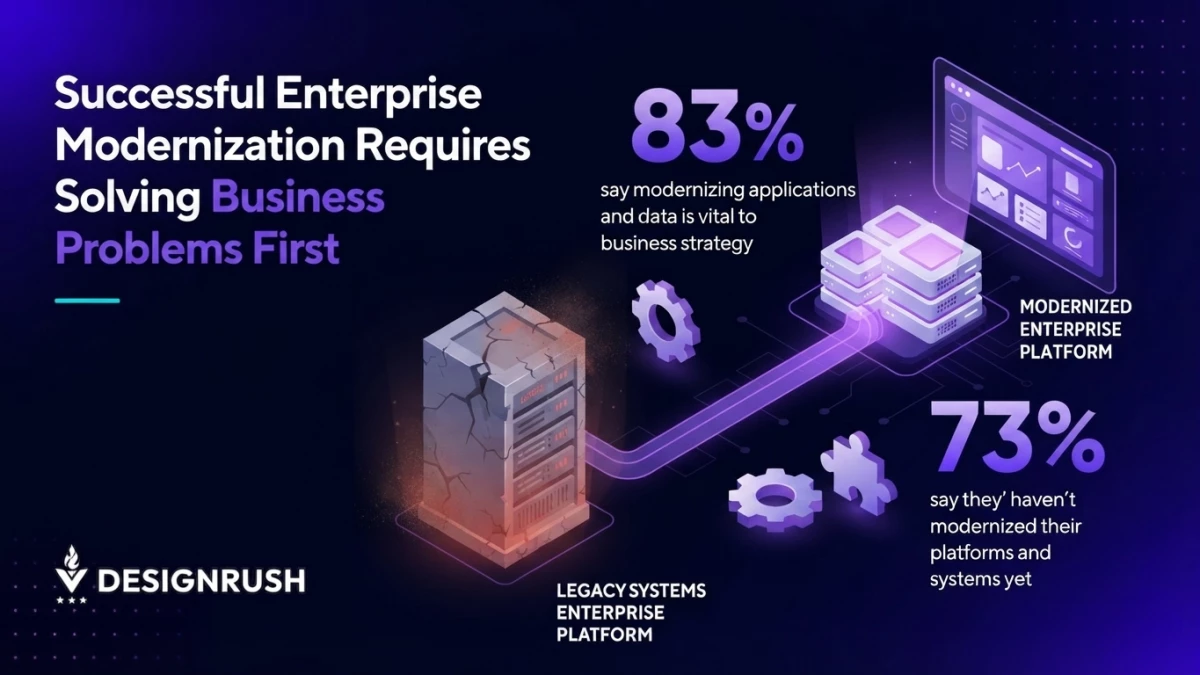
The challenge of modernization is one faced by many enterprises across various industries. For 83% of executives, modernizing applications and data is central to their business strategy, per a report by IBM.
However, only 27% of executives say their organizations have modernized the platforms and systems needed to support that strategy.
That gap suggests a real struggle to translate ambition into operational change that produces lasting business value.
According to Yadav, modernization should start with solving business problems before selecting technology. “Technology should serve as the enabler rather than the objective.
"You have to redesign the workflows, decision-making, and customer experience that the technology exists to support. Otherwise, you're simply rebuilding yesterday's limitations on today's infrastructure."
Instead of beginning by reviewing which platform(s) the business should adopt, Yadav says teams that have accomplished successful modernization ask themselves a deeper question:
What is preventing us from growing, serving customers efficiently, or responding to change?
When working with Cost Plus Drugs, Codal’s goal was to unify what had been two distinct experiences: Cost Plus Drugs and Cuban Card.
The team identified multiple disconnected systems that were hindering the organization’s operational visibility and ability to scale, and consolidated them into a more unified platform.
This gave internal teams a single source of truth across pricing, fulfillment, authentication, and reporting, all while reducing the technical friction that often accompanies rapid growth.
Codal also replaced licensed authentication software with a custom-built solution expected to save the company millions of dollars over time, and improvements to reporting and operational workflows provided teams with faster access to the information needed to make business decisions.
Those architectural changes translated into measurable operational improvements across the business, spanning order fulfillment, product, stock replenishment, user experience, reporting, and customer relationship management.
Codal's approach illustrates three principles that consistently appear in successful modernization efforts:
1. Start With Operational Friction
Disconnected systems slow decision-making. Meanwhile, legacy architecture limits how quickly organizations respond to changing customer expectations.
Modernization begins when you identify those constraints, not before selecting the technology intended to remove them.
When operational priorities drive the conversation, technology investments become easier to justify because they are tied to measurable business outcomes rather than technical upgrades.
2. Build Architecture That Can Adapt
Many legacy systems were designed for stability rather than flexibility.
Today, customer expectations evolve constantly. Regulations shift, and new digital capabilities emerge at a pace few organizations can predict.
This is why modern architecture should be built in a way that accommodates that uncertainty rather than resisting it.
"Architecture should create optionality. Every technical decision should make the next business decision easier, not harder," Yadav adds.
In other words, teams should opt for a platform that is capable of supporting future growth without requiring major redevelopment each time the business expands its capabilities.
A flexible foundation reduces technical debt while allowing innovation to happen more quickly as new opportunities emerge.
3. Treat Product Strategy and Engineering as One Discipline
One of the recurring mistakes in enterprise modernization is separating business strategy from technical execution.
In many cases, this results in product teams and engineering teams having independent conversations and roadmaps.
But this approach overlooks the fact that the strongest modernization programs bring both disciplines together from the beginning.
This allows architectural decisions to support future business capabilities instead of simply recreating existing processes on newer technology.
Modernize the Business Before the Stack
Modernization should not be measured by how many legacy systems were replaced, or how many new technologies were deployed.
It should be measured by whether the business became easier to operate, faster to innovate, and better equipped to adapt to future change.
That mindset shift requires organizations to look beyond implementation milestones and ask more fundamental questions:
- Are workflows becoming simpler?
- Can teams make decisions faster?
- Does the platform create room for future growth, instead of simply introducing new constraints?
"If customers move through the experience more easily, teams operate more efficiently, and future innovation becomes simpler,” Yadav adds.
“That's when modernization starts delivering real returns."