


Our analysts track the AI changes that decide what agencies pay for and sell. Brands building AI programs can partner with vetted AI agencies for strategic implementation.
This week, AI vendors changed hands and prices, and brands got more reasons to check the numbers.
- Amazon agreed to buy Decart's chip optimization software, adding its founders in a deal reported at $7.5 billion.
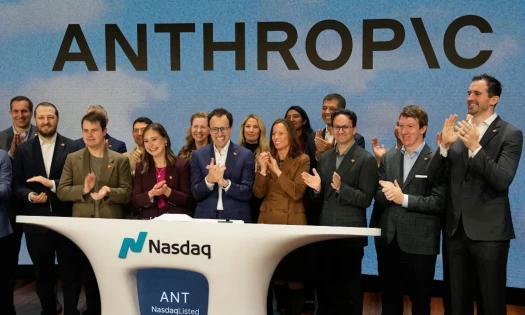
- Anthropic's shares fell below the $83 IPO price, slipping in premarket trading five days after the company's Nasdaq debut.
- Google priced Gemini 4 Neon at $3 and $15 per million input and output tokens, claiming a 32% lower cost per task than Carbon.
- Adobe found that 45% of U.S. consumers name a top brand trust risk that marketers rank last.
All four change the questions that brands should ask before they hire an agency to run AI work.
Our Take: Can Agencies Bank on AI Savings?
Google says that Gemini 4 Neon costs 32% less per task than Gemini 4 Carbon.
We don't think agencies can bank on a model saving, because review labor costs far more than the saving buys.
Artificial Analysis, whose index Google cites, measured Neon's top setting at $6.44 per task, a $1.32 saving against Carbon's $7.76.
A 2026 Promethean Research survey of digital agency leaders found that $175 to $199 is the most common hourly rate.
At those rates, the savings cover less than 30 seconds of review.
Net margins averaged 13% in 2025, the same survey found, so an AI marketing agency that quotes a vendor's savings has no cushion if review hours stay.
Any brand hiring an AI agency should ask for review hours as a separate line on the quote.
Decart Chip Software Joins Amazon
Amazon agreed to buy chip optimization technology from Israeli AI startup Decart, the company says in its announcement.
Decart's three co-founders and its research team will join Amazon, though Decart will keep its AI models.
The post gives no price, but Bloomberg reported that the purchase will cost about $7.5 billion, citing a person familiar with the matter.
Payment depends on targets over five years, according to Israeli business daily Globes, which puts the final figure above $7.5 billion.
Anthropic, which listed on Nasdaq on Nov. 19, had explored a $6 billion Decart deal before dropping it after due diligence.
The technology will optimize inference and strengthen custom chips so customers can train and run models faster at lower cost, the post says.
Decart's software works across chips from Nvidia, Google, and Amazon, according to TechCrunch.
Amazon's post ties the technology to its own Trainium and Graviton chips and lists regulatory clearance as a closing condition.
Until Amazon says the savings reach Nvidia and Google hardware, vendors on those chips have no basis to promise lower AI pricing from this deal.
Brands get more leverage from agencies that run client work across several clouds, since those shops can move a workload when a vendor reprices.
Claude Maker Gives Back Its IPO Pop
Anthropic's shares slipped below the $83 IPO price in premarket trading on Nov. 24, five days after the company's Nasdaq debut, Reuters reported.
Later that morning, the stock was down 12.6% at $76.60 and on course to erase close to $200 billion in market value.
The slide reversed a strong first day, when the stock opened at $111.50 and closed at $97.17, 17% above the offer.
Other high-profile listings have also slipped under their offer price.
SpaceX took about a month to break below its offer price, while Facebook did it on its second trading day in 2012.
An early break doesn't necessarily predict long-term performance, Reuters noted.
Pressure from open-weight models is among the risks that could decide the stock's next move.
Users can download and adapt these cheaper models, which Anthropic has warned could pressure its pricing.
This pressure would hit a company whose compute took 58% of third-quarter revenue.
Teams building client work on Claude should ask for written notice periods on usage-price changes.
Clients of Claude-based agency work should settle up front who absorbs a model price increase.
Gemini 4 Neon Cached Input Costs 95% Less
Gemini 4 Neon, a new Google AI model, costs 32% less per task than Gemini 4 Carbon at the default thinking setting.
Developers pay $3 per million input tokens and $15 per million output tokens, with cached input at $0.15, a 95% discount.
Carbon's promotional $2 and $10 rates run through Nov. 30, so Neon only undercuts it per token once Carbon returns to $4 and $20.
Google also claims that Neon costs 50% to 80% less per task than unnamed top rivals on the Vals Index and Agent Arena.
Artificial Analysis also ranks Neon third overall at its xhigh setting, the company adds.
Introducing Gemini 4 Neon, bringing frontier-level intelligence with fast end-to-end task completion across complex software engineering, knowledge work, and science workflows. Neon balances depth and efficiency across complex coding, analytical reasoning, and enterprise workflows—running standalone or paired with Gemini 4 Carbon and Hydrogen in Google @Antigravity: 🔵 #1 on AA Coding Agent Index with cleaner, more secure repo edits 🔴 Best-in-class STEM reasoning (Terminal-Bench Science, RiemannBench & HLE-Diamond) 🟡 1M-context recall across repos, docs, and spreadsheets 🟢~50–80% lower cost per task than top competing models (Vals Index & Agent Arena) Gemini 4 Neon is rolling out today via the Gemini API (paid tier) in @GoogleAIStudio and @AndroidStudio, in Gemini for business, and in Google @Antigravity for paid Google AI Pro and Ultra subscribers. Learn more ↓ https://t.co/D6GkShYfLw
— Google for Developers (@googledevs) November 18, 2026
Neon uses about 15% more output tokens per task than Carbon, Artificial Analysis found.
Since developers pay per token, agencies should run one recurring client task on Neon and Carbon before switching.
A lower price per task shrinks a bill only if usage stays flat.
Brands with an in-house analyst can run the same test on their own tasks and check any model switch that an agency proposes.
Adobe Finds 74% Plan to Spend More on AI
Marketers rank products that fail to match marketing claims last among their trust concerns (18%), an Adobe survey found.
Consumers rank the same mismatch first, at 45%, for a 27-point gap that is the widest in Adobe's trust table.
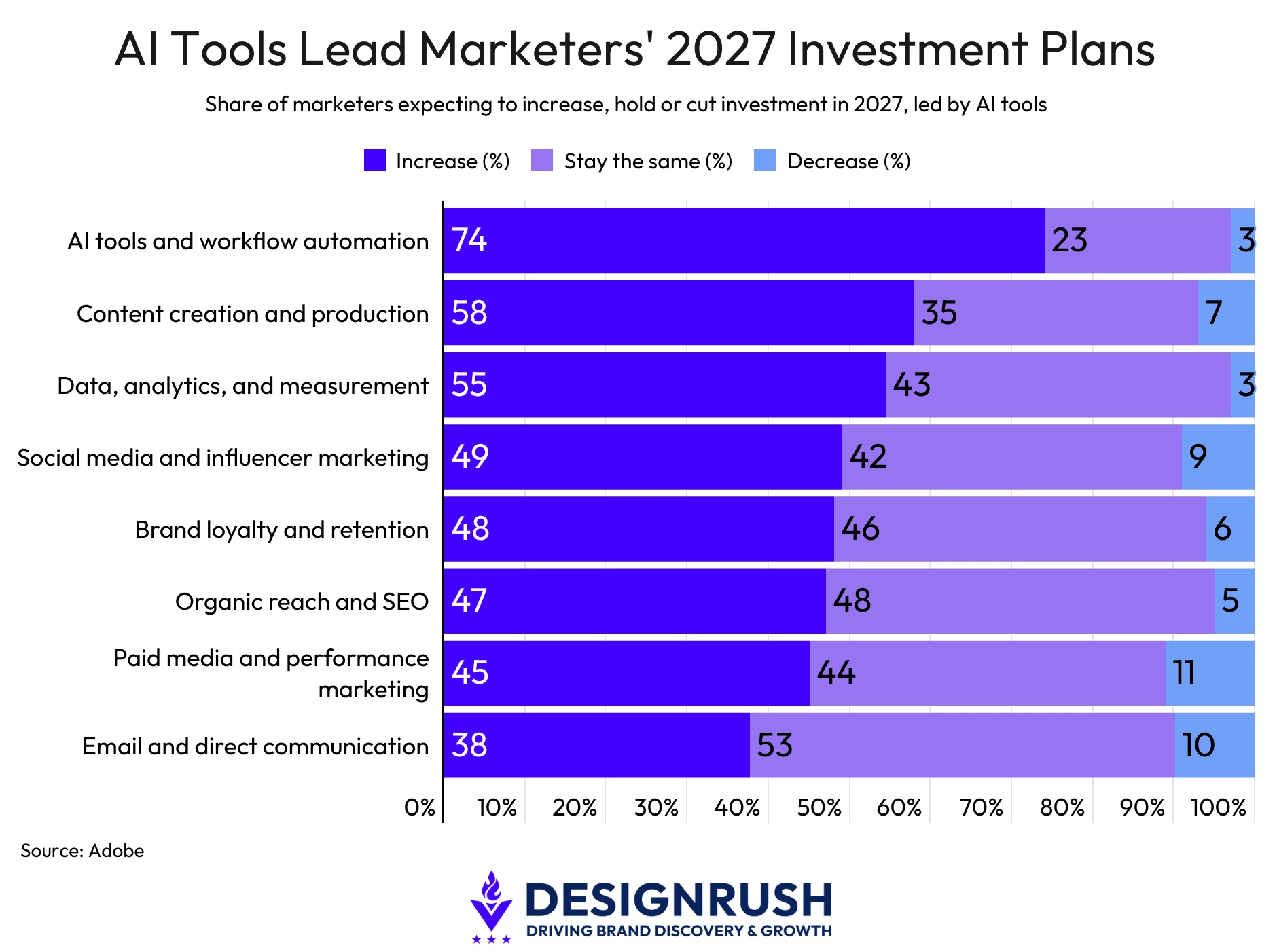
Marketers plan to answer heavier workloads with AI, as 74% expect to raise spending on AI tools and workflow automation in 2027.
More than half of marketers (51%) say their teams are already overstretched.
Adobe, which surveyed 502 U.S. marketers and 1,011 U.S. consumers, pitches AI content tools such as GenStudio for Performance Marketing as the answer to both.
GenStudio checks assets against brand guidelines before launch, yet only the product team knows whether a claim matches what ships.
Overstretched brands can hand content marketing volume to an agency and keep claim sign-off with their internal product team.
Claude-Assisted Riemann Proof Draws Scrutiny
Anthropic mathematician Levent Alpöge says he used a non-public Claude version to prove the Riemann hypothesis, a 167-year-old problem about primes.
Independent mathematicians told Scientific American that the proof is almost certainly true.
Meta chief AI officer Alexandr Wang called it the "absolute pinnacle of intellectual accomplishment" for most who have studied math.
Alpöge posted the result a day after Anthropic's IPO, which CEO Dario Amodei had asked him to wait for, according to Scientific American.
In his announcement, Alpöge called the timing "horrible" and dismissed the obvious cynical view of it as false.
Alpöge later wrote on X that the 250,000-plus-page figure linked to the proof was a joke that people "ran with."
He also conceded that the Lean code is "full of garbage" but still compiles.
In September, Fields Medal winners called AI companies' push to solve math problems as benchmarks "detrimental to the science of mathematics."
Brands that quote such milestones take on the trust risk Adobe's survey flags.
When an agency cites an AI company's breakthrough in a pitch, brands should ask whether that agency is the company's official partner.
Three AI Checks to Run Before Committing Budget
Agencies and the brands that hire them can run three checks before they sign the next AI content marketing scope:
Check Which Hardware Powers AI Tools
Before renewing an AI contract, check whether the vendor's infrastructure depends on chips affected by an acquisition.
Decart's software runs on Nvidia, Google, and Amazon chips, but Amazon will reportedly fold it into its own Trainium and Inferentia processors.
Test Model Costs Against Real Workloads
A lower price per task means little until the model has handled the same client workload under comparable conditions.
Neon's four thinking levels let teams "dial intelligence and token spend to what each workload needs," so one task can cost different amounts at each level.
Verify AI Claims Before Using Them in Campaigns
Any performance claim that makes it into a campaign should have a named source and supporting evidence.
Lean checkers certified Alpöge's 17-million-line Riemann proof within a day, yet the Clay Mathematics Institute still lists the problem as unsolved.
These checks belong in an AI marketing strategy before a company commits budget, repeats a vendor's claims, or makes promises to customers.
An agency RFP can carry all three, so brands see how each shop answers before the pitch.
Last week's AI roundup advised naming approvers for agent actions.
This week's news adds hardware, cost, and claims to the list that brands need to vet.
How do you price AI work for clients?
These leading AI marketing agencies in our directory help brands verify AI claims before campaigns scale.