
Scaling AI Agents, Key Insights:
- Agentic AI enables planning, execution, and decision-making across workflows
- One-click agent creation cuts rollout from months to minutes, letting agencies scale without hiring developers
- Error reduction and cost control come through built-in verification, auto-scaling, and version management
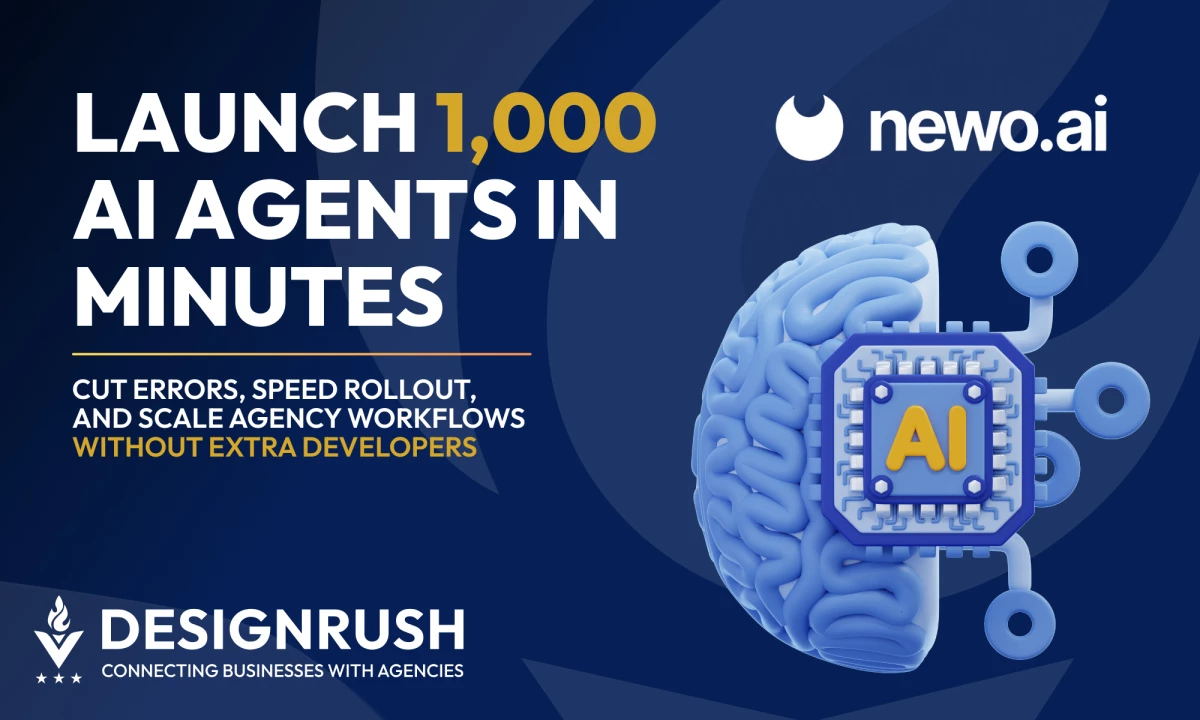
What if scaling your agency meant hiring 1,000 AI agents in minutes?
Sounds impossible? Here’s how it works.
Not long ago, it would’ve taken months of coding, QA, and deployment to scale even a dozen assistants.
But now, platforms like Newo.ai, a cutting-edge platform for creating AI employees, make this process happen in minutes via one-click builds and pre-trained workflows.
In practice, this means launching fully functional agents, without writing custom code or training models from scratch, drastically lowering the barrier to scale.
These aren’t your usual glitchy chatbots. These AI employees execute complex functions without requiring training or a paycheck.
Like human employees, they can effectively perform tasks, such as:
- Taking calls
- Making bookings
- Managing multi-channel communication
This is a huge game-changer for companies and agencies alike. Now, they can scale services without adding staff.
Editor's Note: This is a sponsored article created in partnership with Newo.ai.
The market is catching on.
Data from a 2025 Wakefield Research survey shows 62% of organizations expect more than 100% ROI from agentic AI, with U.S. firms forecasting up to 192%.
This uptick in projected returns is meaningful.
Why? Businesses are moving beyond experimentation and beginning to view agentic AI as a mainstream growth engine.
Cutting Costs and Saving Time with AI Rollouts
Rolling out AI used to mean high costs, delays, and hallucinations. Newo.ai helps agencies bypass those barriers by providing:
- No-code or low-code builder tiers for easy deployment
- Mass version control for large agent networks
- Self-checking systems to cut hallucinations
As a result, rollout becomes a growth path, rather than a technical burden. And agencies move from development headaches to operational automation.
According to Gartner research, as cited in Medium, agentic AI brings 35% efficiency gains and 28% faster process completion compared to traditional automation.
"One-click creation eliminates the traditional barriers of long dev cycles and high integration costs,” says Dr. David Yang, Newo.ai co-founder.
“By embedding self-verification into every agent, we reduce hallucinations at scale. Agencies can go live in minutes instead of months, and that speed lets them experiment across multiple workflows without needing new engineering resources each time."
Why Agencies Must Scale AI Agents to Stay Competitive
Marketing agencies, web designers, and automation experts face surging demand for AI agents that fix client funnels, automate communication, and boost revenue.
But building from scratch, or even customizing templates, creates two big problems:
- Agencies need costly engineers to build or customize AI agents.
- The economics only work if those costs are passed to clients.
To scale efficiently, agencies need platforms that solve both challenges, and here’s how they do it.
- From bottlenecks to automation: replacing slow, manual processes with systems that run accurately and efficiently.
- From manual QA to self-verifying agents: shifting from human error-checking to agents that validate their own outputs.
- From pilot projects to production ecosystems: moving beyond small-scale tests to fully operational deployments across multiple workflows.
For agencies and brands, this could mean launching and managing hundreds of agents at once.
"Don't just look for platforms that can spin up AI agents quickly; that’s only the beginning,” says Luba Ovtsinnikova, Newo.ai CEO, co-founder.
“You need something that actually helps you maintain them, customize their behavior for different clients, and shows you the real ROI. The game-changer is when you stop babysitting individual pilots and start managing entire AI ecosystems that are actually making money for your clients. That's where the real value is,” Ovtsinnikova added.
Evidence to support AI advantages is growing.
In a 2025 field experiment by MIT and arXiv researchers, teams consisting of both humans and AI reached 73% higher productivity than human-only groups.
While the human x AI teams excelled at producing text-based creative outputs like ad copy, human-only teams performed better on image-based tasks.
These productivity gains highlight the growing potential of agents to boost output while maintaining quality.
An example of Voice AI Employees managing multiple calls at once, showing how Newo.ai scales customer interactions without missed opportunities.
Overcoming AI’s Biggest Scaling Challenges
Despite all of these incredible advancements, AI agents aren’t free of hurdles.
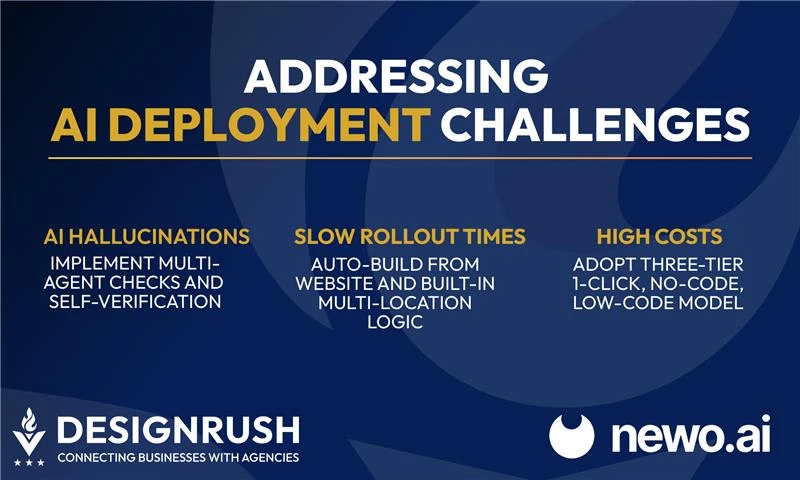
The biggest barriers are accuracy, rollout speed, and cost. These issues can stop even the most ambitious projects from delivering results if left unaddressed.
Newo.ai highlights three main barriers to growth and how it tackles them:
1. Hallucinations: Misread data can disrupt workflows.
Newo addresses this with multi-agent validation to reduce errors.
2. Rollout Time: Deployments often take months.
Newo’s 1-click builder with its auto-build and multi-location logic cuts that down to minutes.
3. Costs: Development and upkeep can quickly spiral at scale.
Newo allows fast rollout, low-cost no-code customizations, automated updates, and monitoring with system self-assessments powered by AI.
Overcoming these challenges is crucial for agencies and white-label partners to implement AI agents efficiently, test new workflows, and scale operations without adding extra technical resources.
When those hurdles are addressed, the business impact can be significant.
According to Newo.ai, some deployments report up to $30,000 per month per location in added revenue from AI agents.
These results show how automating seemingly “small” tasks like calls and bookings can unlock significant new revenue.
Data supports this, too.
A 2025 Salesforce study, reported by ITPro, found that 74% of CFOs believe AI agents will cut costs and increase revenue by up to 20%.
This highlights how leaders in non-AI-centric industries are now seeing agentic AI as both a cost saver and a revenue driver.
Managing AI Agents at Scale
Launching 1,000 agents is only the beginning. The real challenge is managing them.
"At scale, governance becomes critical,” says Apoorva Choudhary, Head of Customer Success at Newo.ai.
“We recommend three practices: first, a single monitoring dashboard so leaders see performance across every agent in real time."
"Second, strong permission controls so clients, partners, and staff only see what they need. And third, usage analytics tied directly to ROI so agencies can measure outcomes, not just activity,” he says.
In greater detail, Newo.ai is building tools for:
- Centralized monitoring: giving agencies a single dashboard to oversee all deployed agents in real time.
- Permission control: defining who can access, edit, or manage different agents across teams or client accounts.
- Usage analytics: tracking key performance metrics like calls handled, bookings made, or error rates, so agencies can prove ROI and refine performance.
- Failover handling: ensuring service continuity by rerouting tasks automatically if one agent or system goes down.
This keeps scaling lean and avoids bloated teams. It also enables white-label partnerships, turning AI into a new revenue stream.
Outside agencies, the results are clear. At a Siemens plant, agentic AI cut unplanned downtime by 25 to 30% by predicting failures before they happened.
The Future of Agentic AI for Agencies
Agentic AI is shifting from pilot projects to core infrastructure.
A 2025 global study by Cisco shows 56% of business interactions will be agent-managed within a year, rising to 68% within three years.
And the ripple effects are clear:
- White-label partners can offer pre-trained agents as turnkey solutions.
- Digital providers can cut onboarding time while unlocking new revenue streams.
- Agencies can shift focus from building AI to deploying it as part of their core strategy.
"The turning point is when scale itself becomes the advantage,” says Chris Sammarone, Founder and CEO of Upcode.
Instead of one or two agents per workflow, agencies can spin up hundreds in parallel, each customized for a specific client or location.
As Sammarone puts it, this is no longer a “technical headache” and rather an operational strategy.
“For appointment-driven industries, scaling voice AI employees across locations instantly captures revenue that would otherwise be lost to missed calls,” he added.
Industries Driving Adoption
The fastest adopters are B2C, appointment-heavy sectors where missed calls or slow responses directly translate into lost revenue. Agencies serving these verticals are already seeing demand for AI employees:
- Restaurants: 24/7 reservations and capturing overflow calls.
- Dentists & Orthodontists: scheduling, reminders, and insurance queries.
- Cleaning & Home Services: inbound quotes and job scheduling.
- Insurance: policy consultations, claims, and FAQs.
- Product Consultations: answering questions and booking demos.
For agencies, scale is already driving results in client-heavy industries where missed calls mean lost revenue.
AI as the Next Business Infrastructure Shift
In addition to speeding up deployment, one-click agent creation reframes scale as a core business strategy.
What was once a technical challenge is now a competitive advantage.
For agencies and partners, the opportunity isn’t about building AI from scratch. It’s about treating AI as a business asset that delivers measurable results at scale.
Think of it like adding a new revenue stream or an extra operational team, only this one is digital, tireless, and instantly scalable.
The race is on, and those who systematize AI deployment now will own the advantage in the future.