
Startup Development Partner Selection: Key Findings
- Startup failure rates sit at 90%, which makes choosing the right development partner as critical as choosing the product itself.
- Most early-stage setbacks come from the wrong agency fit, so founders must prioritize partners who bring product thinking rather than blind execution.
- Outsourcing accelerates MVP progress early, but in-house teams become essential once needs stabilize and cycles repeat.
What really takes out early-stage startups?
According to 2025 data from Exploding Topics, up to 90% of startups fail, and team misalignment accounts for 18% of those failures.
In other words, working with the wrong people has a decent likelihood of tanking your project.
Couple this with an 82% failure rate for first-time founders, and the odds of success are certainly daunting.
In an environment this unforgiving, the people a founder chooses to build with matter just as much as the product itself.
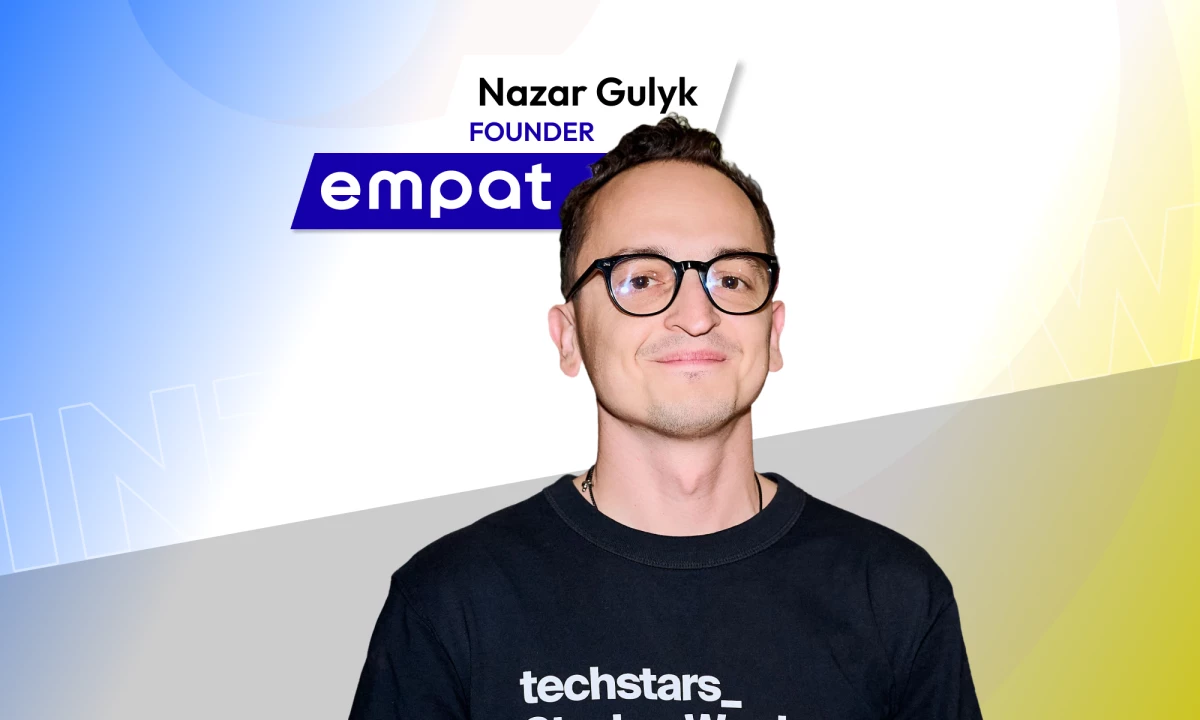
This is where Nazar Gulyk, Founder of Empat, begins every conversation about early-stage growth.
He has worked with founders across industries and levels of technical experience, and his stance is firm.
“A startup cannot afford the wrong partner,” Gulyk says.
“For first-time and non-technical founders in particular, a great agency relationship can be the difference between clarity and confusion, between momentum and unnecessary rebuilding.”
In an interview with DesignRush, Gulyk shares his advice on:
- How tech startup founders can choose the right agency partner
- The red flags to watch for when hiring a team
- Why scaling requires both speed and quality (not one or the other)
Here’s what early-stage founders need to know before choosing a partner that could make (or break) their product.

Who Is Nazar Gulyk?
Nazar Gulyk is a San Francisco–based tech entrepreneur, founder of Empat, and community leader with over a decade of experience building products, companies, and engineering teams across the U.S. and Europe.
Editor's Note: This is a sponsored article created in partnership with Empat.
What to Look for in a Partner Agency
Founders often approach the early stages of product development with a simple goal: they need something built.
Yet, the reality is that this choice is much bigger.
Choosing a development partner at the beginning helps shape a product’s direction, challenges assumptions, and adds structure to the uncertainty that defines the first year of a startup’s life.
“When you’re early, you’re not hiring ‘a team.’ You’re choosing a co-pilot,” Gulyk says.
“The best partners aren’t ‘yes men’ who build exactly what you’re asking for. Instead, they help you understand what you should build first.”
For him, a strong early-stage partner should bring three essential qualities:
- Product thinking, not just execution. Early founders need more than technical output. They need a partner who can question assumptions, shine light on blind spots, and guide decisions that protect the product from early missteps.
- Ability to move fast without breaking trust. Speed has become a badge of honor in the startup world, but predictable communication and clear breakdowns of next steps matter just as much.
- Founder empathy. At this stage, founders balance vision, financial limitations, and a steady influx of unknowns. A partner who stays calm through chaos and communicates proactively reduces unnecessary stress.
Of course, the qualities a founder needs also evolve over time.
The question at the MVP stage asks whether the idea can be validated quickly. The question at scale asks whether the system can grow without collapsing under its own weight.
Validating early-stage ideas doesn’t always require a full build; sometimes the smartest path is testing assumptions before committing engineering resources.
Read more in Empat’s Concierge MVP guide.
-content-large-webp.webp "Visual outlining core performance metrics for a concierge MVP, such as willingness to pay, repeat usage, customer satisfaction, feature requests, funnel drop-offs, and revenue compared to human effort.")
This is why Empat approaches every project with the full founder journey, from idea to scale, in mind:
- Early stage / MVP: senior cross-functional teams designed for rapid validation. Fewer layers, faster decisions, and clear focus on core product delivery.
- Growth stage: additional architectural strength, specialist support, scaling practices, and a more robust QA discipline.
- Long-term: support for hiring and internalizing key roles so the startup can build its own foundation while keeping Empat as a flexible scaling partner.
“For us, the goal is simple: your partner should grow with your product, without forcing you to rebuild the team every 6 months,” he says.
Avoid These Red Flags When Hiring
Many founders select partners under pressure as product timelines always feel urgent, investor expectations loom, and technical choices feel unfamiliar.
This mix often leads to shortcuts that create bigger problems down the road.
Gulyk notes that choosing the wrong partner early can magnify risks instead of mitigating them.
As such, founders must slow down just enough to assess the signals that often show up early.
- They say yes to everything. Agreement without thought is not partnership. It is billing disguised as collaboration.
- They cannot explain tradeoffs clearly. Early product development depends on smart prioritization. A partner who cannot articulate why certain decisions matter will struggle to guide the product later.
- You don’t know who is actually doing the work. Meeting seniors and receiving juniors without transparency often leads to a drift in quality.
- They optimize for output, not outcomes. Features without user value create a slow decline that is expensive to fix later.
- They lack a process for knowledge retention. If information lives only in someone’s head, continuity evaporates, which can be catastrophic when a product goes through iterations and/or scales.
Identifying these red flags early on is crucial since, in the early stage, the biggest risk is building the wrong thing quickly.
Any mistake will scale alongside the product and become more expensive with each release.
This is why Gulyk urges founders to ask one essential question when evaluating a potential partner.
How will you help me make better product decisions, not just build what I say?
“Asking that one single question reveals whether they think like owners or contractors, whether they understand startups, and whether they’ll protect you from expensive mistakes,” he says.
Ask this, and founders will usually be able to spot any of the five red flags based on how the potential partner answers.”
Outsourcing vs Hiring In-house Talent
Outsourcing during the early stage is often a smarter move than hiring a full team, but only when done intentionally.
For founders weighing cost, speed, and long-term flexibility, distributed teams can offer a practical path to scale without overhiring.
Read more in Empat’s guide to hiring remote developers in Eastern Europe.
-content-large-webp.webp "Illustration comparing three operational models, in-house teams, freelancers, and outsourced partners, highlighting differences in collaboration, cost, time management, and scalability.")
Gulyk lays down two grounding principles for deciding which path to take:
- Outsource when speed, expertise, or focus is the bottleneck. This is ideal for shipping an MVP quickly or when the roles required for long-term growth are still unclear. Outsourcing buys time and momentum without premature commitments.
- Hire in-house when needs become clear and repeatable. Once direction stabilizes, core engineering belongs inside the company. Predictable cycles benefit from people who live the product every day.
Scale Up for Both Quality and Speed
Quality does not scale by accident. It requires solid foundations built before the growth curve steepens.
Yet, many products stumble at this stage because speed becomes the priority while structure becomes an afterthought.
However, it’s definitely possible to scale both quality and speed. To do this, Gulyk recommends making a few shifts in both mindset and organizational structure:
- Context stays central. As teams grow, people lose the “why.” We fight that by keeping strong product documentation, clear goals, and constant alignment.
- Systems over heroics. You don’t want quality to depend on a few great engineers. You want repeatable processes: code reviews, QA pipelines, stable environments.
- Senior ownership at every stage. Growth is the most dangerous moment for a product. We keep senior engineers and product leads involved so speed doesn’t dilute standards.
Rethink How You Choose a Partner
Choosing a development partner early on shapes more than the product. It shapes how a founder makes decisions under pressure.
A good partner brings clarity when the roadmap is uncertain and discipline when the pace speeds up.
Also, they protect founders from assuming that urgency and progress are the same thing.
In conclusion, what matters most is finding someone who challenges with purpose rather than agrees out of habit.
Why? Startups grow faster when their partners think like stewards, not spectators.
And while choosing a partner who agrees to everything may feel comforting at first, it often means you’ve found someone who values your budget far more than your success.