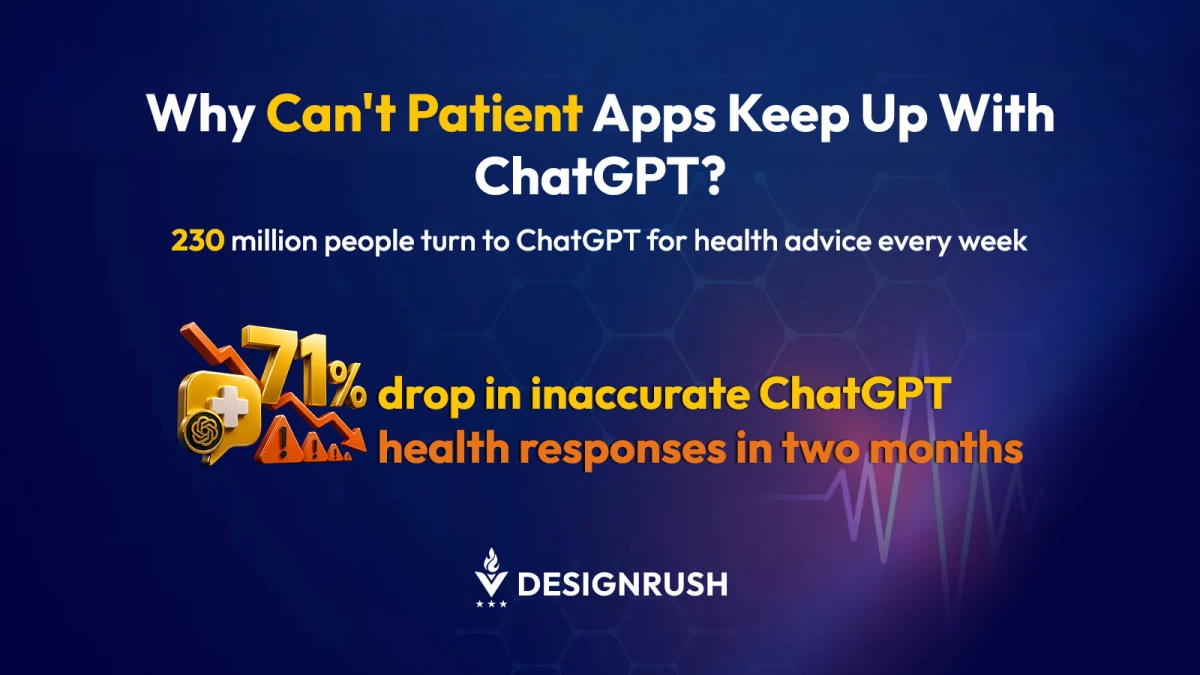

More than 230 million people now use ChatGPT for health and wellness advice every week, as per OpenAI.
This as many are turning to conversational AI to better understand symptoms, treatments, and medical information rather than waiting to speak with a clinician.
This has led to healthcare organizations now facing growing pressure to deliver digital experiences that feel just as intuitive as the GPT’s many consumers now rely on daily.
For companies like Suffescom Solutions, a leader in custom software and mobile app development, the next generation of patient apps will play a central role in meeting those expectations.
Suffescom Solutions CEO, Gurpreet Singh Walia, explains that the biggest change isn't that patients are using AI, but that they're beginning to expect every healthcare software interaction to be just as responsive.
"Most patient apps simply haven't kept up. They're still built for check-ins and bookings, not real conversations," Singh Walia says.
And fixing this requires teams to get clear on what patient apps are actually supposed to do.
YouTube channel Riff's AI Headlines breaks down OpenAI's June 18 health intelligence upgrade to GPT-5.5 Instant:
How ChatGPT Changes Patient Expectations
To strengthen ChatGPT’s healthcare capabilities, OpenAI has worked with more than 200 physicians. In doing so, GPT-5.5 Instant has reduced inaccurate health responses by 71% in only two months.
The company is also expanding personalized health experiences through integrations with health apps and medical records which gives users more relevant information based on their individual needs.
More patients are using conversational AI before speaking with a clinician, and that is changing what they expect once they enter the healthcare system.
"For years, healthcare organizations measured digital success by whether patients logged in,” Singh Walia explains.
“Today, the question is whether those experiences actually help people make informed decisions and feel more connected to their care."
OpenAI's Karan Singhal discusses how AI is changing healthcare and why patient expectations are evolving just as quickly:
Why Patient Portals Fall Behind
Most patient portals were built for basic administrative tasks such as booking appointments, checking test results, renewing prescriptions and paying bills.
But patients want more than a place to access information. They want answers, explanations, and support throughout their care.
Portals built for administrative tasks alone no longer match those expectations.
Fortunately, healthcare providers have started to respond accordingly. This as 70% of C-suite executives in the sector stated that operational efficiency and productivity are a top priority, per Deloitte's 2025 Global Health Care Outlook.
"People shouldn't have to jump between different screens or search for basic information,” Singh Walia says.
“A good patient app should make it easy to find answers, understand what's happening, and keep track of their care."
What Modern AI Patient Apps Need
Just adding a chatbot is not the solution.
Patient apps must allow people to message their care team, book appointments, join virtual consultations, manage medications, access their health records, and receive medical guidance.
AI can make those interactions more useful by pulling up a patient's medical history and previous activity to deliver reminders, explain health information, and suggest appropriate follow-up.
However, none of this matters if patients don't trust the app. Trust can only be built when data privacy, security, regulatory compliance, and clinical oversight are instilled from the start.
"Many organizations add AI without changing how patients actually use their apps," Singh Walia says.
"AI works best when patient communication, clinical data, and digital tools work together."
Building an AI Strategy for Healthcare
Healthcare organizations won't get far by adding AI to existing products. It needs to be part of how those products are built.
That means building platforms that can keep up as technology changes, instead of rebuilding them every time a new capability arrives.
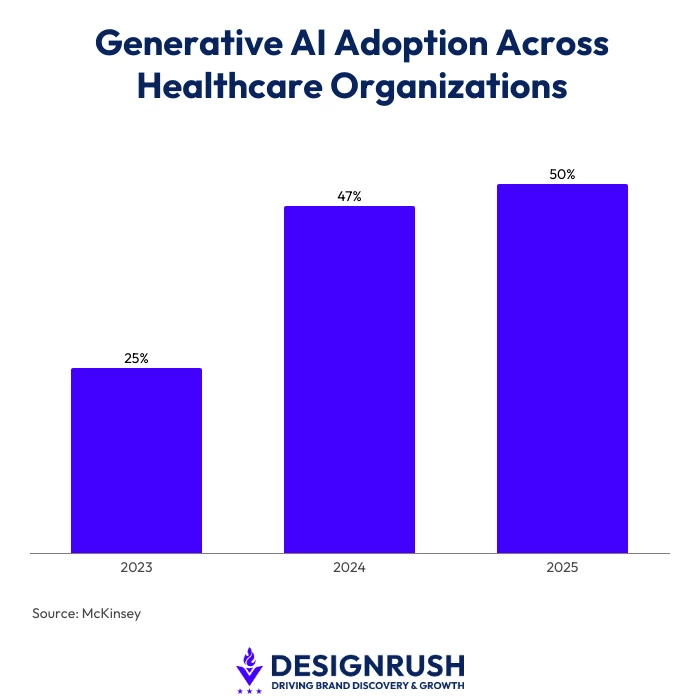
Many providers are already moving in that direction. McKinsey found that 50% of US healthcare organizations had implemented generative AI as of late 2025, up from 47% the year before and 25% in 2023.
Agentic AI adoption is still catching up. Right now, 19% of organizations have implemented it, while another 51% are running proofs of concept,
The adoption of AI also has another upside to it, where the tools can help improve communication, reduce administrative work, help keep patients engaged, and give clinicians more time to focus on care.
"The focus on AI adoption means that healthcare leaders who build adaptable digital foundations today will be able to respond far more quickly as AI continues to reshape the sector,” Singh Walia explains.
What Healthcare Leaders Should Do Next
AI works best when it's built into the patient experience from the start. As such, Singh Walia suggests that healthcare leaders should prioritize the following:
- Build patient experiences around conversations rather than transactions.
- Invest in scalable platforms that allow AI capabilities to evolve over time.
- Connect systems so patients experience one continuous digital journey instead of disconnected touchpoints.
- Treat privacy, transparency, and clinical oversight as competitive strengths rather than compliance requirements.
- Measure success by improvements in patient engagement and experience, not simply by feature adoption.
Even with all this in place, it's critical to remember that the organizations that stand out won't be those with the longest list of AI features.
They'll be the ones that remove friction, earn trust, and make every interaction easier for patients to navigate.
"Patients won't judge healthcare organizations by how advanced their AI is. They'll judge them by whether every interaction feels simpler, faster, and more personal,” Singh Walia says.
“And that's where lasting competitive advantage will come from.”