
Customer demand can change before a business has a revenue problem.
In fact, 42% of CEOs say their companies have entered new competitive sectors within the past five years.
This figure is based on PwC’s 2026 Global CEO Survey of 4,454 chief executives across 95 countries and territories.
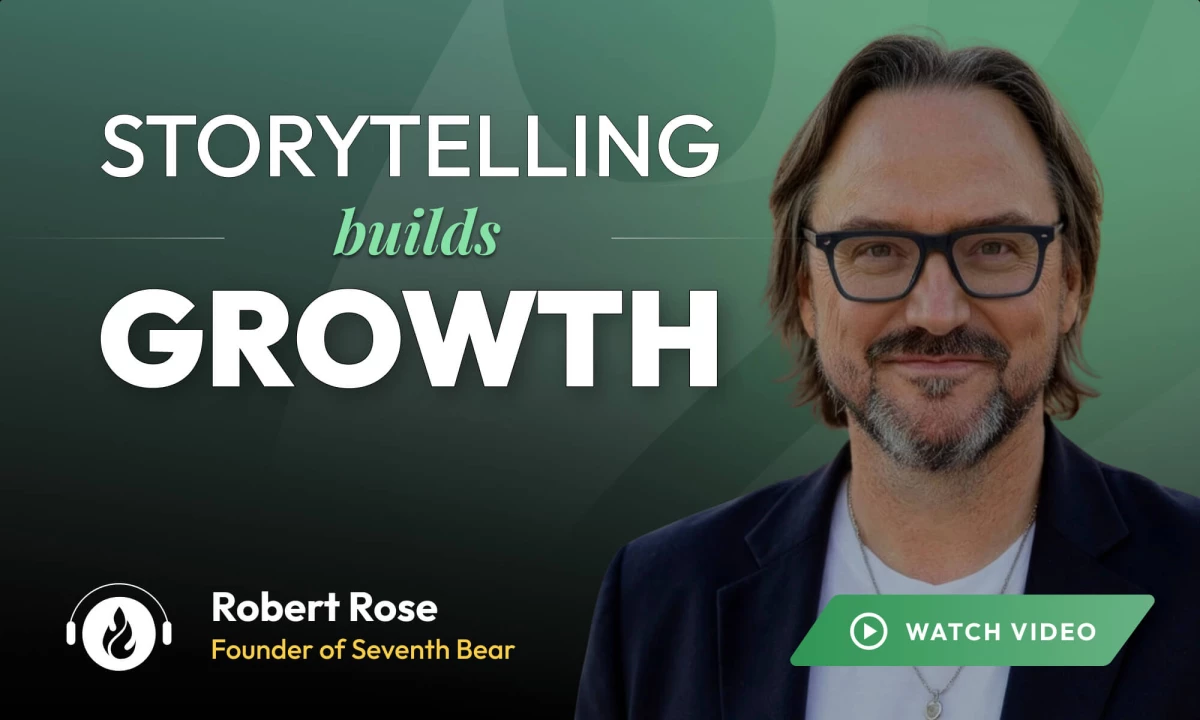
In the latest DesignRush Podcast, I spoke with Seventh Bear Founder Robert Rose about:
- Joining an early cloud software startup during the dot-com crash
- Hiring for hard-to-teach skills
- Hearing buyers reject the value his team expected them to care about
- Recognizing new demand before it became widely established
"I found that by diving into something new, in other words, not being afraid to actually change, like change everything about who I was going to be, it turned out to be the right move," Rose tells DesignRush.
Across his career, Rose has identified five decisions that founders can test inside their own companies:
- What deserves investment
- What to hire for
- Whether buyers value the advantage being sold
- When repeated customer behavior points to a new opportunity
- When the current model no longer has enough evidence behind it
Watch the full episode now on YouTube or listen on Spotify.

Who Is Robert Rose?
Robert Rose leads Seventh Bear, formerly The Content Advisory, and serves as Chief Strategy Advisor at the Content Marketing Institute.
He previously served as CMO at CrownPeak, an early cloud software company.
1. Use Your Strongest Skill to Guide Growth
Rose entered marketing without formal education in the field.
His background was in English literature, theater, and writing, where he had already spent years learning how stories work.
"I learned story structure. I learned the core elements and physics of telling stories, and was fairly well educated on that. And I think that was probably the biggest thing.
You know, all the rest of it, the triaging SEO and figuring out copywriting and lead generation was acquired skills.
The core foundational element was my ability to tell a good story."
Rose’s experience became commercially important when he joined CrownPeak, an early cloud software startup in the dot-com downturn.
At the time, he stepped into the CMO role, driving enterprise web content management.
The company had raised funding, but Rose admits he didn’t yet know how to run its marketing function.
"And they plop millions of dollars on my desk and say, marketing, go do some of that.
And I didn't really know what to do. So what I did was what I knew, which was storytelling."
The first step is identifying which strength the company already understands well enough to guide where the budget and people go next.
For Rose, storytelling provided that starting point.
2. Hire for Skills You Cannot Easily Teach
Once Rose knew what mattered most to the marketing function, he had to decide who should carry it.
He hired strategists, email writers, and creative people who could already tell strong stories, then taught them the technical work required for digital marketing.
"I could teach them pay-per-click marketing, I could teach them SEO, and I could teach all the things around digital and banner ads and aspect ratios.
What I couldn't teach them was how to be good storytellers."
Rose later compared the approach to a hiring philosophy he had heard attributed to UPS, the global package delivery company.
"They asked the CEO of UPS, 'How do you hire the best drivers for your trucks?' And they said, 'We don't.'
We hire the best customer service people, and we teach them how to drive. And it's that philosophy that has served me well."
For founders, the hiring test is to separate the skill someone needs on day one from the technical work the company can realistically teach after they arrive.
DesignRush has also examined how hiring and execution mistakes can hurt startup growth.
3. Test Product Positioning Against Buyer Priorities
The same company exposed another problem: a genuine product difference still has to influence the purchase decision.
CrownPeak was competing with Adobe, IBM, and Microsoft, and believed its multi-tenant cloud and SaaS architecture gave enterprises a strong reason to choose it.
Meanwhile, buyers cared more about price.
"We leaned in on this differentiation of saying, we're true cloud computing, we're true multi-tenant software, we're true software as a service.
All these other companies like Adobe and IBM and Microsoft, they're just installing software in their data centers and renting it to you. They're not true cloud computing.
And what audiences and our buyers said was, 'We don't care, right? They're offering it at a better price than you're offering it. So that's what we care about right now.'"
The team then focused on a problem that buyers already understood: implementation cost and commitment.
Rose says enterprise web content management could require hundreds of thousands of dollars, sometimes millions, in implementation.
CrownPeak could offer the software as a service that customers could rent and turn off.
Before putting more budget behind a product claim, founders should check whether that claim actually affects why customers buy.
DesignRush’s brand strategy guide examines how customer needs and positioning influence the way companies communicate value.
4. Use Customer Questions to Test New Demand
Rose’s next business opportunity started with something customers were already doing.
After reading "Get Content, Get Customers" by Joe Pulizzi, founder of the Content Marketing Institute, Rose sought him out at a conference.
Pulizzi was approaching content from publishing and media, while Rose was seeing similar behavior from the marketing side.
He later invited Rose to advise the Content Marketing Institute. Then, companies started asking how they could do the same work themselves.
"We're getting all these questions from people (who) are looking at our blog and looking at our content and saying, 'How do we do that? How do we do what you're doing?'"
Rose was also watching B2B buyers use search for education, companies gather audiences through social media, and brands invest in blogs, white papers, thought leadership, and lead magnets.
He left CrownPeak in 2009 and went independent during a severe economic downturn, working with Pulizzi as demand became a commercial opportunity.
Repeated customer questions can provide early evidence of demand.
The next test is whether the same problem appears often enough to support an offer customers will pay for.
DesignRush’s B2B content marketing guide examines how audience needs and the buyer journey affect content decisions.
5. Recheck the Business Model When Demand Falls
Years later, Rose faced the same type of commercial decision from a different angle.
The Content Advisory saw strong demand in 2021 and early 2022 as companies hired heavily and sought outside help with digital and eCommerce work.
Rose now calls that period a "false positive."
In 2023 and 2024, demand fell as firms such as Accenture and Deloitte began competing for work that had also gone to smaller independent providers.
"And so business dried up and at some point I had to say, I can continue to do this. This is going back to my Crown Peak days.
I can continue to do this and chase good money after bad, or I can pivot into what the real world is doing now."
Rose moved his focus toward mid-market and small-business clients, emphasizing creative marketing, storytelling, and content strategy.
A profitable year can hide demand that won’t last.
Founders still need to check whether customers, competition, and revenue continue to support the model they are funding.
That brings the discussion back to the 42% of CEOs entering new sectors.
Rose’s five decisions give founders a clear test:
- Invest around proven strengths
- Hire for hard-to-teach skills,
- Listen when buyers reject the sales story
- Act on repeated demand
- Reassess the model when market conditions no longer support it
When the evidence changes, the next business decision should change with it.