
Budweiser's 2026 FIFA World Cup Campaign: Key Findings
- A 40-year sponsorship milestone anchors the beer brand's global campaign tied to FIFA World Cup tournaments since 1986.
- "Budstalgia" features a limited-edition pack with 11 designs linked to World Cups from 1986 to 2026 with QR-enabled digital content and localized rewards.
- The push includes a global film and OOH series distributed across digital, social, and key international markets.
Budweiser is celebrating 40 years as an official FIFA World Cup sponsor with a global push built around its long-running visibility at the tournament.
The "Budstalgia" campaign, developed with Africa Creative, centers on a cinematic film, limited-edition packaging, and an OOH series linked to past tournaments.
The anniversary pack, created with branding agency JKR, includes 11 can and bottle designs, each referencing a specific World Cup from 1986 through 2026.
The beer brand has been sponsoring the World Cup since the mid-80s.
This is long enough that most fans won’t remember a tournament where it wasn’t there somewhere: on the sidelines, in ads, in the background.
"Budweiser has been part of the global story of the World Cup for 40 years, creating moments that fans carry with them long after the final whistle," Africa Creative Co-CCO Nicholas Bergantin told DesignRush.
"With this campaign, we wanted to capture that sense of 'Budstalgia,' celebrating the memories, rituals, and shared joy that connect generations of fans through the game."
The anniversary pack was designed with visual cues from each specific World Cup year, pulling from logos and color systems.
Some designs reference details that fans who have followed the game over time will recognize quickly.
Each design also includes a QR code that leads to a digital hub with content tied to the era on the bottle or can.
This includes team-related material and location-based prize mechanics.
What method was used to decide the USA ‘94 World Cup final?
— Budweiser Nigeria (@BudweiserNG) April 3, 2026
Drop your answer in the comments and use the hashtags: #Budstalgia#BudweiserXFWC26 for a chance to win exciting prizes. 🏆✨
T&Cs apply.
NB: You Must Be Following Across Platforms.#Budweiserpic.twitter.com/tlRuhyEZxz
The anniversary pack is rolling out this month across non-U.S. markets, including Brazil, China, and select European countries.
The release arrives ahead of the FIFA World Cup's expanded 2026 tournament, where more teams and matches will increase competition for attention.
Budweiser's campaign relies on brand recognition, using long-term visibility as the starting point for engagement.
Recognition Over Reinvention
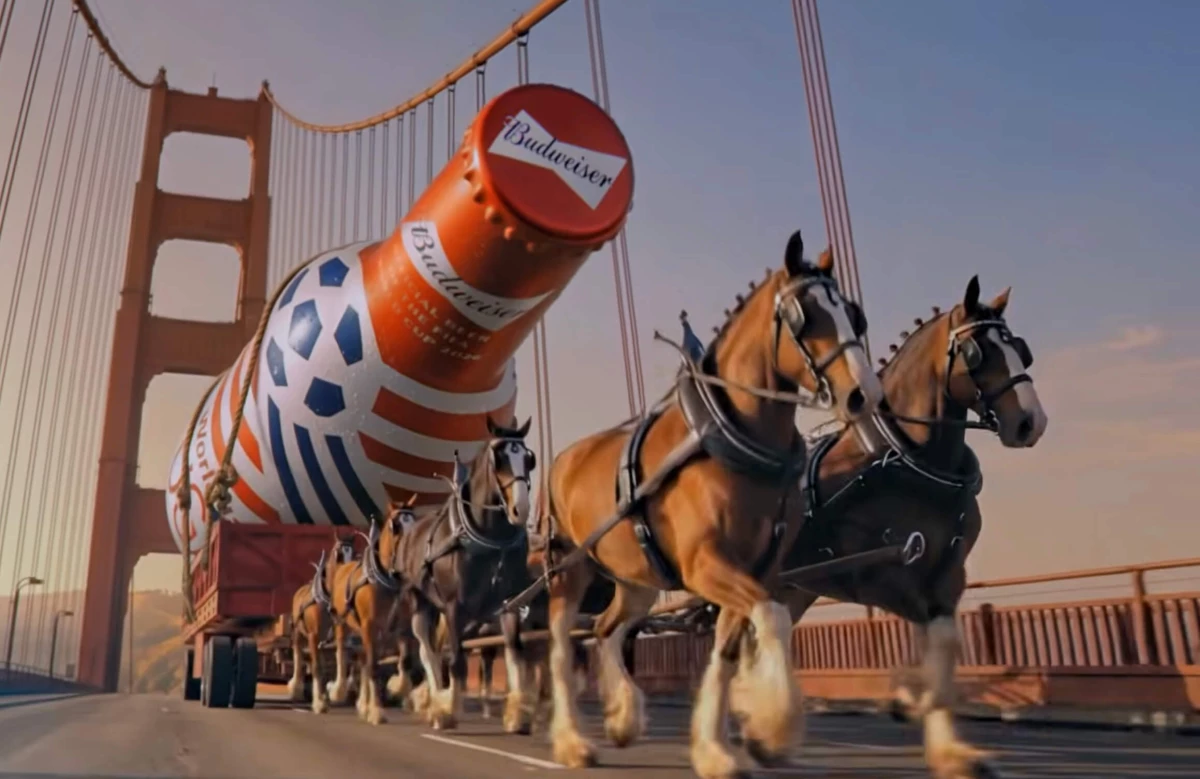
Central to "Budstalgia" is the hero film titled "The Big Drop," which opens with a slowed version of “You’ll Never Walk Alone.”
This sets the pace as oversized Budweiser bottles move across different terrains, from open fields and deserts to dense urban spaces, before arriving at World Cup stadiums.
Along the way, they’re carried by trucks, lifted by cable cars, pulled by horses, and even carried by hot air balloons, making the journey itself part of the story.
The cinematic visuals carry scale, while the soundtrack holds the emotional weight, allowing recognition to build without explanation.
Nostalgia marketing often works this way, using familiar cues to trigger quicker engagement.
And this especially works for Budweiser, because its long-term exposure in tournaments has already done most of the groundwork.
Making people realize how it has been present all these years is more effective than reinventing itself for the World Cup.
The film runs across digital and social channels, acting as the entry point for the wider rollout.
Everywhere All at Once
The film sets the tone, but the rollout doesn’t stay in one place for long.
It moves into outdoor placements tied to each World Cup year featured in the campaign.
The OOH series, "Proudly on the Pitch," uses archival FIFA imagery to place Budweiser signage back into historic match scenes.
These visuals appear across multiple markets, pulling from moments that fans have already seen in different forms over time.
The "Budstalgia" structure keeps people moving between touchpoints, from viewing to scanning to browsing.
This kind of setup works as a connected system, where each piece feeds into the next without needing to restart attention.
Recognition reduces the effort needed to engage and increases the chances of follow-through.
- Keep movement between touchpoints continuous. When people don’t have to restart, they stay within the campaign longer.
- Tie access points to immediate outcomes. When scanning or clicking leads somewhere clear, participation becomes easier to sustain.
- Use the same visual cues across formats. Familiar elements hold everything together as the campaign spreads across channels.
These steps allow campaigns to scale across markets while staying coherent, with each part reinforcing the next without introducing new friction.
Our Take: Can Nostalgia Carry the Campaign?
Nostalgia works when people actually remember the thing you’re referring to.
And we think it will work here as Budweiser brings past associations back into focus and makes them easy to engage with again.
The film, the outdoor placements, and the digital layer all pull from past tournaments, so the experience feels familiar without needing much setup.
Where it gets more complicated is scale.
We’re looking at a tournament that keeps expanding, with audiences who don’t all share the same history with the brand.
Nostalgia still carries weight, but it also depends on reach and repetition to land with people who are seeing this for the first time.
Looking to build campaigns that don’t rely on starting from scratch?
Explore DesignRush’s selection of the top brand strategy agencies to turn existing brand equity into something that still lands.