
Sports broadcasters are competing for attention with historic firsts connected to major soccer matches as the 2026 FIFA World Cup approaches.
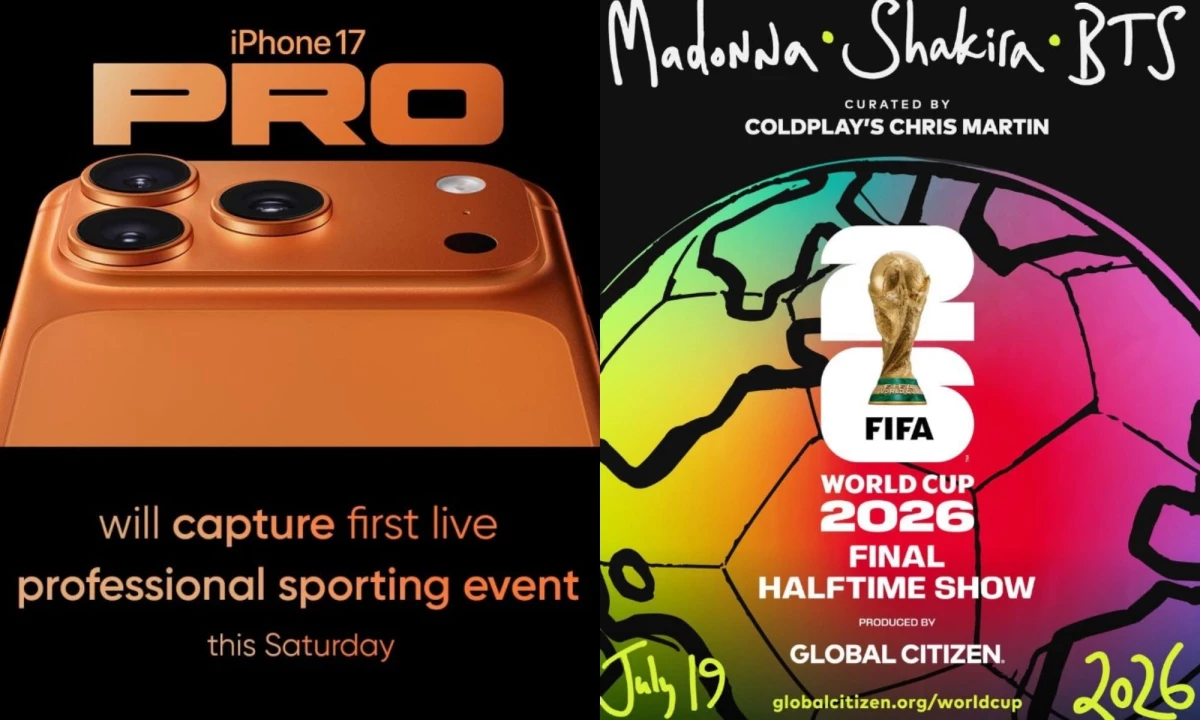
Apple TV will stream the first professional sports broadcast captured entirely on iPhone 17 Pro during this Saturday's MLS clash.
The streaming platform developed the production with MLS for the LA Galaxy vs. Houston Dynamo FC match at Dignity Health Sports Park in Carson, California.
Apple is positioning iPhone 17 Pro cameras throughout the stadium to capture everything from player entrances to in-net goal angles.
This comes after FIFA confirmed the first halftime show in World Cup finals history.
It partnered with Global Citizen and Live Nation to stage the production, headlined by Madonna, Shakira, and BTS at MetLife Stadium.
The collaboration also links the entertainment spectacle to a global education fundraising effort.
"[T]his historic show will also shine a light on a greater purpose by supporting the FIFA Global Citizen Education Fund and our shared mission to expand access to quality education and football opportunities for children worldwide.
It will be a celebration of football, unity and shared humanity that will resonate far beyond the final whistle," FIFA President Gianni Infantino said in a statement.
Apple wants to prove consumer hardware can power premium live production, while FIFA is borrowing the Super Bowl format to widen commercial and entertainment reach.
The World Cup gives both companies a rare moment to extend their brand awareness to a genuinely global audience.
The Tech and Music Takeover
Apple's MLS broadcast marks the company's most aggressive sports production test yet.
The tech giant first experimented with iPhone-shot sports footage during a 2025 "Friday Night Baseball" MLB game.
Apple said iPhone 17 Pro's compact design allows for camera angles that traditional broadcast equipment can't easily capture.
The production also strengthens its sports streaming ambitions after its MLS partnership and recent Formula 1 rights deal.
FIFA is pursuing a parallel strategy from the entertainment side.
The World Cup halftime show, curated by Chris Martin, positions football's biggest global event alongside large-scale American sports productions.
The philanthropic angle adds commercial weight to the spectacle, giving the halftime show a purpose that outlasts the event itself.
This gives FIFA a way to grow its audience and brand equity simultaneously.
Data, Reach, and Revenue Stakes
The announcements highlight how sports companies are expanding revenue opportunities around live events.
Apple TV streams MLS coverage in more than 100 countries, using live sports as a global subscriber acquisition tool.
Similarly, FIFA aims to raise $100 million for CSR programs through its education fund, including $1 from every World Cup 2026 ticket sold.
Global Citizen said its programs have impacted nearly 1.3 billion people worldwide.
Live events are now generating subscription growth, sponsorship value, and philanthropic capital simultaneously, opening more entry points for brands and agencies.
Entertainment partnerships tied to measurable causes help large-scale events sustain attention.
- Familiar formats create faster adoption. Media companies should attach new technology to established viewing habits to reduce friction.
- Entertainment lineups expand reach. Sports brands should collaborate with global music and cultural figures to attract casual viewers.
- Social impact strengthens event positioning. Organizations should connect major events to impactful causes to sustain interest after the final whistle.
When sports broadcasts combine technology, entertainment, and philanthropy, the event becomes only one part of the product.
The numbers behind the World Cup tell a more complicated story, though.
Infantino called the tournament the equivalent of 104 Super Bowls, but nearly 80% of hoteliers across U.S. host cities report bookings are tracking well below expectations.
FIFA room block cancellations, visa barriers, and rising costs are cited as the main reasons.
The gap between the scale FIFA projected and the demand that materialized shows that brand storytelling and ground-level execution are two different problems.
Our Take: Can Sports Keep Selling Firsts?
Yes, if the execution feels meaningful beyond the headline, and we think that the World Cup is already testing it.
Infantino's 104 Super Bowls framing was a brand story, but the hotel data is the reality check.
Long term, the brands and leagues that win this format are the ones that close the gap between the narrative they sell and the experience they deliver.
We think that Apple's path is cleaner because the iPhone broadcast is a product proof point with a measurable outcome.
FIFA's approach is harder because the spectacle is only as credible as the commercial reality surrounding it.
Selling the world's biggest stage is easy. Filling it is the real work.
Brands exploring sports entertainment partnerships may need agencies that specialize in live production and audience strategy.
Browse these Top Sports Marketing Agencies in our directory.