
Amazon's AgentCore: Key Findings
- AWS introduced AgentCore, a new platform for deploying enterprise AI agents with security in mind.
- AgentCore components like Memory, Runtime, and Gateway support secure, large-scale AI agent operations.
- AI Agents and Tools Marketplace enables faster adoption of agentic AI with prebuilt, enterprise-grade options.
Quick listen: AWS just made enterprise AI agents easier to scale — here’s how, in under 2 minutes.
AWS wants to power the future of agentic AI, and it’s building the rails to do it.
At the AWS Summit New York last week, Amazon Web Services introduced “AgentCore,” a modular suite of services designed to help businesses deploy and operate AI agents securely at scale.
With new tools spanning from memory infrastructure to runtime environments, AWS is targeting the core pain points developers face when moving from AI proof-of-concepts to production-ready systems.
Swami Sivasubramanian, AWS VP of Agentic AI, emphasized the stakes in his keynote.
"It’s a tectonic change in a few dimensions,” he said.
“It upends the way software is built. It also introduces a host of new challenges to deploying and operating it, and potentially most impactfully, it changes how software interacts with the world — and how we interact with software.”
AgentCore is AWS’s answer to the challenge of scaling autonomous software agents built on foundation models.
These agents, powered by frameworks like LangGraph, CrewAI, and LlamaIndex, require complex infrastructure that’s often outside the typical dev team’s wheelhouse.
AgentCore offers an integrated alternative.
Among the first customers to test the platform are Itaú Unibanco, Box, Boomi, and Epsilon, signaling early traction among large enterprises with real-world agent use cases.
AWS also reaffirmed its long-term bet on agentic AI with an additional $100 million investment in its Generative AI Innovation Center.
This center supports companies like BMW, Warner Bros. Discovery Sports, and AstraZeneca in their AI transformation efforts.
Inside the AgentCore Stack and What’s Coming Next
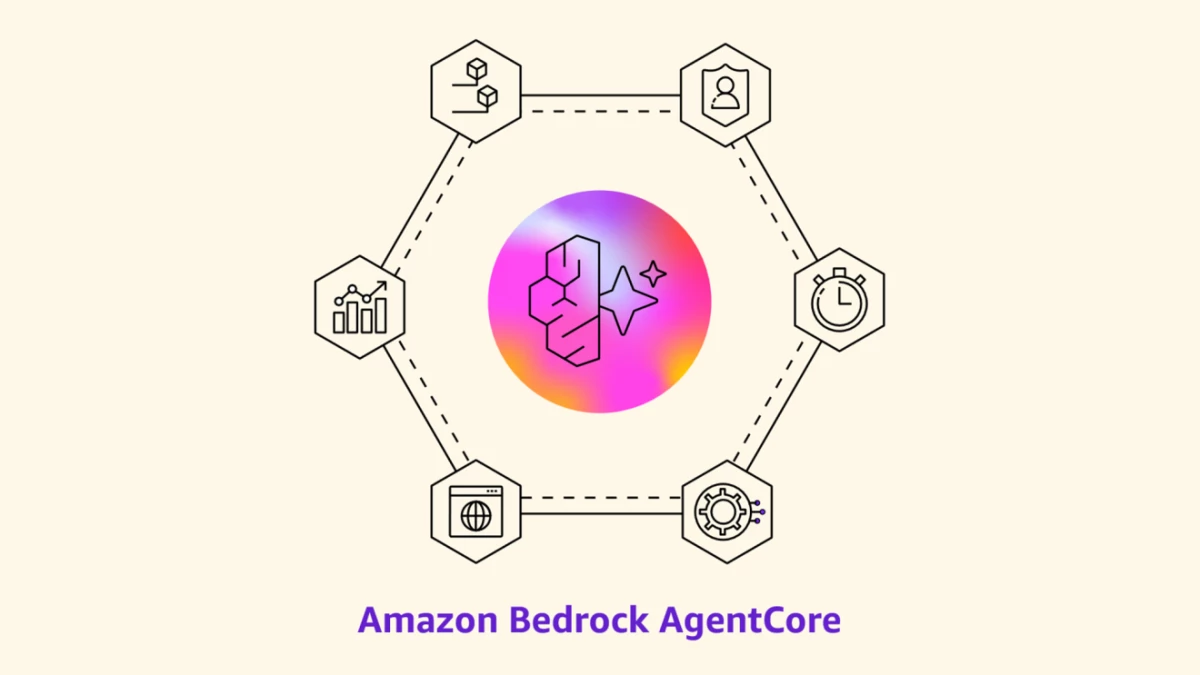
At the heart of the announcement is the suite of AgentCore services:
AgentCore Runtime supports both synchronous and asynchronous workloads with up to eight hours of operation time, industry-best session isolation, and low latency.
AgentCore Memory gives agents long- and short-term memory, enabling context-aware interactions.
AgentCore Identity integrates seamlessly with platforms like Amazon Cognito, Microsoft Entra ID, and Okta to help agents securely authenticate and access resources.
AgentCore Gateway lets developers turn APIs, AWS Lambda functions, and third-party tools into agent-compatible components.
AgentCore Code Interpreter allows agents to safely execute code in sandboxed environments tailored to enterprise security.
AgentCore Browser enables agents to navigate websites or fill forms at scale using a secure, model-agnostic browser.
AgentCore Observability integrates with Amazon CloudWatch, offering full telemetry and dashboards to trace agent actions in production.
AI Agents and Tools, a new Marketplace category, further accelerates adoption by letting customers find, buy, and deploy agent-ready tools and services in one place.
Using just a few lines of code with AgentCore Gateway, devs can link their agents to external APIs or third-party services while maintaining governance and compliance.
AWS says that the AgentCore SDK supports developers looking to integrate individual components into their own tech stacks, including open source frameworks.
The flexibility aims to reduce infrastructure overhead so teams can focus on shipping real features, not building plumbing.
Our Take: Is AWS Quietly Owning Agentic AI?
While many tech companies are still exploring how to incorporate AI tools, AWS has gone all-in on infrastructure.
AgentCore is less about novelty and more about solving real operational problems like observability, memory, and authentication that can bottleneck production AI systems.
Personally, I think it positions AWS as the go-to for serious AI builds.
This isn’t flash but function. And in enterprise AI, that’s what scales.
In other news, Wix recently launched its AI Overview Visibility tool to show how brands appear in AI-generated responses across platforms.