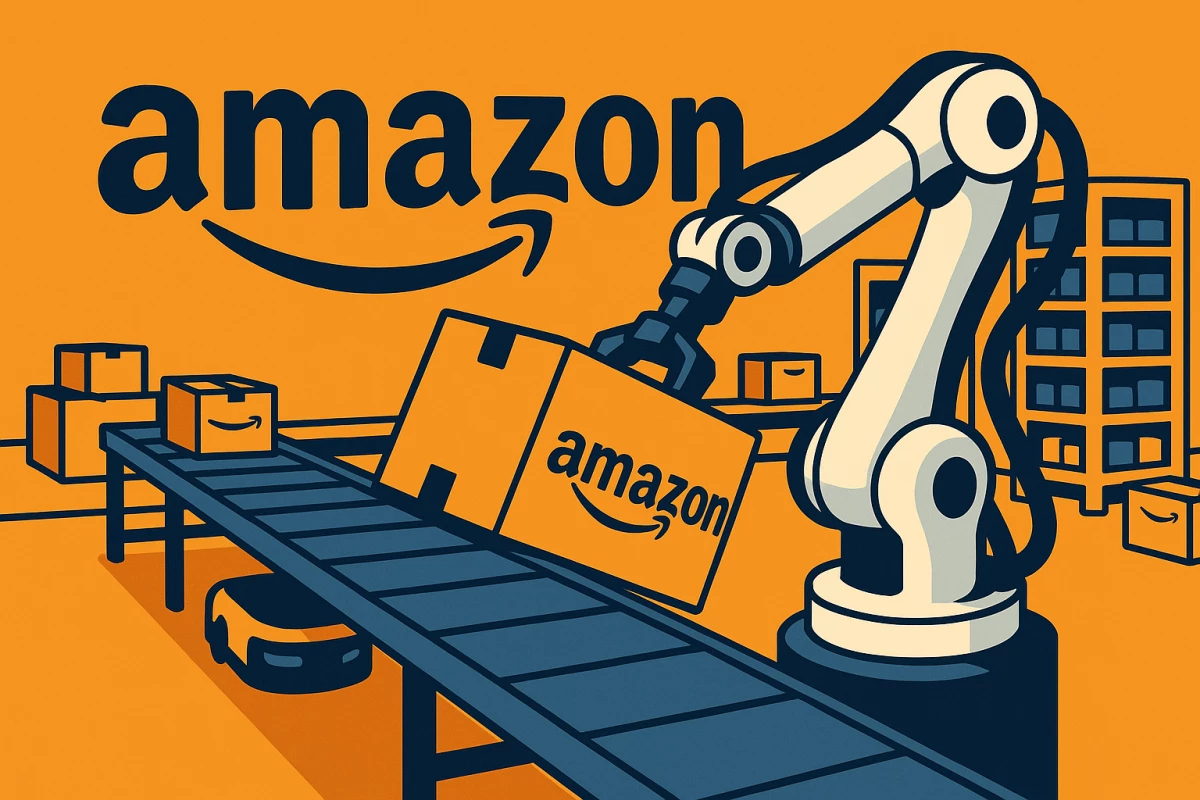

Amazon's Robotic Future: Key Findings
- Amazon’s automation plan will replace 600,000 roles while doubling output, showing how efficiency now outweighs workforce expansion in logistics.
- The company is rebranding automation as “advanced technology” and adding technician training, signaling that innovation must evolve alongside human skill.
- This move could speed up robotics adoption across e-commerce, proving that progress in one company can reset expectations for an entire industry.
Amazon is quietly preparing for one of the most sweeping workforce transformations in corporate history.
Internal documents obtained and reported by The New York Times show that Amazon will be replacing more than half a million human jobs with robots.
It details the e-commerce giant's plans to automate 75% of the company’s operations by 2033, potentially displacing 600,000 workers.
Amazon, the nation’s second-largest private employer, is reportedly planning to replace more than 600,000 jobs with robots, in what could be one of the largest workplace automations in U.S. history. @SamChampion has the details. pic.twitter.com/6B24Sh1hDY
— Good Morning America (@GMA) October 22, 2025
All in hopes of doubling product sales without significantly expanding its U.S. workforce.
Executives estimate the company could save roughly 30 cents on every item picked, packed, and shipped by relying more heavily on robotics.
“That you have efficiency in one part of the business doesn’t tell the whole story for the total impact it might have,” said Udit Madan, Amazon’s head of worldwide operations.
Amazon, which already employs 1.5 million workers, said it isn’t cutting jobs but expects to avoid hiring new ones as automation expands.
“No company has created more jobs in America over the past decade than Amazon,” a spokesperson told CNET, noting plans to hire 250,000 seasonal workers this year.
Building Warehouses Without People
At Amazon’s newest robotic warehouse in Shreveport, Louisiana, over 1,000 robots already handle most of the heavy lifting, allowing the site to operate with a quarter fewer workers.
The design will be replicated in 40 more facilities by 2027, including Virginia Beach and Atlanta’s Stone Mountain hub.
Both are intended as prototypes for near-humanless fulfillment.
Behind the scenes, executives have reportedly advised teams to avoid using words like “automation” or “AI,” preferring softer terms like “advanced technology” and “cobots” to signal collaboration rather than replacement.
Internally, Amazon has also discussed boosting its “good corporate citizen” image through local events and charity drives to offset backlash from displaced communities.
The company currently runs more than one million robots worldwide and has invested heavily in technician training.
Over 5,000 employees have completed its mechatronics apprenticeship since 2019, and technicians at the Shreveport site earn an average of $24.45 per hour.
MIT economist and Nobel laureate Daron Acemoglu said Amazon’s automation could have ripple effects across the labor market.
“Once they work out how to do this profitably, it will spread to others too,” he said.
What Amazon’s Automation Means for the Industry
Amazon’s aggressive move toward robotics and AI tools is a drastic change in how large-scale operations will function across industries. Here's what this move might mean:
- Automation will increasingly target hiring freezes rather than layoffs, changing how companies talk about workforce reduction.
- The next competitive edge will come from how fast supply chains can adapt to a hybrid human–machine model.
- Companies that manage transparency and can manage to explain why automation benefits both workers and consumers will face less backlash.
Walmart is already adapting in similar ways, using AI-powered logistics with retraining programs to avoid losing public trust.
Amazon’s scale, however, could set the tone for how every major employer approaches automation in the decade ahead.
It feels like the start of a new labor narrative, one where efficiency, ethics, and public trust have to evolve together.
Our Take: What Happens When Machines Take Over?
Watching Amazon’s transformation feels like standing at the edge of an old factory as the lights flicker off for the last time.
I get that efficiency wins, but something is unsettling about a future where the rhythm of human labor is replaced by the hum of precision machines.
However, the company knows better than to let this fear linger among consumers.
Amazon is already shaping how the public sees this shift, framing robots not as replacements but as partners in progress.
It’s a deliberate move to make automation feel beneficial, at a time when people are scared of the inevitable.
But is it working? Only time will tell.
In other news, Channel 4's recent "Dispatches" episode featured Britain's first-ever AI reporter, confusing viewers and sparking debate over AI use in journalism.