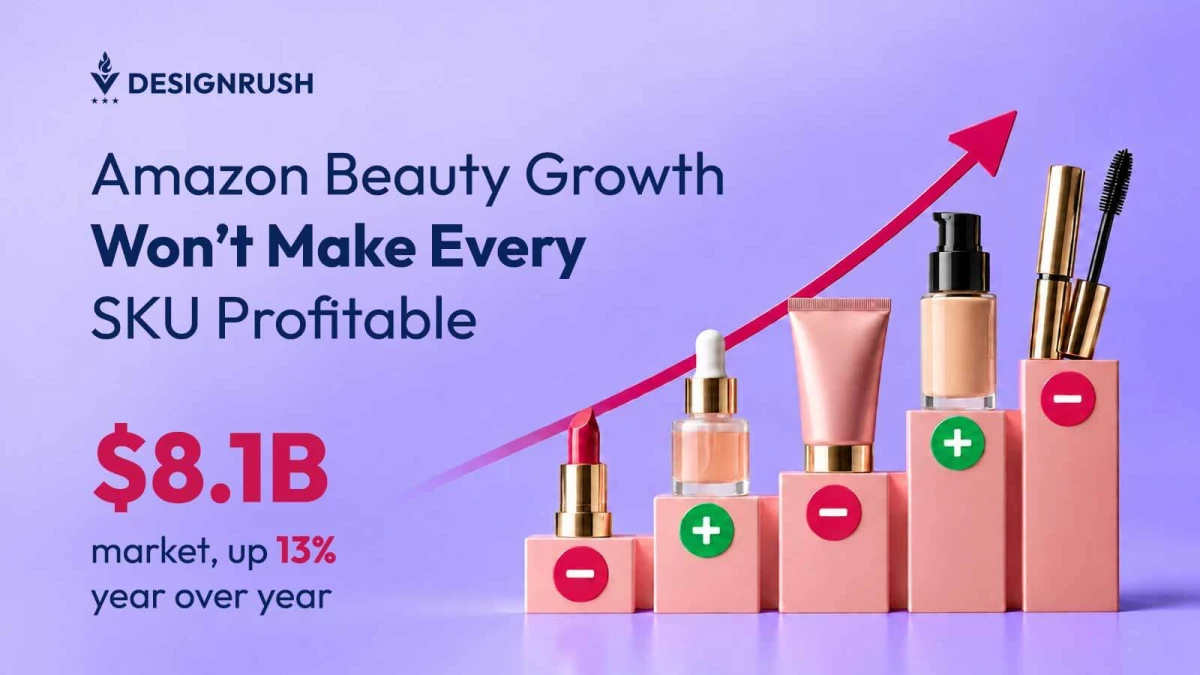

Amazon’s beauty category generated $8.1 billion in Q1 2026, up 13% from a year earlier, according to Front Row’s May 2026 report.
That growth is putting more money in play for brands, while the same Amazon search results increasingly contain established beauty companies, DTC brands, K-beauty labels, international sellers, and specialist brands.
For a brand trying to gain share, the first question is where to put its money.
Creating a bigger catalog, more advertising, or more aggressive keyword bidding can all increase activity
But doing all that doesn’t automatically improve the economics of the business.
How can beauty brands gain market share on Amazon?
Alex Stoykov, CEO of Olifant Digital, argues that the first decision is where to compete.
“Product selection determines where a brand spends, which SKUs get the most support, and how difficult it’ll be to earn visibility.”
Skin care accounted for 34% of Amazon’s beauty market in Q1, with sales reaching $2.7 billion after 18% year-to-date growth, according to Front Row.
Sets and kits also rose 37%, while some narrower segments grew even faster.
Those figures show where demand is moving, but they don't tell a brand which products deserve more investment.
Five percent annual growth would take the global beauty market to $590 billion by 2030, McKinsey reported in June 2026.
The report also found that new entrants and products from adjacent categories are gaining ground against established players, while eCommerce is expected to generate the largest share of beauty sales growth through 2030.
“For Amazon sellers, that makes product selection an early business decision, before advertising enters the picture,” Alex Stoykov says.
“A broad catalog can spread inventory, ad spend, creative resources, and management time across too many products.
“A tighter assortment gives a brand more room to support products with stronger demand and a clearer reason to buy.”
Onsen Secret shows what that can look like when the problem is profitability rather than a lack of traffic.
The Japanese-inspired skincare brand had steady traffic and healthy conversion, but efforts to push revenue higher were putting pressure on profitability.
Olifant moved reporting from ACoS to TACoS, focused PPC spending on proven converters, and worked on product listings before pushing harder into competitive keywords.
Onsen Secret added $95,934 in monthly Amazon revenue and tripled profit.
New product launches reached top-seller status in the U.S., Canada, Europe, and Japan.
The results came from changes across product selection, listings, advertising, and account performance, rather than from simply spending more on ads.
How should beauty brands strengthen Amazon listings and performance?
Seventy-five percent of consumers had abandoned a shopping basket in the previous three months because they felt bombarded by content, overwhelmed by choice, and frustrated by the effort required to make decisions, according to Accenture’s June 2024 report.
On Amazon, where products sit side by side, a listing has to answer basic questions:
- What is it?
- Who is it for?
- Why should it be trusted?
- What does the shopper get for the price?
For Onsen Secret, Olifant Digital rewrote listing content, tested the hero image, title, bullet points, and A+ content, then kept winning variations live.
It also concentrated paid spend on products already showing conversion strength.
“A strong product page can only do so much if the economics underneath it are weak,” Alex Stoykov says.
“More clicks can create more chances to lose a sale when a listing leaves shopper questions unanswered or fails to justify the price.”
Deloitte’s 2026 Global Consumer Products Industry Outlook found that 79% of surveyed consumer-products executives expect power to shift toward retailers, while 65% anticipate greater private-label competition.
The survey covered 300 senior executives across food and beverage, household goods, and beauty and personal care companies.
Amazon also gives brands detailed data on what shoppers search, compare, click, and buy.
Paid traffic, organic sales, conversion, product-level profitability, and inventory all affect the picture.
Olifant reports that moving from ACoS to TACoS exposed where Onsen Secret’s growth spending was eating into profitability.
After concentrating budget on high-converting ASINs and improving listings before expanding paid traffic, the brand’s organic rankings rose alongside its paid performance.
What should business leaders watch on Amazon?
The $8.1 billion market creates room for growth, but profitability depends on which SKUs get inventory, advertising spend, and listing support.
Business leaders should keep a close eye on:
- SKU economics: Which products generate revenue with healthy margins, and which ones consume ad spend without enough return?
- Assortment size: Which SKUs deserve continued inventory, creative, and advertising support?
- Conversion by product: Are higher rankings producing sales, or just more expensive traffic?
- Organic versus paid sales: Is advertising supporting stronger organic demand, or carrying products that struggle without it?
- Listing performance: Are product pages answering the questions that stop shoppers from buying?
- Inventory pressure: Can the business keep its strongest products in stock when demand rises?
- Competitive movement: Are private labels, new entrants, or adjacent categories taking attention from established products?
That gives leadership a clearer way to read Amazon performance.
Revenue growth can hide weak margins, expensive traffic, excess inventory, or a catalog full of products that don't deserve continued support.
The real task is deciding where the next dollar of inventory, advertising, and attention should go.
Amazon may keep getting bigger, but that doesn't mean every SKU will grow with it.