
Every product catalog I've worked on has been a little bit broken.
That's not a criticism of anyone. It's just what happens over time.
Descriptions get written by someone who left three years ago. Categories get guessed at during a platform migration.
Specs get copied out of a manufacturer PDF and never looked at again. If you sell a few thousand things, some share of what you've told the internet about them is wrong or missing right now.
For twenty years that was fine. A shopper who couldn't find a spec would email you, or squint at the photo, or buy it anyway. The gaps cost you a bit of conversion rate and nobody lost sleep over it.
But in our experience at ForeFront Web, that's the part that's changing.
Shopify examines how agentic storefronts are making products discoverable and purchasable directly through AI platforms:
Google Merchant Center Can Miss Your Product Data
An industrial equipment distributor we work with has thousands of product reviews. Real ones, from real customers, collected over years and sitting right there on the product pages.
As far as Google was concerned, they had none.
The reviews were never connected to Merchant Center as a product review source, which is a separate feed from seller ratings and doesn't sync on its own.
So the star ratings that should have shown up beside their Shopping listings never did, and Google marked those listings ineligible for them.
Nobody made a mistake here. The reviews are real, the products are good, and the store is run by people who know what they're doing.
The information just wasn't anywhere a machine could go find it.
Google Ads explains how product data reaches Merchant Center and how merchants can identify information that needs attention:
AI Shopping Agents Read Product Data First
That used to be a footnote. It isn't anymore, because more and more of the buying starts with software instead of a person.
When an AI agent shops for someone, it doesn't open your product page. It never sees your photography or your brand story or the comparison chart your team spent three weeks on.
It reads your data, matches it against what the shopper asked for, and comes back with three or four options. If your data can't answer the question, you're not one of them.
Google announced the Universal Commerce Protocol at NRF in January, built with Etsy, Target, Walmart, Salesforce and Shopify. OpenAI shipped its own version a few months before that.
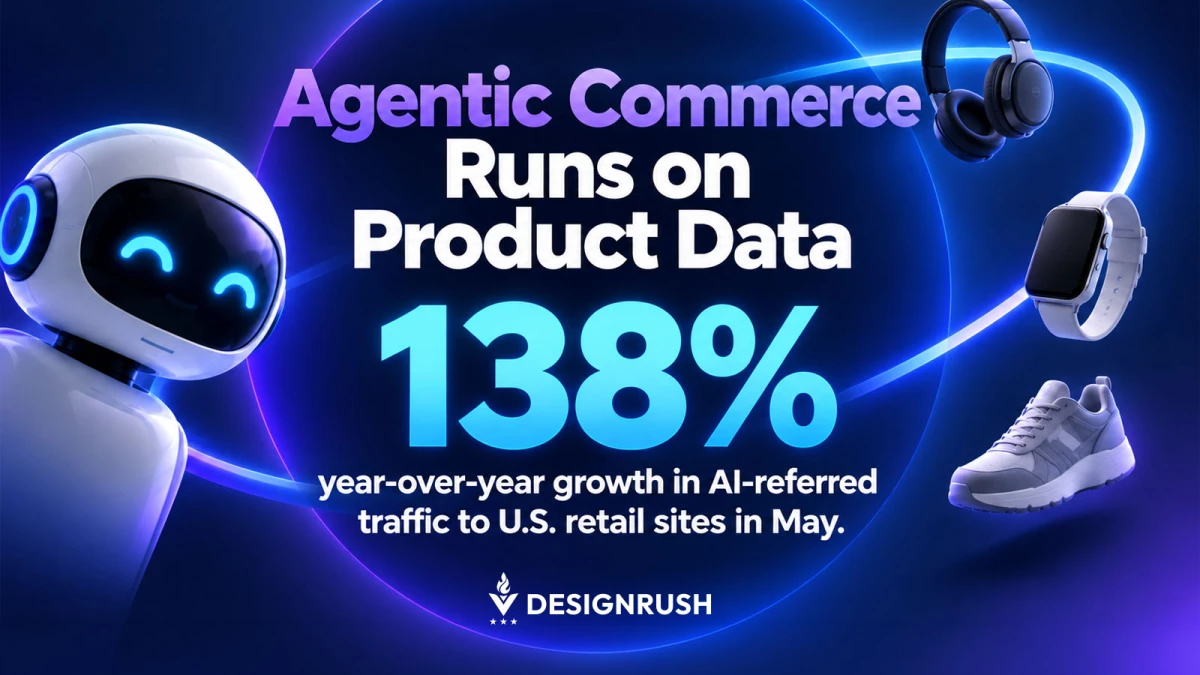
Shopify now handles most of the plumbing for its merchants automatically. And people are actually using it. Adobe, which tracks over a trillion visits to U.S. retail sites, found AI-referred traffic to retail up 138% year over year this past May.
So the old math has flipped. Bad product data used to cost you some conversions. Now it can cost you the chance to be considered at all.
Google Cloud shows how AI shopping agents can connect directly with product catalogs, inventory, and checkout systems through the Universal Commerce Protocol:
Merchant Center Errors Can Hide in Product Feeds
Most marketing problems tell you they exist. Conversion rate drops, cost per lead climbs, somebody notices a chart pointing the wrong way and asks about it in a meeting.
This one is silent. You just don't show up, and there's no notification for not showing up.
Take that same distributor. Google crawls their site daily and pulls their Shopify feed daily, at different times, then compares the two. Any mismatch between what the feed says and what the page says gets the item disapproved.
With several thousand products and prices moving constantly, something is always disapproved. It's not an incident anybody escalates. It's just another Tuesday.
They had a stranger version of it too.
One of their best paid products was running on a product ID that no longer existed in Merchant Center, left over from a listing that got replaced during a cleanup.
Budget kept spending. Conversions kept landing against an ID that pointed at nothing. It only turned up because somebody sat down and reconciled two exports by hand.
Now picture that across a dozen manufacturers, each sending data in its own format to its own standard, loaded in bulk.
One sends dimensions in inches. Another buries them in a text field. Somebody runs a CSV import at four on a Friday.
Google Ads shows how Merchant Center product issues can lead to disapprovals and where merchants can identify problems affecting product visibility:
Product Data Needs a Clear Owner
Ask a marketing team who's responsible for product attribute completeness and you'll usually get a pause.
Merchandising handles assortment. Operations handles inventory. Purchasing owns the manufacturer relationships and takes whatever data shows up with them. Marketing has the site and the campaigns.
Product data falls in the space between all of them, so it never becomes anyone's number in a quarterly review.
I think that's why good teams are exposed here.
And it's not a skills problem. Any decent eCommerce team can fill in GTINs and clean up category mappings. It's that no one has been told to.
The fix is boring.
Check your feed against Merchant Center's required attributes. Count how many SKUs are missing GTINs, how many have categories that got auto-guessed on import, and how many have descriptions written for a person skimming rather than a system reading.
Reconcile your product IDs everywhere they appear. Then put someone's name on keeping it that way, because a one-time cleanup on a catalog that changes every week gets you about a week.
Google Ads explains how primary and supplemental data sources and feed rules can be managed across complex Merchant Center inventories:
Product Data Is the Agentic Commerce Advantage
I'm not arguing that creative stopped mattering. It didn't.
Brand might matter more than ever, because when an agent narrows a category down to three choices, being a name the shopper already recognizes is worth a lot.
But all of that now sits behind a question that didn't exist five years ago, which is whether a machine can read your catalog well enough to put you on the list.
There's something a little funny about where this ended up.
After a decade of eCommerce competing on design and storytelling and experience, a real chunk of the advantage is going to whoever is willing to open a spreadsheet and fill in the blanks.
Plenty of brands will decide that's beneath them. That's the opportunity.