
The paid versus organic argument is one of the oldest in digital marketing, and it never resolves, because both sides are right.
The SEO people point out that paid traffic stops the day you stop paying. The paid people point out that SEO takes a year to show up and you have a number to hit this quarter.
Everybody nods. Somebody makes a slide with two columns on it. We settle on a split that feels defensible, revisit it next quarter, and nudge it a few points toward whatever the last report made look good.
I've been in some version of that meeting for eight years. I don't think it's a real question anymore.
Google Search Central explains how websites can appear in AI features in Search and what those experiences mean for SEO:
One Number Changed How I Think About This
Seer Interactive published a study in April looking at what AI Overviews are doing to click-through rates.
It's a big dataset, with 53 brands, 5.47 million queries, more than two billion organic impressions and nearly 300 million paid ones, tracked over fourteen months.
There's a table near the bottom of it that I keep coming back to.
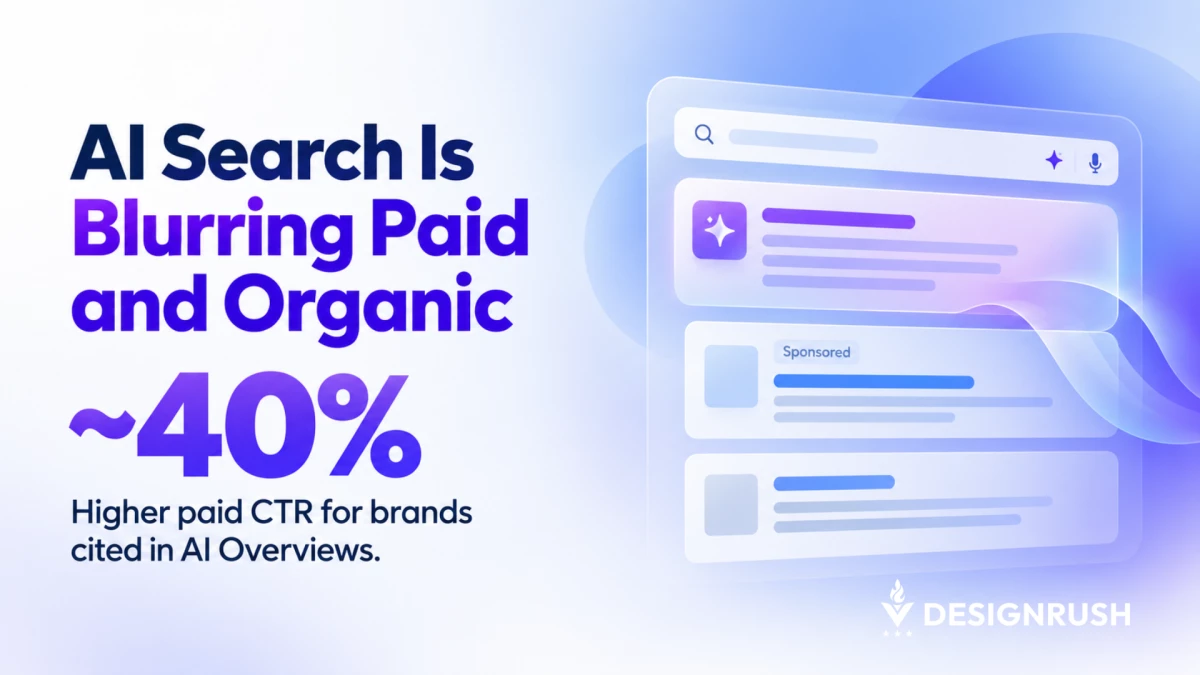
On informational searches where an AI Overview showed up, brands cited inside that AI Overview averaged 15.74% paid click-through rate.
Brands that weren't cited averaged 11.19%. Same search, same auction, same ads.
Your organic citation status is now affecting your paid performance. Whether Google's AI decided to reference your content moves your ad click-through rate by about 40%, and Seer found that gap held every single month of 2025.
Sit with what that means for a budget decision.
A team decides content isn't paying off fast enough, cuts it, and moves the money into ads. Under the old model that's a reasonable trade.
Under this one, the cut quietly degrades the performance of the thing they just bought more of.
Nothing in a standard reporting setup would show them that.
Google outlines how AI is changing Search and bringing advertising into new AI-powered discovery experiences:
The Two Channels Aren't Behaving Like Two Channels
The rest of the study is strange in the same direction.
Paid click-through rates went up on searches with an AI Overview over that window, and down on searches without one.
Organic did the reverse, dropping hard on AI Overview searches before recovering somewhat this year, while improving steadily on searches with no AI Overview at all.
So on one results page, the same query can be squeezing your organic and stabilizing your paid at the same time. And the thing driving both is a citation nobody is buying.
The surfaces themselves keep blending too.
AI Mode passed a billion monthly users, and in May Google started putting sponsored listings inside AI Mode's generated answers, dropped into the middle of the response next to the organic recommendations.
If you're running Performance Max or AI Max, you're already showing up in AI Mode whether you chose to or not.
Google's own product direction says the same thing.
They're folding Meridian, their marketing mix model, into Analytics 360 and adding a metric designed to credit upper-funnel work that today's attribution misses.
When the platform starts building marketing mix modeling into the analytics suite, that's a fairly loud hint about last-click.
Google Analytics introduces Meridian, its marketing mix modeling framework for measuring the effects of marketing investments across channels:
The Split Is an Org Chart, Not a Strategy
This is the hard part, and I'll be honest that we haven't fully solved it on our end either.
Paid and organic were never really separate strategies. They're separate teams, separate budgets, separate reports, sometimes separate agencies.
That setup made sense when the two things ran independently. Taking it apart is a lot harder than telling people to think holistically, which is where most articles about this stop.
Start smaller. Take the twenty or thirty searches that actually drive your business and build one view of them. AI Overview presence, citation status, organic position, paid impression share, blended cost per acquisition, all on the same page.
That usually turns up something awkward within a day.
You'll find searches where you're paying to compete on a page your own content is already cited on, which is sometimes smart and sometimes just expensive.
You'll find others where you're neither cited nor bidding, and a competitor is quietly getting both.
It also helps to know how exposed you actually are.
Seer found AI Overviews on roughly a third of informational searches but only about one in twenty transactional ones. Comparison searches trigger one 95% of the time.
If your organic program is built on how-to guides and versus pages, that's the deep end. If you're mostly transactional, you have more room than the headlines make it sound like.
Google Analytics shows how marketers can verify that data is being collected correctly before relying on it for reporting and analysis:
Make Sure Your Numbers Are Real First
One warning before anybody rebuilds their reporting around all this.
A few months back I was putting together a quarterly deck for a nonprofit client and the paid search spend looked low to me.
I pulled the numbers straight from the API instead of the report template. Actual spend was more than four times what we'd been showing.
The figure had been built off a subset of campaigns at some point, and the account had grown to around twenty campaigns across seven states since then. Nobody caught it because it looked about right.
That's an uncomfortable thing to put in print. I'm including it because I doubt we're unusual.
Most teams have a number like that somewhere, and a blended measurement model sitting on top of bad inputs is worse than a simple one.
So fix the inputs. Then ask a better question than how to divide the budget, because that was never really the question.
The question is which searches matter to your business, whether you're showing up on them, and what mix of earned and paid presence gets you the result you want.
That one doesn't fit neatly in two columns. It's also the only one the search results are still answering.