
Every time search marketing evolves, we see a familiar pattern.
At first, we rush to create as much content as possible using the latest tools. But soon after, we pause to reflect and ask a key question.
How is all this effort truly helping our business?
Today, we're at that important moment for AI search.
Over the past two years, many brands have concentrated on producing more content, updating their websites for new answer engines, and discussing the future of SEO in an AI-driven world.
While much attention has focused on being recognized by platforms like ChatGPT, Perplexity, or Google AI Overviews, a more important change is happening that we should not overlook.
The real, lasting advantage in AI Search is learning how to measure their impact effectively.
Why Traditional Search Metrics Just Broke
Traditional SEO gave us a comfortable, deterministic feedback loop. You targeted a keyword, tracked your rank on a scale of 1 to 100, measured organic sessions in Google Analytics, and calculated conversions.
It was linear, predictable, and easy to explain in a monthly slide deck.
But AI search completely dismantled that loop for three core reasons:
- Zero-Click Interception: AI answer engines do not simply point users toward answers. They synthesize the answer directly on the screen. A user can get full value from your brand's data without ever visiting your website.
- Nondeterministic Results: Unlike a standard Google search page that looks largely identical for users in the same location, an LLM generates answers dynamically. Two people typing similar prompts might receive entirely different sources, citations, and product recommendations.
- Multi-Dimensional Discovery: Modern discovery no longer happens on a single surface or through a single crawler. As such, visibility now spans both the Experience Dimension (human interactions) and the AI Dimension (machine interactions).
As outlined in Boostability’s Be Found Framework (BFF), winning your share of search now requires you to measure performance across four distinct pillars:
- SEO (Search Engine Optimization): Ensuring traditional crawlers discover and index your assets.
- GEO (Generative Engine Optimization): Getting cited and synthesized inside LLMs and answer engines.
- SXO (Search Experience Optimization): Converting human searchers once they land on your properties through intuitive, low-friction UX.
- AXO (Agent Experience Optimization): Structuring data so autonomous AI agents can validate, evaluate, and complete transactions on behalf of users.
If your marketing performance is still measured strictly by organic click-through rates and single-screen website sessions, your reports are already lying to you.
Your brand could be heavily influencing purchasing decisions inside AI synthesis engines or agent workflows right now, but your analytics dashboard will only show a drop in web traffic.
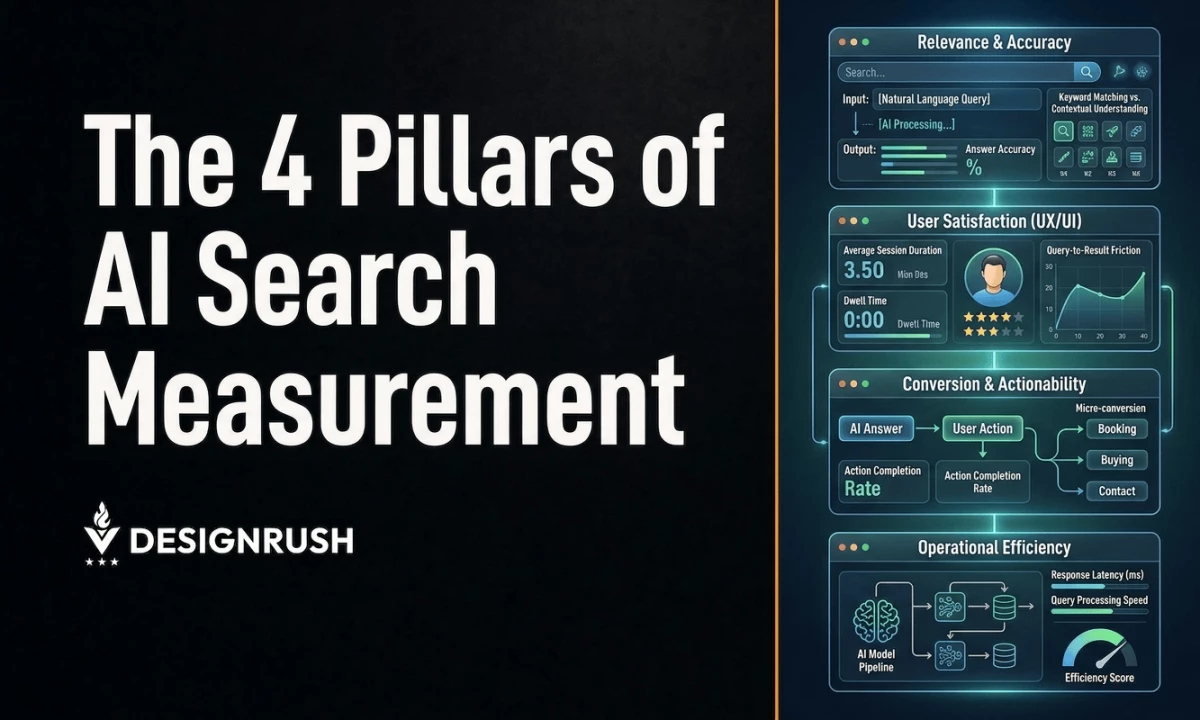
The Four Pillars of AI Search Measurement
To build a real measurement framework around modern AI Search, forward-thinking brands need to stop looking at traffic alone and start tracking authority across both machine engines and human experiences.
That requires four specific metrics:
1. Citation Share of Voice (GEO Measurement)
How often does an LLM explicitly reference your brand, product, or proprietary research when answering category-level prompts?
If ten potential customers ask Perplexity or ChatGPT for the best solution in your niche, what percentage of those answers mention you as an authoritative source?
2. On-Site Experience and Intent Conversion (SXO Measurement)
When a human user does click through, standard bounce rates do not tell the whole story. Measurement must track visual hierarchy efficiency, time-to-value, and conversion friction.
Is your layout fulfilling search intent above the fold, or are users bouncing due to a poor user experience?
3. Agent Readiness and Machine Actionability (AXO Measurement)
As autonomous agents research and compare options for users, can machines accurately read your structured data?
Measuring AXO requires auditing Schema.org completeness,
machine-readable pricing clarity, and verifying that automated agents can evaluate your suitability criteria without encountering broken endpoints or CAPTCHA blocks.
4. Contextual Sentiment and Downstream Lift
AI engines do not just list facts. They frame them.
How is the model describing your brand? Is it pulling outdated product specs, leaning into old customer complaints, or accurately reflecting your current positioning?
Brands mastering modern measurement cross-reference AI citation spikes with increases in direct traffic, branded search volume, and self-reported attribution ("How did you hear about us?") on lead forms.