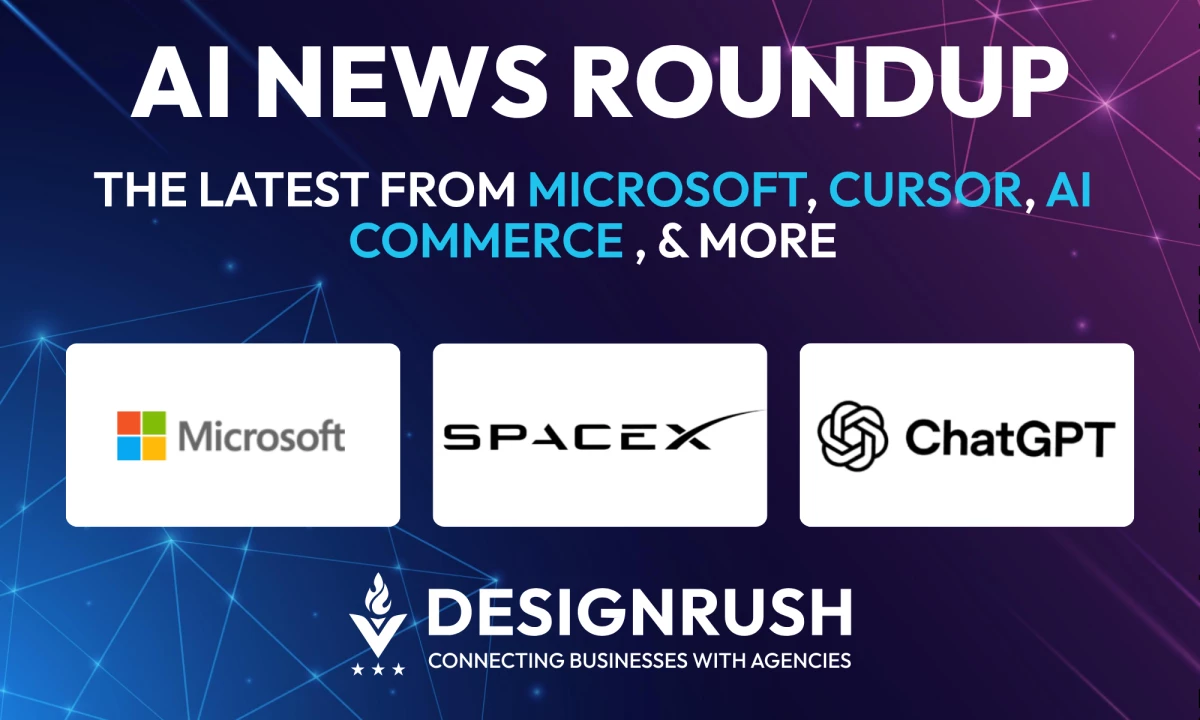

Our analysts track the weekly developments reshaping AI and how it reaches users. Brands building AI products can partner with vetted AI companies to bring their ideas to life.
The same government that shut down Anthropic's top models last week is letting Microsoft sell OpenAI models to China's biggest tech companies this week.
A company that had been public for only four days spent $60 billion to buy one of the most popular coding tools on the market.
And the place where people buy their makeup quietly started moving inside a chat window.
This was the week brands learned that AI access is a contract. Here's where things stood, in more detail.
Microsoft Sells OpenAI Models to China
Microsoft is selling OpenAI models to China's largest tech companies through Azure, even as OpenAI and Anthropic themselves refuse to sell directly in China.
The business is too big to give up. Azure's AI revenue in China tripled in the fiscal year ending June 2025, after about 400% growth the year before.
Microsoft's contract with OpenAI lets it set its own terms for selling the models abroad, an arrangement no other U.S. company holds.
OpenAI has pushed back privately, worried Chinese customers will use its models to train rivals, but the dispute is unresolved.
Here's where it gets strange. Last week, the U.S. government blocked Anthropic's models from foreign users.
This week, the same government lets Microsoft sell OpenAI models to ByteDance, the Chinese parent of TikTok.
The split came down to what each company signed years ago.
Anthropic's contracts gave officials the power to cut off foreign access, while Microsoft locked in the right to sell OpenAI's models abroad on its own terms.
SpaceX Acquires Cursor for $60 Billion
SpaceX agreed to buy Anysphere, the startup behind AI coding tool Cursor, for $60 billion in stock, per an SEC filing.
The deal closed four days after SpaceX's stock market debut.
It gives the company, now merged with Musk's xAI, a direct foothold in the developer tools market.
And the foothold is sizable. Cursor was running about $2.6 billion in annualized B2B revenue when the deal closed.
This move means a lot of enterprise engineering teams now have Musk in their software stack.
And this is where the risk starts.
SpaceX disclosed in its IPO filing that xAI's Grok chatbot is under investigation by eight regulatory agencies over non-consensual deepfakes.
Any team deepening its reliance on Cursor should study the governance record of the company now controlling it.
At Monday’s closing price of $154.60, the average investor who bought SpaceX shares on the open market after its debut has now seen most of their gains disappear, market data shows. https://t.co/vo5SGp7YQD
— NBC News (@NBCNews) June 23, 2026
The stock raises a second flag. SpaceX shares jumped roughly 16% the day the deal was announced, then lost most of these gains within the week.
A company whose stock swings this hard around a major acquisition isn't a stable base to build on yet.
Beauty Brands Set Up Shop in ChatGPT
L'Oréal put Maybelline's ModiFace virtual try-on directly inside ChatGPT at VivaTech 2026.
Shoppers can test makeup looks in real time without a separate website or app.
SkinCeuticals, CeraVe, and Garnier joined a ChatGPT ad pilot, placing ads inside AI conversations right at the point of purchase intent.
Sephora also launched its own ChatGPT app in March 2026, connecting product discovery to Beauty Insider loyalty accounts.
These brands are working off the assumption that the purchase decision now starts inside a chat window.
And Accenture's survey of 25,590 consumers across 16 countries backs it up.
- 74% trust a personal AI agent more than their best friend to make a purchase for them.
- 71% expect AI to influence at least half their buying decisions within a year.
- 56% would tell their agent which brands to consider.
These numbers describe a buyer who stops comparing options personally.
The AI agent does the comparing, and the shortlist forms inside that conversation before the buyer ever opens a website.
Brands earn a spot on that shortlist through machine-readable product data, verified claims, and clear content.
Without this groundwork, the purchase decision moves upstream and leaves them behind.
Manage Your AI Dependence
AI access, tool ownership, and commerce entry points are all moving faster than most strategies account for. Three moves matter most right now.
- Vendor dependency is a continuity risk. Document which workflows stop if AI access is revoked and identify alternatives before you need them.
- AI assistants are the new front page. Structure your content so they can cite it directly, since that's where people now start before they ever reach your site.
- AI commerce is already filtering brand shortlists. Make your product data, pricing, and claims machine-readable so agents can find and evaluate your brand.
Brands that build these habits early won't scramble when an AI provider changes the deal.
Our Take: Is the Real AI Risk in the Fine Print?
Most boardroom AI conversations center on ethics policies, bias audits, and model transparency, all of which assume the model will still be there tomorrow.
We think this assumption is the real danger, since any model can be shut off, sold, or restricted overnight.
A bias audit means nothing if the model behind it vanishes, the way Fable 5 and Mythos 5 did last week.
The US government, citing national security authorities, has issued an export control directive to suspend all access to Fable 5 and Mythos 5 by any foreign national, whether inside or outside the United States, including foreign national Anthropic employees.
— Anthropic (@AnthropicAI) June 13, 2026
The net effect of…
Companies already know how to vet a vendor.
They run a full legal review on standard software: the SLAs, the termination clauses, and the data portability terms.
But they skip all of these for AI tools, because they felt fast and low-stakes to bring in.
This double standard is the risk.
The contract behind an AI tool decides whether your access survives a policy change, a sale, or a sudden shutdown.
And this fact makes it every bit as critical as the agreements companies always scrutinize.
For analysis on the Fable shutdown, Apple's Gemini deal, and the AI in-house production shift, check out last week's AI roundup.
If the AI tool your team depends on changes hands tomorrow, do you know who controls your data?
These leading AI companies help brands move from generic tools to specialized models trained on their own data.