DesignRush
  • Trending Brand News
  • AGENCY DIRECTORY
    Featured
    Branding & Creative
    Website & Interface
    Marketing
    Software & App
    IT Services
    Featured
    • Web Design Companies
    • Web Design Companies
    • Digital Marketing Agencies
    • Digital Marketing Agencies
    • Software Development Companies
    • Software Development Companies
    • Mobile App Development Companies
    • Mobile App Development Companies
    • Web Development Companies
    • Web Development Companies
    • SEO Agencies
    • SEO Agencies
    • AI Companies
    • AI Companies
    • UI/UX Design Agencies
    • UI/UX Design Agencies
    • PPC Agencies
    • PPC Agencies
    • Branding Agencies
    • Branding Agencies
    • Google Ads Agencies
    • Google Ads Agencies
    Featured
    Branding & Creative
    • Digital Agencies
    • Digital Agencies
    • Branding Agencies
    • Branding Agencies
    • Creative Agencies
    • Creative Agencies
    • Product Design Companies
    • Product Design Companies
    • Logo Design Companies
    • Logo Design Companies
    • Graphic Design Companies
    • Graphic Design Companies
    • Packaging Design Companies
    • Packaging Design Companies
    • Video Production Companies
    • Video Production Companies
    • Public Relations Firms
    • Public Relations Firms
    • Design Agencies
    • Design Agencies
    • Reputation Management Companies
    • Reputation Management Companies
    Branding & Creative
    Website & Interface
    • Web Design Companies
    • Web Design Companies
    • eCommerce Development Companies
    • eCommerce Development Companies
    • Web Development Companies
    • Web Development Companies
    • WordPress Web Design Companies
    • WordPress Web Design Companies
    • WordPress Development Companies
    • WordPress Development Companies
    • Magento Development Companies
    • Magento Development Companies
    • Shopify Development Companies
    • Shopify Development Companies
    • UI/UX Design Agencies
    • UI/UX Design Agencies
    • Small Business Website Design Companies
    • Small Business Website Design Companies
    Website & Interface
    Marketing
    • Digital Marketing Agencies
    • Digital Marketing Agencies
    • SEO Agencies
    • SEO Agencies
    • PPC Agencies
    • PPC Agencies
    • Social Media Marketing Companies
    • Social Media Marketing Companies
    • Search Engine Marketing Agencies
    • Search Engine Marketing Agencies
    • Email Marketing Agencies
    • Email Marketing Agencies
    • Small Business SEO Companies
    • Small Business SEO Companies
    • Local SEO Companies
    • Local SEO Companies
    • Google Ads Agencies
    • Google Ads Agencies
    • Advertising Agencies
    • Advertising Agencies
    • eCommerce SEO Agencies
    • eCommerce SEO Agencies
    • Media Buying Agencies
    • Media Buying Agencies
    • Content Marketing Agencies
    • Content Marketing Agencies
    • Lead Generation Companies
    • Lead Generation Companies
    • Video Marketing Services
    • Video Marketing Services
    Marketing
    Software & App
    • Software Development Companies
    • Software Development Companies
    • Offshore Software Development Companies
    • Offshore Software Development Companies
    • Outsourcing Software Development Companies
    • Outsourcing Software Development Companies
    • Mobile App Development Companies
    • Mobile App Development Companies
    • VR & Augmented Reality Companies
    • VR & Augmented Reality Companies
    • AI Companies
    • AI Companies
    • Android App Development Companies
    • Android App Development Companies
    • iPhone App Development Companies
    • iPhone App Development Companies
    • Blockchain Development Companies
    • Blockchain Development Companies
    • Software Testing Companies
    • Software Testing Companies
    Software & App
    IT Services
    • IT Services Companies
    • IT Services Companies
    • IT Outsourcing Companies
    • IT Outsourcing Companies
    • Managed Service Providers
    • Managed Service Providers
    • Cybersecurity Companies
    • Cybersecurity Companies
    • Big Data Analytics Companies
    • Big Data Analytics Companies
    • Cloud Consulting Companies
    • Cloud Consulting Companies
    • Staff Augmentation Services
    • Staff Augmentation Services
    • SharePoint Consultants
    • SharePoint Consultants
    IT Services
  • List Your AgencyFind An Agency
  • Marketplace
  • Awards
    • All the Latest Winners
    • Website Design
    • Logo Design
    • Print Design
    • App Design
    • Packaging Design
    • Video Design
List Your AgencyFind An Agency
Trending Brand News
  • Latest News
  • Interviews
  • Podcast
  • Trends
  • Trending Brand News
  • Gartner Says 80% of Firms Will Have Smaller AI-Augmented Teams by 2030
Receive our Newsletter
Join over 70,000 B2B decision-makers growing their brands
Receive proposals from qualified agencies
Get Proposals
4 min read

Gartner Says 80% of Firms Will Have Smaller AI-Augmented Teams by 2030

Igor Repeta at Empat on running software teams with AI-native development.
Artificial Intelligence 4 min read
Gartner Says 80% of Firms Will Have Smaller AI-Augmented Teams by 2030
Article by Ilze-Mari GründlingIlze-Mari Gründling
Published Apr 17 2026
|
Updated Apr 17 2026
Share

AI Software Teams Shrinking: Key Findings

  • Most organizations will be running smaller, AI-augmented software teams by 2030, pointing to a rethink in how development work gets done.
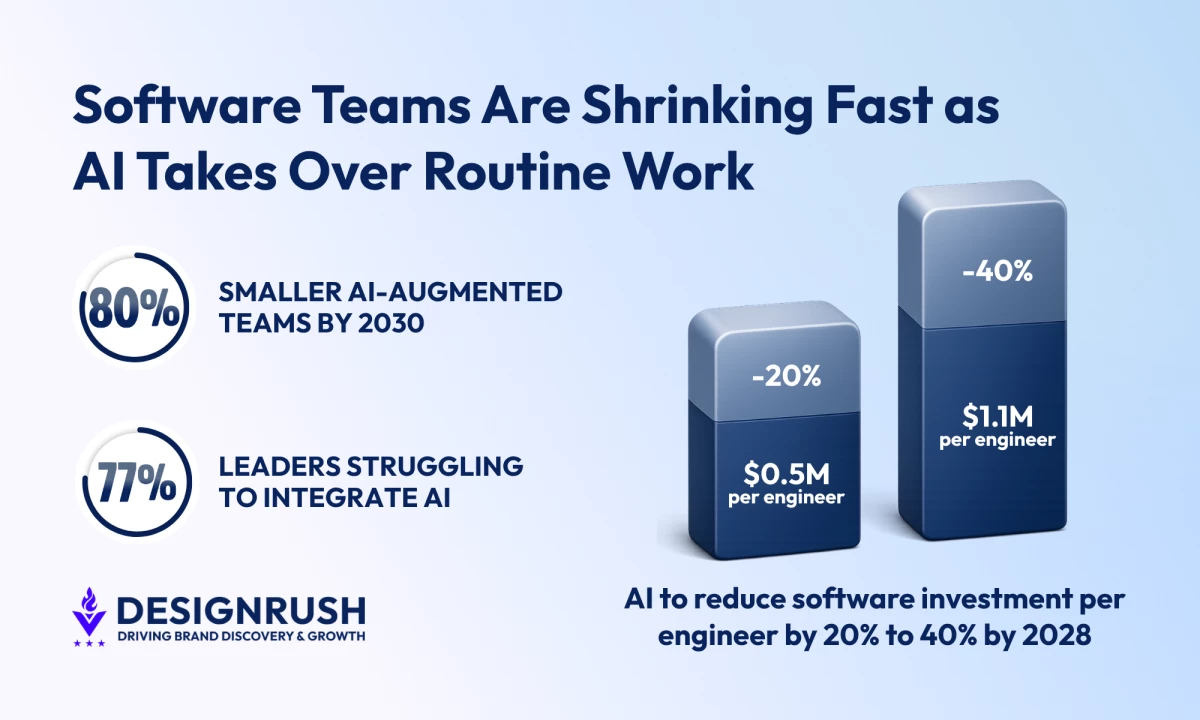
  • 77% of engineering leaders report trouble integrating AI into applications, which points to a bigger need for clear processes, solid documentation, and roles built for AI workflows.
  • AI tools could cut 20% to 40% of software investment per engineer by 2028, proving that training teams to guide AI output and write precise specs pays off.

By 2030, around 80% of organizations will evolve large software engineering teams into smaller, AI-augmented ones, according to Gartner.

This indicates the old build process, with its heavy handoffs and long waits, is losing its edge fast.

“AI-native development isn't about using Copilot to autocomplete code,” Igor Repeta, CEO of Empat, tells DesignRush.

“In practice, it means developers write in natural language first and code second: they describe business logic, edge cases, and constraints, and AI handles the scaffolding.”

Engineers aren’t sitting there typing every line anymore.

They spend less time on repetitive work and more time steering AI output, tightening requirements, and catching mistakes before they snowball.

The daily rhythm changes with it.

“The engineer's core job becomes reviewing, steering, and testing AI output,” Repeta says.

That means standups start centering on validation too. Senior engineers spend more time on architecture calls, security checks, and the ugly corners AI still misses.

Editor's Note: This is a sponsored article created in partnership with Empat.

Teams, Workflows, and Documentation Drive AI Success

The days of obsessing over every bracket and semicolon matter less. Clear intent matters more. Plain English is doing the heavy lifting.

Most software teams are still behind because they bought AI like a separate gadget instead of rebuilding work around it.

Empat recently launched an AI-based estimation tool that generates preliminary project costs in minutes, giving teams an early view of budget ranges before a discovery call.

The output is directional and still requires deeper scoping, but it shows how AI can be built into early-stage workflows instead of sitting on the sidelines.


View this post on Instagram


A post shared by empat (@empat.tech)

Gartner’s 2025 survey of 400 U.S. and U.K. engineering leaders found that AI adoption is still causing headaches:

  1. 77% said building AI into applications was a serious or moderate headache
  2. 71% said using AI tools to boost software workflows caused the same kind of pain

AI tools are already in the stack, but teams are still wrestling with how to make them work inside real workflows.

Many teams are still using AI as a faster keyboard rather than a different operating model, and their hiring practices haven’t caught up either.

Engineers are still tested on algorithm puzzles instead of skills for managing AI-generated code and workflows.

They don’t test prompt clarity, output review, or how well someone works inside AI-generated code. Legacy codebases do not help either.

Tight coupling, thin documentation, and vague ownership make AI assistance stumble before it gets anywhere useful.

The stumbling blocks in skill and codebase design explain why AI adoption hasn’t reached everyone yet.

Only about 11% of leading companies give nearly all employees access to AI tools, even as overall access has grown roughly 50% year-over-year, according to Deloitte’s State of AI in the Enterprise 2026 report.

That limited access makes structured documentation crucial.

And that’s where documentation starts doing real work.

“Specs, ADRs, and inline comments become the prompt layer,” said Repeta.

AI can’t read minds, and it definitely can’t clean up a messy codebase on its own.

How Teams and Processes Make AI Actually Work

The team structure piece is also changing.

The number of AI architect roles is expected to increase from 30% to 58% over the next two years, which means team structures will change. This comes from Deloitte’s 2026 Tech Trends report.

The same report says leading organizations are designing modular architectures for flexibility and rethinking talent around human-machine collaboration.

That lines up with how AI-assisted development actually works: small modules, clear interfaces, and single responsibilities give them a bounded space to work in.

Modular systems allow AI to tweak code without juggling half the codebase and keep any slip-ups from spreading.

This keeps mistakes small and predictable, turning AI-generated changes into manageable updates rather than surprise disasters.

A bad function in an isolated service is easy to fix.

But a bad assumption in a tightly coupled monolithic codebase can ripple through the whole system like cheap coffee at a Monday meeting.

That’s why modular architecture deserves more attention than it usually gets.

Deloitte’s Tech Trends 2026 says leading organizations are tying AI initiatives to business results they can track and designing modular architectures for flexibility.

And that’s not buzz. It’s the basic plumbing AI needs if the goal is faster delivery without turning every deploy into a small thrill ride.

One example is an AI system handling restaurant bookings end-to-end without forms, calls, or emails:

For product and engineering leaders, the cleanest advice is to stop judging AI adoption by the number of subscriptions sitting in procurement.

“Stop measuring AI adoption by tool subscriptions and start measuring it by how your delivery metrics change,” Repeta said.

That’s the right instinct. The first question is not how many tools the team bought. The first question should be whether cycle time, quality, and throughput improved in any meaningful way.

Deloitte’s banking forecast translates those changes into actual cost savings.

It predicts AI tools will cut 20% to 40% of software investment in banking by 2028, or roughly US$0.5 million to US$1.1 million per engineer, giving leaders a clear idea of where AI should be targeted: on repetitive, high-volume work first.

They should train engineers to judge output, challenge weak answers, and write tighter specs.

They should treat the codebase like a product for AI consumption, with cleaner documentation, lower coupling, and conventions that keep output consistent.

And, yes, that work is boring…but it’s also the part that usually decides who gets ahead and who spends the next year cleaning up after their own experiments.

“Clean boundaries aren't just a software design principle in 2026,” notes Repeta, adding that “they're an AI collaboration primitive.”

And that’s the whole story in one line.

AI-native development isn’t a side tool bolted onto an old process. It’s a new way to organize teams, write requirements, review code, and ship work without drowning in rework.

The teams that get this right won’t be shouting about AI at every meeting.

They’ll ship faster because their specs are precise, their modules are clean, their tests actually catch problems, and they aren’t scrambling to fix avoidable mistakes.

Consistency and clarity become the real competitive edge.

👍👎💗🤯
Tags:
AI software teams 
empat 
Ilze-Mari Gründling
Ilze-Mari Gründling
Senior B2B Reporter

Ilze-Mari brings a decade of publishing experience to DesignRush, writing news, interviews, case studies, ghostwritten bylines, editorials, and press releases distributed by Reuters, AP, Dow Jones, and others. She was previously Digital Copywriter for CapeTown ETC and an in-house writer for African Decisions, a respected corporate and government journal in Africa, and Johannesburg Stock Exchange Quarterly (JSE) Magazine, the flagship publication of Africa’s largest stock exchange.

Follow on: LinkedIn Send email: ilze@designrush.com

Latest Artificial Intelligence News

view all
  • AI coding adoption rises with 91% usage and widespread developer time savings, alongside security and failure rate concerns.
    Artificial Intelligence

    Is AI Coding Now a Job Requirement? 91% Adoption Suggests Yes

    By Ilze-Mari Gründling  |  56 minutes ago  |  4 min read
  • Artificial Intelligence

    84% of Leaders Say Their Data Isn’t AI-Ready: How Modern Data Platforms Fix It

    By Alexey Astakhov  |  1 day ago  |  5 min read
  • DesignRush Podcast Thumbnail with Headshot of Guest Simon Davis of wearemighty
    Artificial Intelligence

    80% of Marketers Use AI, Yet Usable Content Remains a Challenge

    By Kia Johnson  |  1 day ago  |  6 min read
  • goji labs verification charts
    Artificial Intelligence

    PwC Data Shows 88% Boost AI Budgets, But Only 42% Redesign Processes

    By Ilze-Mari Gründling  |  1 day ago  |  5 min read
view all

Most Popular Artificial Intelligence Stories

  • ai agent growth graphs
    Artificial Intelligence

    How AI Agents Are Transforming Business Communication in 2026

    By Ryan de Smidt  |  1 month ago  |  4 min read
  • A drive thru employee at Burger King wearing a headset talking to AI assistant "Patty"
    Artificial Intelligence

    Burger King's AI Assistant 'Patty' Coaches Drive-Thru Friendliness in 500 Stores

    By Katherine Maclang  |  1 month ago  |  3 min read
  • Graphic titled “Are support teams ready for AI in 2026?” featuring the text “3 Critical AI Limits Support Teams Must Manage” and a 3D network illustration with connected user icons, warning symbols, and a check mark, alongside the caption “Hugo Shows Why
    Artificial Intelligence

    3 Critical Limits of AI in Customer Support That Leaders Can’t Ignore in 2026

    By Ilze-Mari Gründling  |  1 month ago  |  3 min read
  • Graphic titled “Why Enterprises Miss The Mark With AI Implementation” showing statistics that 62% stay stuck in experimentation or pilot phases and 7% fully deploy and integrate AI across their organization, alongside a large pie chart labeled 88% with th
    Artificial Intelligence

    Only a Third of Enterprises Have Scaled AI, Here’s How They Did It

    By Enrique Jose Tabuena  |  1 month ago  |  4 min read
DesignRush

DesignRush is the premier agency directory, awards platform, and media hub connecting brands with top agencies in software, app development, design, and marketing. We deliver vetted reviews, insights, and trends to drive business growth.

For Businesses

  • Agency Categories
  • Agency Ranking Methodology
  • Trending Brand News
  • FAQs
  • Advertise

For Agencies

  • Benefits Of Listing With Us
  • Submit An Agency
  • Sponsorship
  • All Agencies

About DesignRush

  • Team & Story
  • Contact Us
18117 Biscayne Blvd
Miami, FL 33160
United States
© DesignRush 2026, All Rights Reserved
  • Sitemap
  • Terms of Use & IP
  • Privacy Policy
  • Accessibility
  • Fraud Protection
s