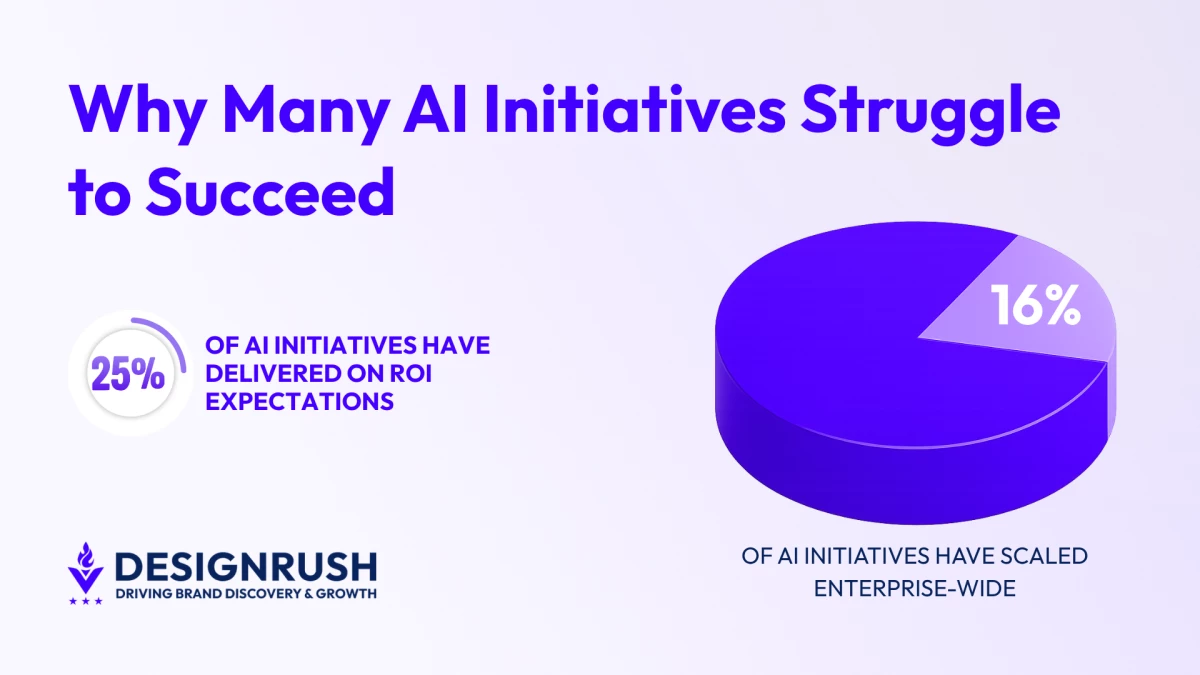

Only 25% of AI initiatives over the past three years have delivered on their expected ROI, according to IBM’s 2026 CEO Study.
To make matters worse, only 16% have scaled enterprise-wide.
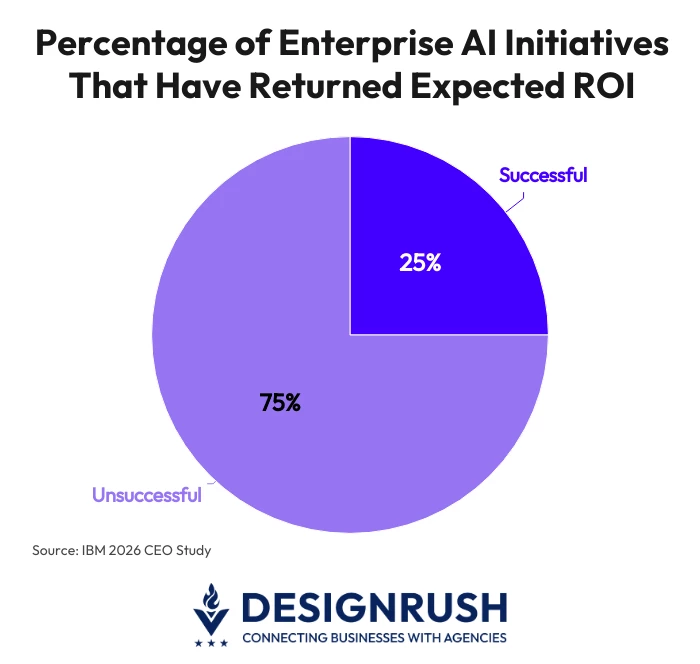
These numbers are worth analyzing because they contradict the prevailing narrative that AI adoption is, by itself, a strategic advantage.
That gap between intent and outcome is not a technology problem. It is a targeting problem.
The difference lies in how organizations approach their AI initiatives.
Why Most AI Initiatives Fail
The IBM data suggests that organizations are investing in AI capabilities rather than AI outcomes.
When the initiative is framed as “integrate AI into our operations,” the success criteria are vague and the scope expands until the project collapses under its own ambition
When the initiative is framed as “reduce order processing time by 60%” or “cut document review costs by half,” the AI becomes a means to a specific end.
In other words, the companies landing in the successful 25% are asking the right questions before they write a single line of code.
As such, the technology choices, scope decisions, and success metrics all flow from the business problem, not from the technology itself.
Case Studies That Speak Louder Than Words
At Unico Connect, we have used that “AI capability-first" approach to build AI solutions across logistics, fintech, and enterprise operations.
Three projects in particular illustrate why targeting matters more than technology.
Replacing a Manual Bottleneck in B2B Logistics
A logistics company in India processed hundreds of orders daily through WhatsApp voice notes sent in Hindi and English.
Every order required manual transcription, data entry, and validation against a product catalog.
This meant their operations team spent hours each day converting voice messages into structured orders, and errors were frequent.
We built an AI agent that integrates with WhatsApp Business, which was designed to:
- Transcribe multilingual voice notes
- Extract order details
- Validate them against the catalog
- Create structured entries in the client’s operations system
The agent handled the repetitive, error-prone work. The operations team handled exceptions and customer relationships.
The key decision here was scope.
We did not build a company-wide AI platform. We identified one process that consumed disproportionate time, carried a high error rate, and operated on a channel the client’s customers already used.
The AI solved a specific problem with a measurable before-and-after.
Document Intelligence for a Fintech Platform
A fintech client processed high volumes of compliance documents, each requiring review, classification, and extraction of specific data points.
The review cycle was slow, and the cost per document made it difficult to scale operations.
We deployed a document intelligence agent that classifies incoming documents, extracts relevant fields, flags anomalies, and sends proactive alerts when documents require human attention.
The system did not replace the compliance team. It handled the initial triage so human reviewers spend their time on judgment calls rather than data entry.
Before building anything, we mapped the document review workflow end to end.
Based on our analysis, we identified where human expertise was essential and where it was being wasted on reading standard forms and copying data between systems.
AI went where human time was spent on pattern recognition, not where it sounded impressive on a roadmap.
Operational Analytics for an Enterprise Client
An enterprise operations team tracked performance across multiple systems, spending significant time assembling reports from disconnected data sources.
But by the time reports were ready, the information was often days old.
Our team at Unico Connect built an operational analytics agent that pulls data from the client’s systems, identifies trends and anomalies, and surfaces actionable insights in near real time.
This allowed their team to move from reactive reporting to proactive decision-making.
The project started with a single metric the leadership team cared about most.
We proved value on that one metric before expanding to adjacent data sources.
Starting narrow and expanding based on demonstrated impact avoided the common trap of building an analytics platform that tries to do everything and delivers nothing useful.
The Pattern Across All Three
Each project followed the same logic:
- Identify a specific, measurable business problem. Not “we need AI” but “this process costs X hours, produces Y errors, and blocks Z growth.”
- Map where human expertise adds value and where it does not. AI replaces repetitive pattern recognition. Humans handle exceptions, judgment, and relationships.
- Start narrow. Prove ROI on one well-defined process before expanding. The 16% enterprise scaling figure from IBM’s study likely reflects organizations that tried to scale before proving value.
- Measure before and after. If you cannot articulate what success looks like in operational terms before you start, you will not be able to demonstrate ROI after you finish.
- Build for production, not for a demo. Pilot projects that never move beyond proof of concept inflate the 75% failure statistic. Every solution we build is designed to handle real transactions, real documents, and real decisions from day one.
AI Success Depends on Precision, Not Scale
In short, most organizations struggle with their AI initiatives because they approach AI like a broad transformation mandate instead of a targeted operational decision.
As such, organizations looking to implement AI should resist the temptation to automate simply for the sake of optics or "because it's the trend nowadays."
Instead, they should define the operational problem first, establish what success looks like in business terms, and maintain human oversight where judgment, relationships, and accountability still matter most.
Because the companies that benefit most from AI will won't necessarily be the ones using it everywhere. It will be the ones disciplined enough to use it where it actually counts.