
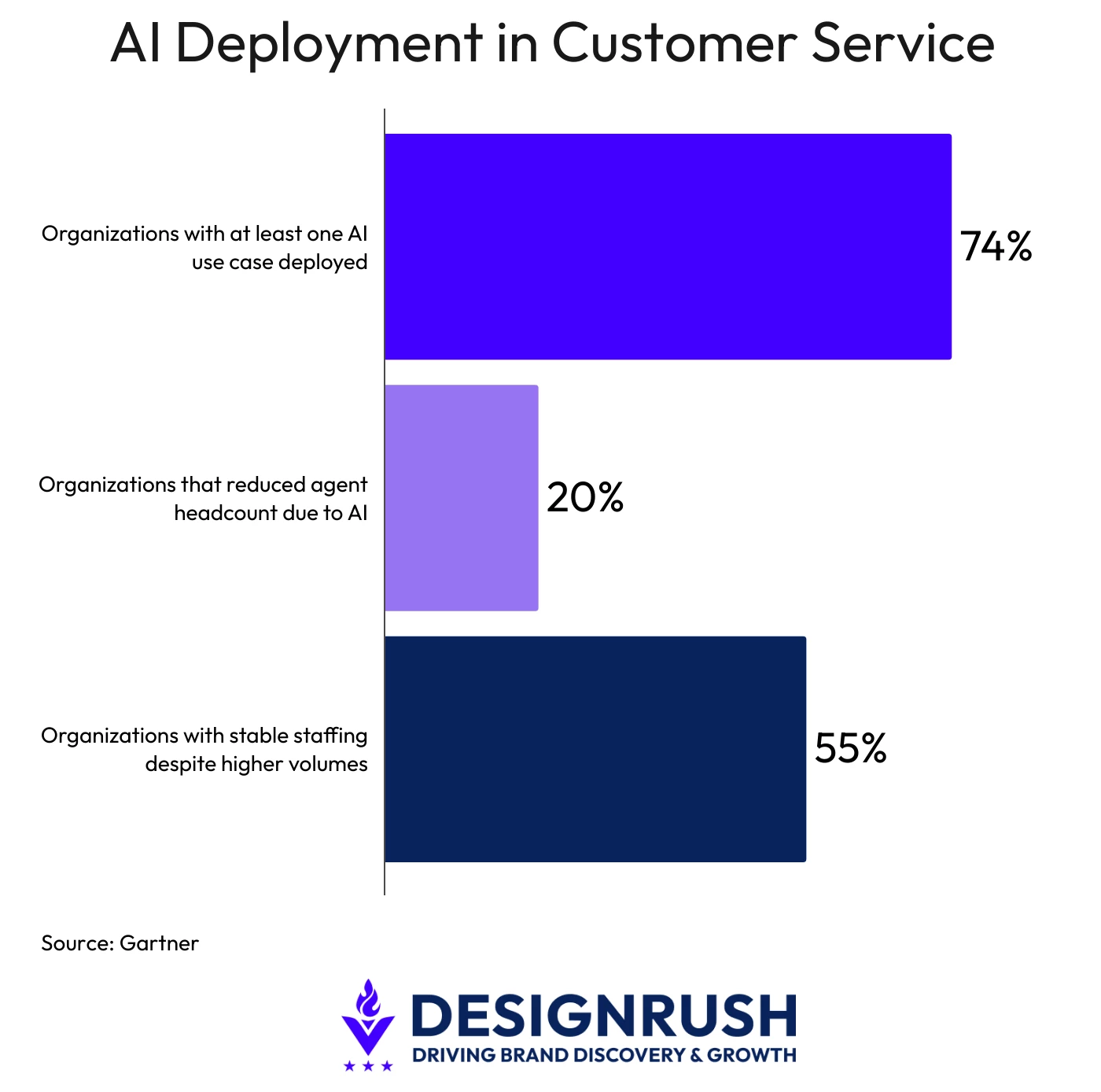
Seventy-four percent of organizations have deployed at least one AI use case in customer service.
Yet only 20% have reduced agent headcount, according to a Gartner survey of 321 customer service and support leaders.
And only 55% report stable staffing while handling higher customer volumes.
For customer service leaders under pressure to show AI returns, that stability signals a correctly redesigned operation rather than a missed opportunity.
When Automation Stops, the Hard Work Starts
AI absorbed the predictable layer of customer service, leaving behind tone, context, and the customer who is technically wrong but genuinely upset.
Hugo Inc., a customer support and AI operations provider trusted by Meta, Google, and Faire, points to a client engagement in which a missing payout report masked a potential fraud case.
Resolving it required verifying the account, assessing fraud risk, and determining whether the payout was legitimate, all in a single interaction.
“Once AI absorbs the simpler requests, the work left for human agents carries more complexity and consequence,” says Funmi Mide-Ajala,, Director of Customer Support and Digital Operations at Hugo Inc.
“It wasn't a simple 'where's my money?' question. The agent had to read both the customer context and the risk signals. Get that wrong, and the business can lose trust or absorb avoidable fraud.”
That kind of ticket; one interaction carrying both a service decision and a fraud risk call; is what 85% of organizations are now building their agent expansion around, per Gartner.
Five Hours Saved, Zero Captured
Customer service teams save roughly 5.5 hours per agent per week with AI, according to Gartner. Most of that time never reaches a customer interaction.
"AI frees up agent capacity, but no one redefines what agents should do with it. So the time saved does not translate into anything measurable," Mide-Ajala says.
Hugo Inc.’s audits consistently surface three reasons why:
- AI layered on a broken process. Automation accelerates existing workflows, flaws included, delivering the same poor outcomes faster.
- Metrics that only track what AI improves. Deflection rates look good while unresolved interactions accumulate cost and friction elsewhere.
- No plan for the freed-up time. Capacity appears on paper but disappears into longer handle times or idle time that dashboards never surface.
All three reasons point to the same root cause. The investment goes into the tooling while the problem stays in the workflow.
AI improves existing processes, but it does not fix ones that were never properly built.
The Agents Who Can Supervise AI
Ninety-one percent of customer service leaders are under executive pressure to implement AI, per Gartner. Most deployed it before asking who would catch the errors.
AI suggestions carry the appearance of authority. Only business context exposes the errors underneath.
Hugo Inc. built its workforce model around agents who bridge technical teams and business leadership, supervising AI output before it reaches the customer.
In one client engagement, an AI claims agent reviewed damage claim photos and suggested low severity. The evidence said otherwise.
What saved the customer experience was the human-in-the-loop design.
A quality reviewer caught the misjudgment before it reached the policyholder and corrected the AI's reasoning entirely.
For the customer, that is the difference between feeling short-changed and getting a fast, fair resolution.
“The real value of automation is not just resolving routine claims faster; it is knowing when the system should stop and escalate,” Mide-Ajala explains.
“Human oversight has to sit early enough in the workflow to catch the point where AI confidence and business judgment start to diverge, before a wrong decision reaches the customer.”
The same gap shows up in interactions that aren't about errors at all, but about everything happening around the request.
In healthcare support, a patient contacting support about a billing issue may also be managing a denied claim and real financial stress.
AI processes the query but cannot read the weight behind it. Getting the answer right but the tone wrong can be worse than a delayed response.
Mide-Ajala calls this context compression. AI flattens a multi-dimensional situation into a single classification. The full picture is one only a human agent can see and resolve accordingly.
Software Purchase to Process Change
Organizations are cutting agents to fund AI rather than because AI is ready to replace them.
But half of those that reduced headcount due to AI will rehire by 2027, under different job titles, according to Gartner, because the work they eliminated still needs to get done.
"Keeping headcount after deploying AI is evidence that you understood the problem correctly," Mide-Ajala says.
"The companies that cut teams and then rehire within 18 months are correcting their own misunderstanding of what AI actually replaces and what it does not."
Cutting agents to fund AI assumes the remaining workforce will absorb the harder work.
However, 60% of employees do not want to take on more complex work, per Gartner.
Simply put, what AI creates is the capacity for harder interactions, yet it does not create the appetite for them.
Workforce redesign is a product decision, not an HR one. Teams that treat it as a soft problem alongside AI implementation will always be catching up to the work the tooling created.
The fix starts with mapping agent workflows, escalation paths, and role expectations before a single AI tool is deployed.