
AI Sales Tools: Key Findings
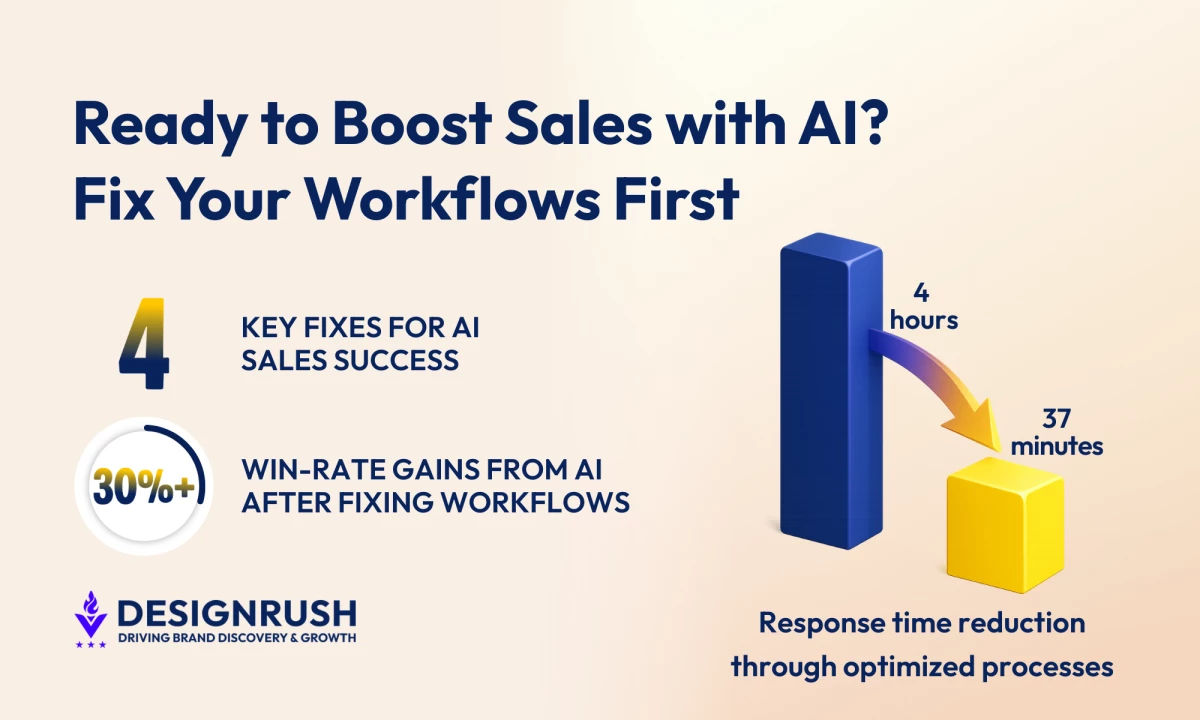
- Early adopters using AI sales tools see 30% or higher win-rate gains, so fix workflows first to capture similar results.
- Automating broken processes with AI sales tools produces little impact, so redesign sales processes before implementation.
- Success with AI sales tools depends on clean data, focused use cases, and leadership support, so prioritize governance and executive alignment.
A 2025 Bain & Company report found that early adopters of AI-powered sales tools are seeing win-rate gains of 30% or more.
The figure is compelling. Achieving it is far less common.
Across the sales and operations programs Hugo runs for clients, one pattern is clear: Most teams rush to layer AI onto unclear workflows and inconsistent CRM systems.
They expect transformation, but what they often get are micro-productivity gains like faster note-taking, CRM updates, and marginal time savings.
This means the real problems remain stuck in sales execution, leading to win rates stalling.
“The teams that struggle most aren't the ones without AI, they're the ones that automated before they standardized,” said Funmi Mide-Ajala, Director of Customer Support & Digital Operations at Hugo.
“You can't scale what you haven't stabilized.”
Bain's findings back this up: the real drivers behind that 30% figure are process design, clean data, governance, and clear ownership.
The 30% lift is possible. But only for organizations that fix structure first.
Editor's Note: This is a sponsored article created in partnership with Hugo.
Working across the full sales execution lifecycle, from prospecting and outreach to pipeline management and deal support, Hugo sees firsthand where AI delivers impact and where it falls short.
That perspective points to four areas leaders need to address before expecting AI to meaningfully move the needle.
1. Redesign the Sales Process Before Adding AI
AI shines most when embedded in redesigned workflows rather than slotted into existing ones.
Instead of treating AI as a productivity tool, Bain & Company reiterates that increasing win rates requires a full-process view from lead handoff to close.
Most sellers spend only part of their week on real selling. Automating small tasks doesn’t help unless the main steps in the sales process are smoother.
This is where experienced operational partners earn their value. Hugo doesn't just maintain the connective tissue between sales stages, its teams bring 16+ years of sales expertise to the execution itself.
That commitment to operational excellence extends to how Hugo builds its own teams, reflected in industry recognition for its people-first approach.
For example, Hugo helped a SaaS client process 2,000 more subscription modifications monthly through organized workflows and clear tracking.
Hugo’s solution combined specialized teams, rapid onboarding, and workflow expertise with smart workload management and integrated systems.
Agents were trained in 7–10 days, supported multiple channels, and handled high-volume, time-sensitive tasks across regions.
This approach yielded significant results for the SaaS company:
- First response time reduced from 4 hours to 37 minutes
- Subscription inquiries resolved in 2 hours instead of 24 hours
- Peak-period resolution improved by 60%
- Customer satisfaction rose from 82% to 96%
- Subscription modifications processed per month increased to over 2,000
The takeaway? Well-organized operations with experienced people create the stable foundation AI needs to deliver compounding gains.
2. Establish Data Quality and Governance Before Automation
AI recommendations are only as good as the data they consume.
Sales and go-to-market (GTM) systems are often messy due to missing or inconsistent records and unclear responsibilities. Layer AI on top of that and outputs become unreliable.
High-performing revenue teams get specific about who owns data validation, how records are standardized, and which metrics anchor decisions.
For example, Hugo’s structured reporting and dashboards, from generated leads to conversion metrics, anchor outcomes in validated data rather than in busywork.
“Inconsistent records and unclear responsibilities create errors no matter what system you use. We focus on verifying data and defining ownership so teams can work with accurate information,” Mide-Ajala said.
3. Focus AI on High-Impact Use Cases
The instinct to automate everything at once is understandable. It's also a reliable way to create integration chaos and dilute results.
Pick a handful of high-leverage tasks (deal strategy, prospect qualification, pricing optimization) and prove they work before expanding scope.
Once those run smoothly, everything else can follow.
Drawing on 16 years of sales delivery experience, Hugo's teams know which processes need to be airtight before automation enters the picture, and which ones benefit most when it does.
Watch Lydia Hickman from Hugo explain how early onboarding sets global teams up for success, why first-day alignment matters, and how smart workflow design frees staff for more valuable work:
4. Anchor Execution to Leadership and Behavioral Change
Technology adoption is ultimately a people problem. Visible leadership support and follow-through are what move AI implementations from promising experiments to embedded capabilities.
That means tying AI outputs to the metrics teams already track, reinforcing new workflows through training, and creating governance structures that hold.
"The biggest risk isn't a bad tool, it's a good tool that no one builds habits around. We've seen teams get excited in week one and revert to spreadsheets by week six. The difference is whether leadership treats AI adoption as a process change, not a software rollout," Mide-Ajala said.
The Real Meaning of 30 % Win-Rate Gains
The 30% uplift reported by Bain is real, but it’s conditional. It requires:
- Sales activities redesigned to elevate high-value engagements
- Integrated, trustworthy data and governance
- Focus on high-impact use cases
- Executive commitment to embedding AI into operating rhythms
Across the programs Hugo runs, the strongest gains appear when teams solve for these four things. The goal is getting the operational foundation right– process design, data integrity, and focused execution.
What could your win rates look like if AI was working on top of a sales operation that was already running right?
That's the question Hugo helps clients answer by building the process discipline, data integrity, and execution consistency that make those tools perform.