
Google’s introduction of Google Pics at I/O 2026 is another sign that high-quality creative production is becoming faster, less expensive, and more accessible.
Pics, which is built on Google’s Nano Banana image model, allows users to generate images from a blank canvas or edit existing visuals with control over individual objects, text, and specific areas of an image.
Google is initially making the platform available to trusted testing partners, with a wider rollout planned for Google AI Pro and Ultra subscribers, along with a preview for Google Workspace suite business customers.
The immediate appeal of Pics is obvious, as marketing teams will soon be able to produce campaign graphics, social content, infographics, and other digital assets with fewer technical barriers and much shorter production timelines.
However, there is a larger implication.
Just imagine, if every business can generate high-quality design assets within minutes, attractive imagery alone puts the brakes on competitive advantage.
Generative AI may lower the barrier to creating polished content, but it also raises the standard for the complete brand experience surrounding said content.
Making creative production more efficient does provide a great deal of value.
AI tools, such as Pics, can help teams explore ideas, generate variations, resize assets, and manage repetitive production tasks.
A small marketing team may be able to test more creative directions without adding staff or extending a campaign timeline.
Experienced designers can spend less time completing routine adjustments and more time thinking about the larger creative strategy.
These are all meaningful benefits that businesses should take advantage of.
The real danger with using Generative AI is assuming that producing more creative content automatically leads to highly effective marketing, which sadly, it does not.
A small marketing company can now generate 50 visual concepts in the time it used to take to develop five.
Sure, that sounds productive, but if those same 50 concepts are built around weak positioning or unclear messaging, then the company has only created more noise around the brand, thus diluting the original position or message.
Think of it this way: speed improves production time, but it doesn’t provide direction.
Why AI Tools Cannot Replace Brand Strategy and Creative Direction
I have witnessed digital design evolve since we founded Lounge Lizard in 1998.
In the early days of the internet, things like stock photography, website templates, and drag-and-drop platforms made it easy for businesses to publish their own websites without writing code.
Then came social media platforms such as Facebook and Instagram, along with a plethora of tools that made it easy to design and distribute content within minutes.
Every advancement came alongside predictions that custom design and creative agencies would become less important.
However, what really happened was totally different.
As the tools became more accessible, businesses produced more of their own websites and content, but much of it began to look and sound the same.
And, of course, it would when they all had access to the same cookie-cutter tools.
In every single instance, the businesses that benefited the most from user-friendly tools were not the first to adopt the tools; rather, they were the ones that understood how to use them in service of a larger idea.
Case in point, only 34% of organizations are using AI to fundamentally transform their business, while 37% are applying it only at a surface level with little or no change to underlying processes, Deloitte found.
When you put it into that perspective, it seems that Generative AI may accelerate that pattern.
AI is very good at recognizing and reproducing standard visual practices.
However, without strong creative direction, it tends to output work that feels familiar, as if every brand is starting to look the same.
The result may be polished and technically impressive, but there’s nothing that makes it unforgettable.
Before creating anything with AI, businesses still need to answer several real customer- or human-based questions:
- Who are we trying to reach?
- What do we want them to know or think about our business?
- Why should they choose us?
- What emotions should they feel when they encounter our brand?
- What makes us different from the competition?
The bottom line is that AI can help businesses express those answers, but it cannot decide what those answers should be.
Why Website Design and UX Matter for Brand Trust and Conversions
AI-generated visuals may capture people’s attention, but attention or awareness is only the beginning of the customer journey.
Content, whether it be an ad, social post, blog, or email, still needs to lead people to a final destination. In most cases, they lead to a landing page or website.
This destination is where a brand needs to turn that initial curiosity into trust and action.
Think about it. Some very important questions need to be answered when designing a landing page or website:
- Does the website immediately explain what the company does or offers?
- Is the messaging specific and persuasive?
- Can visitors find what they are looking for?
- Does the experience work equally well on phone and desktop versions?
- Are there clear calls to action?
These questions cannot be answered using AI and hoping AI will generate a stellar hero image.
To design and build a website optimized for conversion, businesses need an experienced marketing team and designer.
I have seen businesses invest heavily in visual campaigns only to send visitors to slow, confusing, or generic landing pages.
The creative may have earned those clicks, yet the user experience truly determines what that click is worth.
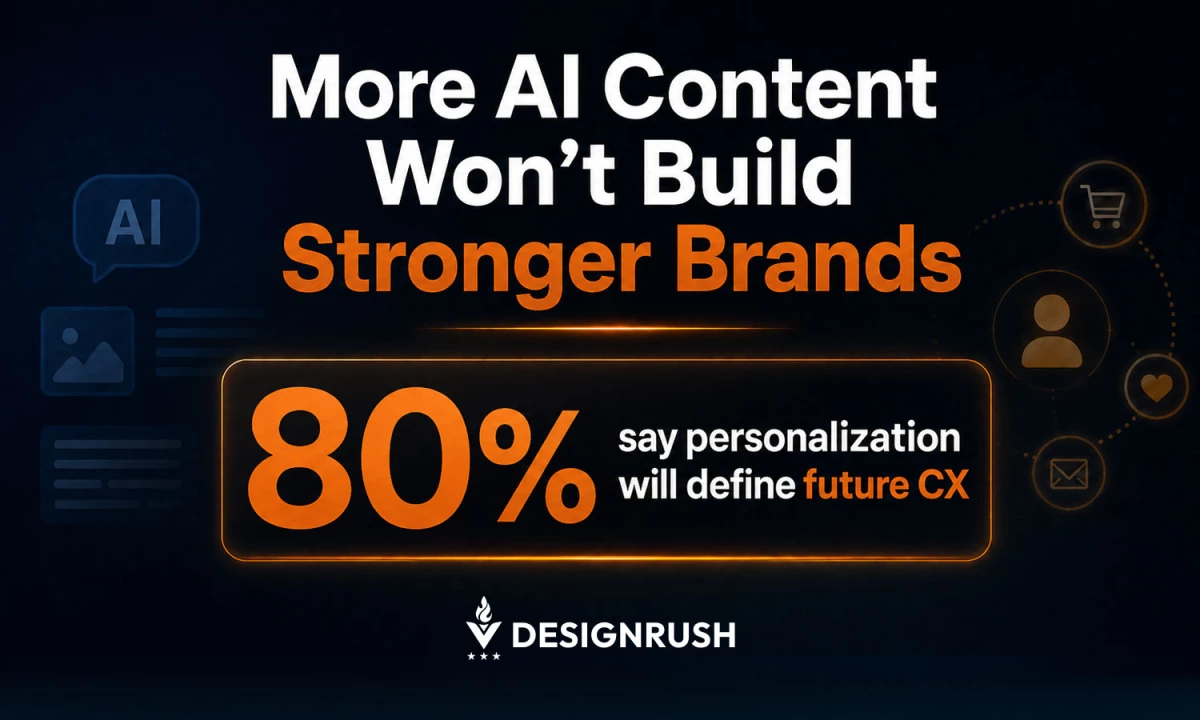
Nearly 80% of organizations believe highly personalized experiences will define customer experience breakthroughs over the next two to three years, according to Adobe’s 2026 AI and Digital Trends report.
That’s why custom web design and conversion-focused UX will become even more significant as the AI-generated marketing efforts continue to grow.
When visual production becomes easier, the quality of the user experience after those initial clicks becomes a much stronger differentiator.
With that said, a stunning visual can pique interest, but a well-designed digital experience converts that interest into revenue.
Do Human Stories Still Carry More Weight?
Memorable brands are rarely created by following common trends.
They are built through unique experience and expertise. The way the story is told is where that experience and expertise are brought to life.
A founder’s anecdotes, a customer transformation, or an insight gained over time in a business gives brands that storytelling edge that AI cannot create on its own.
This is where the fusion between AI and humans comes to life. The human experience is the ultimate catalyst for creating something beautiful and long-lasting using generative AI.
To put it in context, broad claims are everywhere.
Every company is innovative, every service is personalized, every product is designed to be life-changing.
But those claims mean nothing without real evidence and a true story that makes them believable.
People are starting to place greater value on content that feels authentic.
Brands that know what they believe and are willing to express those beliefs clearly will stand out from those simply generating AI content to fill up their monthly or quarterly social media calendar.
How to Use AI as an Accelerator
Marketers and designers alike should embrace tools such as Google Pics, as AI-powered design is set to become a standard part of the creative process.
Think of all the innovations that came before Generative AI, including editing software and content management systems.
Companies should use AI to explore concepts, create variations for A/B testing, and adapt assets to accelerate production time, ultimately.
However, I must stress that human insight and experience must guide:
- Brand positioning
- Messaging
- Creative direction
- User experience
- Conversion strategy
If not, then we’re all in for some boring and ineffective marketing efforts in the years to come.
Refreshingly, Google has even advocated for a human-in-the-loop approach, in which people use their subject-matter knowledge and experience, along with professional judgment, to direct and refine generative AI output.
Balance as such truly matters, as AI performs best when it’s given clear direction, strategy, constraints, and oversight.
Without these factors, AI allows businesses to produce generic work more efficiently.
The bottom line is that Google Pics may make it a lot easier for the average person to generate a polished visual. Still, it won't make every company memorable or successful.
The brands that succeed will be the brands with original thinking, branding, and digital experiences designed around real human behavior.