
Human Agents in AI Workflows: Key Findings
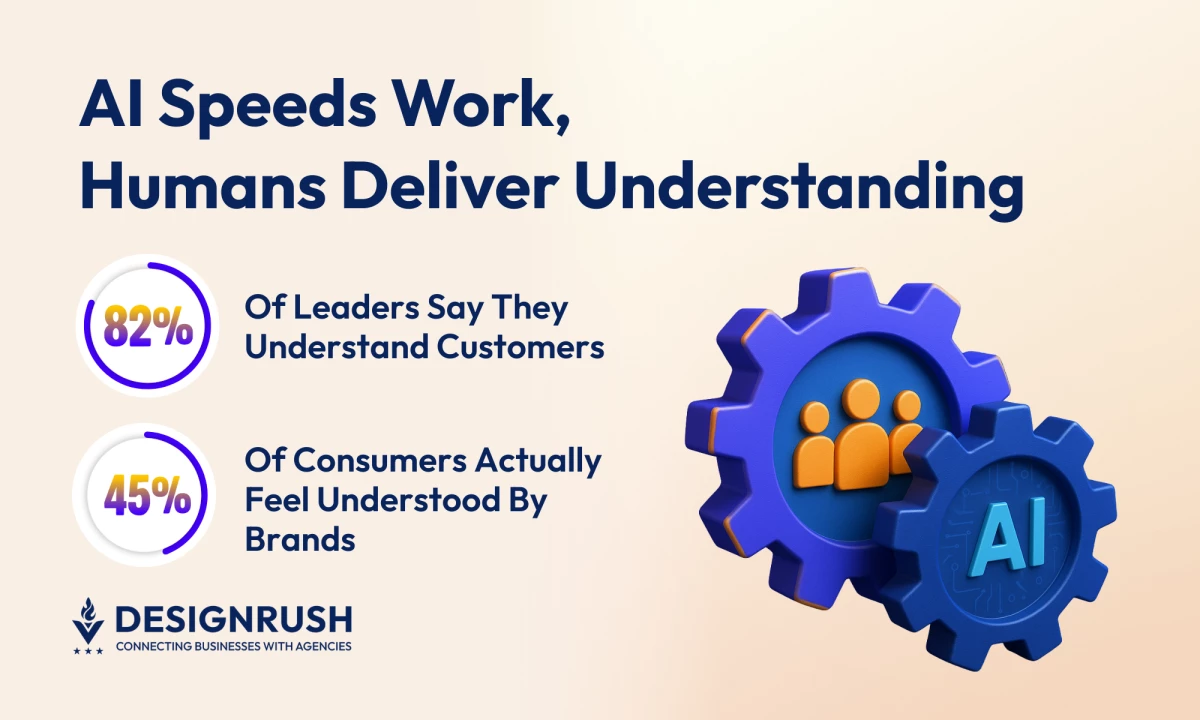
- 82% of leaders say they understand customers, but only 45% of consumers agree, demonstrating why human insight is essential for making AI outputs meaningful.
- Close the gap by embedding humans into AI workflows, starting with key handoffs and letting AI handle repetitive tasks without losing context.
- Hugo’s client cut human-handled chats by 50% on day one by combining clear workflows with AI, proving disciplined execution scales quality efficiently.
AI has become the default answer to customer experience problems. But despite massive investment, the results tell a different story.
A recent report from Twilio reveals a widening perception gap: 82% of business leaders believe they understand their customers. Only 45% of consumers agree.
That gap puts billions in personalization, CX, and automation spend at risk. And it explains why so many “AI-powered” experiences still feel generic, disconnected, or frustrating.
AI is excellent at speed, pattern recognition, and scale. What it cannot do on its own is:
- Interpret nuance when signals conflict
- Explain why a customer is behaving a certain way
- Build trust in moments of uncertainty
Those gaps require human agents who can read nuance, catch the signals machines miss, and feed context back into the system
Brands don’t need bigger promises. They need better execution, starting with smarter, hybrid support models that combine automation with human judgment.
Editor's Note: This is a sponsored article created in partnership with Hugo.
Putting Humans First in AI Workflows
This is the gap global outsourcing firm Hugo focuses on closing.
Across support, sales, and back-office operations, Hugo sees the same pattern: AI is adopted quickly, but without clear handoffs, shared context, or ownership.
Agents end up rewriting responses, second-guessing outputs, or working around the system entirely.
In practice, the fastest fix is almost always the simplest. Start small, track what moves each week, and expand only when quality holds.
Funmi Mide-Ajala, Director, Customer Support & Digital Operations at Hugo, puts it simply:
“The goal isn’t more automation. It’s about clearing noise quickly and letting humans focus where they add real value. The AI handles routine questions, and anything uncertain goes straight to an agent with full context.”
Once the noise is removed, human agents finally have the bandwidth to catch nuance, coach the AI, and close the understanding gap that automation on its own never solves.
In one case, Hugo helped a client reduce human-handled chat volume by roughly 50% on day one by deflecting routine requests through clearer AI workflows and escalation logic.
That shift led to a measurable lift in first-contact resolution, as agents handled fewer but more context-rich conversations.
The Real Reason Personalization Breaks Down
Most brands fall into the same trap Twilio highlights.
They invest in AI with the hope of unlocking personalization, only to learn their teams can’t operationalize the intelligence being produced.
Insights stall in dashboards, notebooks, and reports. Meanwhile, frontline teams, the people shaping customer experience in real time, wait on answers that should take minutes.
SimplicityDX points out that context matters: shoppers arrive from different sources with different intentions, yet most brands still funnel everyone to the same static experience.
Personalization fails not because predictions are wrong, but because context doesn’t travel.
When humans and AI share the same thread, signals can be interpreted, challenged, and acted on immediately.
Hugo’s most effective programs keep AI and agents tightly linked:
- Agents see live signals, not post-hoc reports
- Interventions happen in real time
- Feedback loops continuously refine the model
That combination turns raw intelligence into experiences that customers actually notice and value.
The most effective hybrid models are intentionally narrow at first.
In customer support:
- AI drafts responses, classifies requests, and surfaces patterns
- Humans refine tone, resolve ambiguity, manage exceptions, and safeguard quality
Sales and ops teams get similar boosts.
- AI generates proposals or outreach messages, while humans spend time nurturing relationships and closing deals.
- Back-office teams process paperwork faster, and multilingual content flows smoothly without miscommunication.
The trick is starting small. Pick one workflow, test AI, gather feedback, refine, and expand.
Oversight is non-negotiable. AI cannot interpret cultural nuances, handle exceptions, or maintain ethics on its own.
Humans-in-the-loop are vital to keeping AI trustworthy.
What This Means for Brands and Agencies
Twilio’s findings point to a clear conclusion: Companies that sideline the human layer risk widening the gap between what leaders believe they deliver and what customers actually feel.
If your goal is real customer understanding, treat human insight as a core input, not an optional extra.
Start with the workflow your teams touch most, clean the handoffs, and let AI handle the repetitive load so agents can work with context instead of noise.
Hugo’s clients, seeing the strongest gains, have anchored AI to clean workflows, given agents visibility into live signals, and designed feedback loops that continuously sharpen both human and machine performance.
Turning AI into Real Understanding at Scale
The bottom line for brands trying to personalize at scale?
Brands that pair high-accuracy AI with capable human agents are far more likely to close the gap Twilio highlights and deliver experiences customers actually trust.