
Shopify Horizon Takeaways:
- 91% of SMBs say AI drives revenue and boosts efficiency, making Horizon’s AI features a strategic advantage.
- Migrating to Shopify Horizon requires managing complex technical shifts and a steep learning curve while phased rollouts minimize risk.
- Human judgment and creative strategy remain crucial even as AI handles routine tasks; early adopters who master this balance win.
91% of SMBs using AI say it drives revenue, and 90% say it improves efficiency, according to Salesforce's Small & Medium Business Trends Report.
Shopify’s Summer ‘25 rollout makes that clear with Horizon: a modular, AI-powered theme system that reduces development time and lowers barriers to experimentation.
However, switching from legacy themes to Horizon isn’t a simple plug-and-play.
As Caleb Bradley, CEO of Bighorn Web Solutions, puts it: “The merchants who win are the ones who let AI handle the busywork so their teams can focus on strategy, performance, and brand.”
Powerful, Flexible — But Not Plug-and-Play
With its block-based structure, AI-assisted customization, and ten conversion-optimized presets, Horizon strips away the complexity that’s long slowed down site changes.
“The integration of AI enables the generation of custom theme blocks based on simple prompts, in theory will greatly reduce the barrier to exploring a lot of ideas by reducing timeline/cost and other dependencies part of a more traditional design/development process,” Bradley said.

But unlocking those benefits demands a clear understanding of the technical and operational shifts Horizon brings, as Bighorn Web Solutions has found:
1. Migration Complexity
- Merchants using older Liquid-based themes (like Dawn or legacy custom builds) can run into issues moving to Horizon’s React-powered, block-based setup.
- Backward compatibility with older themes is limited.
- Custom features, metafields, or unique design elements need to be rebuilt using App Blocks or React components via Oxygen.
2. Learning Curve for In-House Teams
- Moving to a component-driven, API-first setup with Shopify Functions, Theme Blocks, and Custom Pixels is a big change.
- Non-technical teams often struggle to grasp how schema, slots, and extensibility work in Horizon themes.
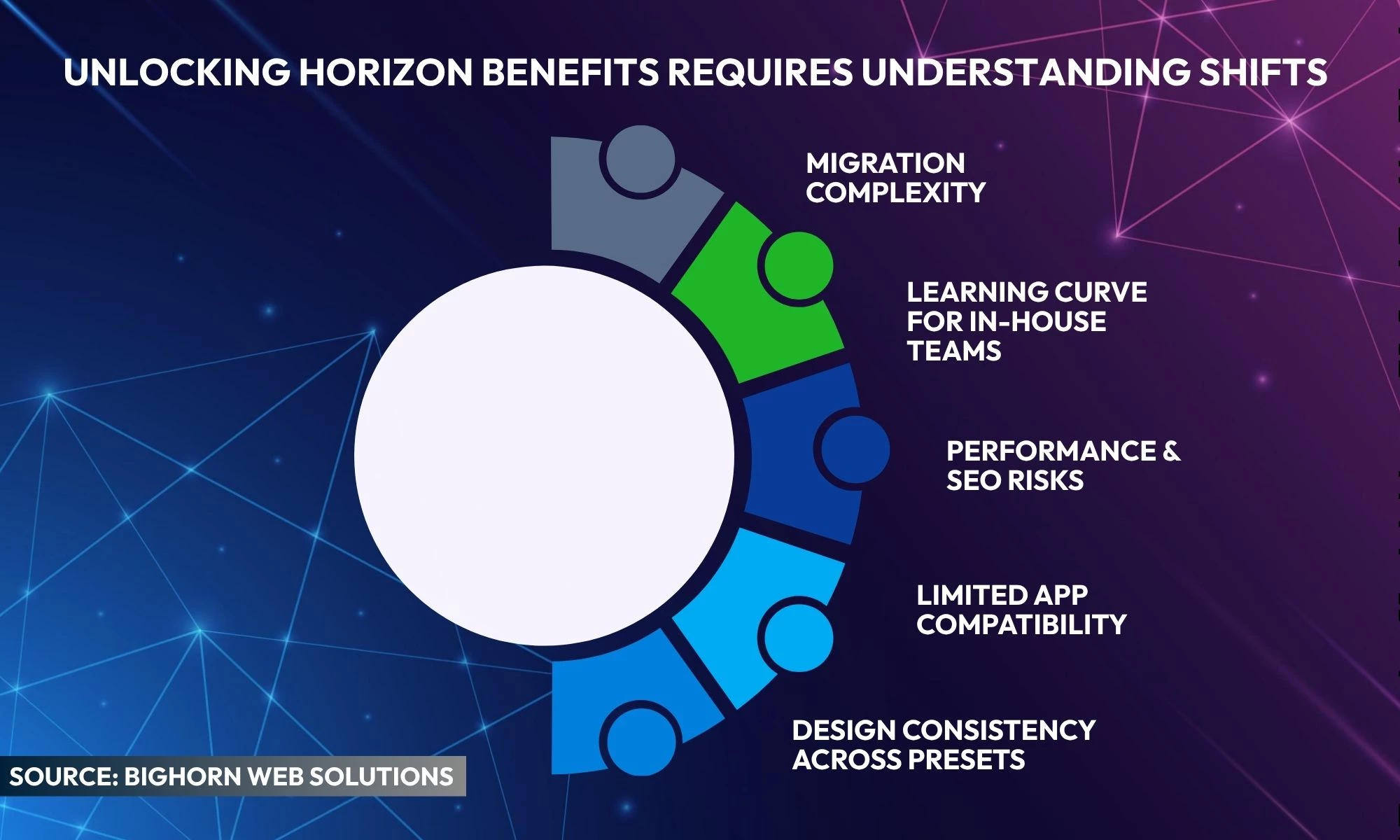
3. Performance & SEO Risks
- Poor implementation can cause bloated blocks and misconfigured hydration logic.
- Broken LCP benchmarks may undermine Core Web Vitals.
- Misusing client-side interactivity can hurt crawlability and indexing.
4. Limited App Compatibility (Initially)
- Many third-party apps are still updating to be compatible with Horizon.
- Merchants may find that key apps don’t yet support embedded theme extensions.
- This is especially true for apps relying on deprecated theme APIs.
5. Design Consistency Across Presets
- Horizon’s starter themes are solid but use a preset model.
- Businesses wanting a tightly branded UI may find presets limiting.
- Custom development or design system integration is often needed for full brand consistency.
Phased Rollouts, Smarter Gains, Less Burnout
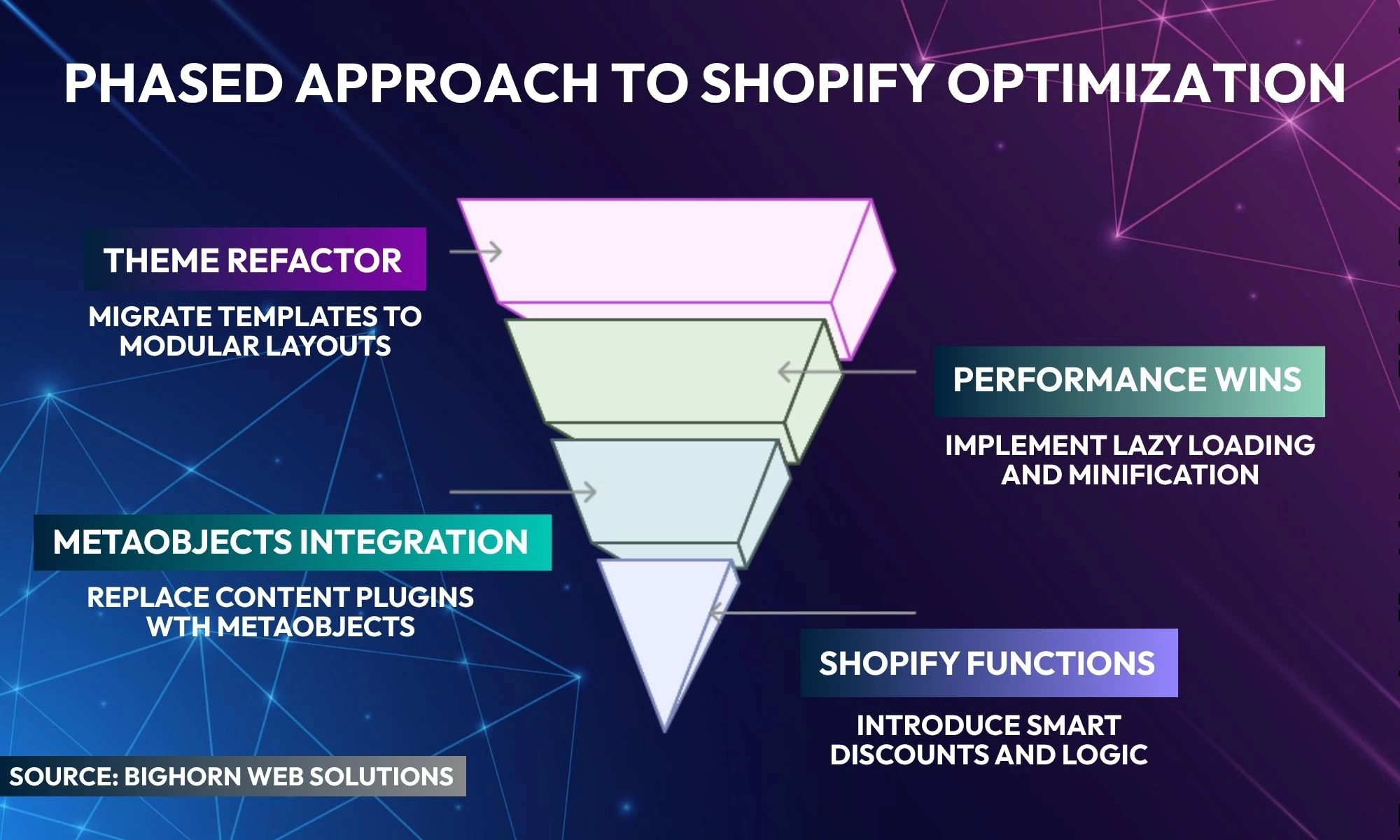
The good news? You don’t need to overhaul everything at once. According to Bradley, the smartest move for most merchants is a phased approach that delivers early wins without stretching teams or budgets too thin, consisting of:
1. Incremental Theme Refactor
- Move one or two key templates, such as the product page or homepage, to modular layouts powered by metaobjects
- Introduce performance wins such as lazy loading, minified Liquid, and Shopify-hosted assets
2. Leverage Metaobjects + Shopify Functions
- Use metaobjects to replace content plugins
- Introduce Shopify Functions for smart discounts, shipping logic, or cart rules
“The winners won’t just be the loudest brands, but the ones who quietly replace app bloat with native extensibility, leverage metaobjects like a CMS, and master Shopify’s built-in tools for retention and margin growth before everyone else does,” Bradley added.
As teams embrace a phased rollout and lean into Horizon’s modular capabilities, the question becomes: where do humans add the most value when AI like Sidekick (Shopify’s 24/7 “expert”) is already handling the heavy lifting?
According to Bradley, human teams still play a central role in anything involving judgment, systems thinking, or creative differentiation.
Bottom line: The advantage will go to those who adopt what matters, master it early, and let AI clear the path for smarter, faster, more focused growth.
Beyond the headline features, Shopify’s 2025 rollout includes a handful of overlooked updates that give early movers a quiet edge:
1. Native Bundles API Improvements (Now GA)
Shopify’s native Bundles API now enables advanced logic, built-in analytics attribution, and real-time inventory synchronization without relying on third-party apps.
“It matters because merchants can build custom kits, volume-based bundles, and cross-sells with no performance drag. Developers can now tie these directly to metaobjects or subscription logic via Shopify Functions,” Bradley said.
2. Deeper Metaobject Display Support
Metaobjects now enable dynamic sections in Online Store 2.0 themes and receive enhanced support in Horizon.
According to Bradley, you can build CMS-like systems within Shopify, including custom landing pages, shoppable galleries, and location finders without apps.
“Brands that move fast here will cut down reliance on bloated tech stacks and create scalable content faster.”
3. Checkout Extensibility for Post-Purchase Upsells
New extensibility features in checkout and post-purchase areas let apps and custom developers add personalized upsells and logic directly.
“Instead of janky third-party solutions, smart brands can drive AOV using Shopify’s secure APIs with no checkout conversion penalties.”
4. ShopifyQL Notebooks Enhancements
ShopifyQL now supports custom visualizations and longer retention windows.
“Brands who embed this into their reporting (instead of exporting to Looker or GA) will have better velocity on insights like LTV, cohort performance, and merchandising ROI.”
5. Built-In B2B Permissions & Price Lists Enhancements
Expanded capabilities now support B2B customer segmentation, permissioning by catalog, and tiered pricing without requiring complex ERP systems.
This too matters, Bradley said.
“SMBs selling wholesale or DTC+B2B now have more leverage to run hybrid stores without separate storefronts or custom code.”
From modular themes to smarter media strategies, the playing field is shifting. The real winners aren't chasing every trend but building systems that serve real people in real time.
As heard on the floor at Shoptalk, it’s about connecting better. That’s the mindset shaping the next wave of retail.