-details-webp.webp)

Key Findings:
- Tech salaries in Wyoming fell 6.62% after adjusting for inflation across the decade.
- Limited broadband access continues to block remote work expansion, and the state offers few tax incentives tailored to the tech industry's needs.
- Workforce programs focus more on trades than digital careers, and major cities like Cheyenne lack the scale to support tech hubs.
- Venture capital activity remains low or nonexistent, with no flagship university STEM initiative linked to tech growth.
- Tech professionals are leaving in search of better opportunities.
Quick listen: Wyoming ranks last for tech salary growth. Here’s why it matters, in under 2 minutes.
While neighboring states capitalize on remote work and rising tech investment, Wyoming ranks dead last in tech salary growth.
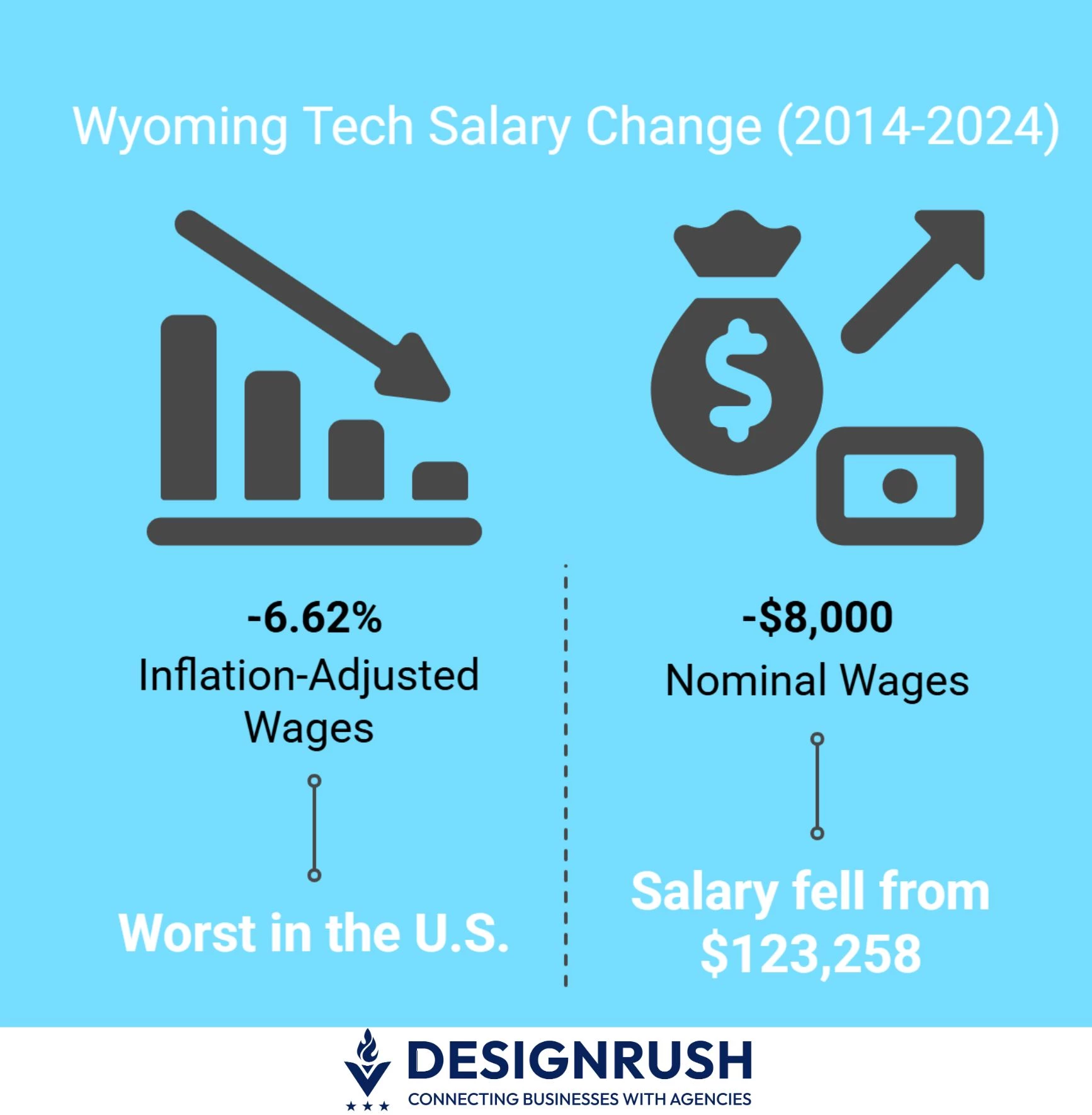
DesignRush’s 2025 U.S. Tech Salaries Report reveals that from 2014 to 2024, tech professionals in the state experienced a -6.62% inflation-adjusted wage decrease.
Even as remote work opened new markets across rural America, Wyoming struggled to attract or retain tech professionals.
Unless bold, targeted policy changes are introduced, the Equality State risks remaining a digital desert in the next phase of the tech economy.
Why Wyoming Ranks Last in U.S. Tech Wage Growth
Wyoming’s inflation-adjusted tech salary fell from $123,258 in 2014 to $115,100 in 2024.
This resulted in a real earnings loss of $8,158 (–6.62%), the steepest decline in the nation, placing it at the bottom when it comes to tech wage performance.
Wyoming experienced flat or even negative growth in key fields such as:
- Cloud computing
- Network engineering
- Cybersecurity
Other states like Idaho (ranked as the best for tech wage growth by DesignRush) saw double-digit salary increases.
The absence of upward wage pressure in these roles contributed significantly to the tech salaries' overall decline in Wyoming.
It currently supports fewer than 1,000 tech professionals, with minimal contributions to gross state product from digital industries.
The state's rural nature and the absence of major corporate tech hubs suppress both employment growth and wage competitiveness, unlike neighboring states with urban-based tech clusters.
This contributes to an outflow of tech talent seeking better career prospects elsewhere.
Weak Digital Infrastructure Undermines Remote Potential
Wyoming has received over $347 million in federal broadband grants, yet more than 39,200 homes and businesses remain unconnected.
Vast geography, rough terrain, and sparse population density complicate last-mile connectivity, especially outside Cheyenne and Casper.
The state’s 2020 broadband report confirmed persistent service gaps in remote communities, limiting remote work opportunities and local tech hiring.
Minimal Business Incentives for Tech Growth
Unlike Idaho’s generous 30% TRI tax credits, Wyoming lacks tech-specific incentives that appeal to fast-scaling companies.
State programs largely focus on energy and manufacturing. Training grants are available, but:
- Only about 8% of state incentives are tax-based, compared to a national average of 45%.
- A budget of $4,000 to $5,000 per hire reflects how business development programs offer limited per-job support.
This policy gap reduces Wyoming’s competitiveness when courting tech firms that increasingly evaluate tax relief, workforce support, and infrastructure when choosing where to grow.
Underdeveloped Workforce Pipeline
Despite a strong culture of apprenticeships, Wyoming’s workforce training system lacks a digital reskilling focus. Key issues include:
- No state-backed coding bootcamps, DevOps academies, or data science fellowships
- Public support programs prioritize trades over software, cloud, and analytics roles
- No scalable partnerships with tech giants like Amazon, Google, or IBM for upskilling
This misalignment reduces the size and skill level of Wyoming’s tech workforce, making it difficult to grow salaries through internal promotions or specialized hiring.
Lack of Tech Hubs or Anchor Employers
Idaho has Boise. Utah has Salt Lake City. Colorado has Boulder and Denver.
Wyoming lacks a metro-scale city capable of sustaining a tech economy, specifically, Cheyenne and Casper lack:
- Major corporate anchors in software or IT
- Competitive STEM talents and large STEM programs from research universities
- Venture capital presence or co-working infrastructure
This leaves the state dependent on outbound migration, further depressing salaries due to low demand, fewer job alternatives, and poor market competition.
The Worst States for Tech Salary Growth in 2025
Aside from Wyoming, nine other states also experienced a decline in tech salaries over the past decade.
Delaware closely follows Wyoming with a -6.57% drop in tech wages, despite its growing startup scene.
-content-large-webp.webp "10 Worst states for Tech salary growth in 2025")
Rhode Island and Mississippi saw steep declines of -4.05% and -3.90%, signaling deeper regional challenges in supporting tech talent.
Even large states like New York weren’t immune, posting a -1.48% drop, reflecting high costs and sluggish wage growth in the sector.
The Road Ahead: Bridging the Digital Divide
Despite the drawbacks it's experiencing, Wyoming still has the opportunity to reverse course by:
- Fast-tracking broadband infrastructure via the BEAD program and state-local partnerships
- Introducing targeted tax credits and capital incentives for tech relocation
- Partnering with universities and Big Tech for STEM bootcamps
- Supporting urban development and co-working ecosystems in Cheyenne, Casper, and Laramie
Until these foundational gaps are addressed, the state will remain at the bottom of the national tech salary ladder.
Methodology
This analysis is based on the U.S. Bureau of Labor Statistics’ Occupational Employment and Wage Statistics (OEWS). Data includes:
- Inflation-adjusted 2014 salaries using CPI
- 2024 nominal salaries
- States with full data coverage (Colorado excluded as per BLS notice)
- Key tech occupations selected via SOC codes
For source accuracy, see BLS tables and the CPI inflation calculator.
From workforce mobility to digital infrastructure, these agencies help brands and governments act on what the data actually shows: