
Imagine this: your small business is the talk of the town, but you're not in the room to hear it. Your customers are chatting about you online, and every mention could hold valuable insights, but you're not in the loop.
How do you join the conversation? By proactively tracking your Share of Voice (SOV) and brand mentions.
Monitoring brand mentions isn't just a strategy — it's your key to staying relevant and thriving as a small business in a competitive market. It can even lead to securing a multi-million dollar deal — which did happen to a brand!
In this interview, Mentionlytics' Head of Product and Co-Founder Manos Perakakis discusses:
- How to handle reputation management with limited resources
- How tracking competitors' mentions can improve your digital presence
- How it helped ContentCal find its market position before securing Adobe’s $100M acquisition

Who Is Manos Perakakis?
Manos is the Head of Product and Co-Founder at Mentionlytics, a Web & Social Media Monitoring platform. With a Ph.D. in UX-related research from Brunel University, an MSc in Internet Tech and Multimedia from the University of Bristol, and a BSc in Computer Science from the University of Essex, he is an expert in UX/UI design. Manos also lectures on digital marketing topics at the Hellenic Mediterranean University.
I was curious to hear from Manos whether small businesses need to track brand mentions as rigorously as larger corporations due to their limited resources and different scale of operations.
This was his answer:
“I can quite relate to this since the idea when we started Mentionlytics eight years ago was to create a tool that would be affordable, both in terms of budget and time, for small businesses and not only big ones.”
He cited a few reasons why small businesses should track their brand mentions online:
“One main reason is to check on competitors, which are probably established businesses, and see what works for them and what doesn’t.
This way, they can get ideas quickly and adjust their digital presence accordingly.
This could be a great shortcut to finding out what works for you, which is not easy without a lot of experience and assets.
In the same fashion, they can easily discover what is going on in their industry, and even find leads, or ideas for their products.”
Always Track Negative Mentions During Brand Crisis
As per Manos, monitoring the volume of negative mentions is crucial when taking steps to counteract and resolve a brand crisis. He even reinforced that this is one of the most common case studies of using Mentionlytics.
I agree with him!
Every business should be on top of negative mentions to understand the severity and impact of the situation.
By tracking how often negative comments and mentions about your brand appear, you can gauge the severity of the issue and the effectiveness of your corrective actions.
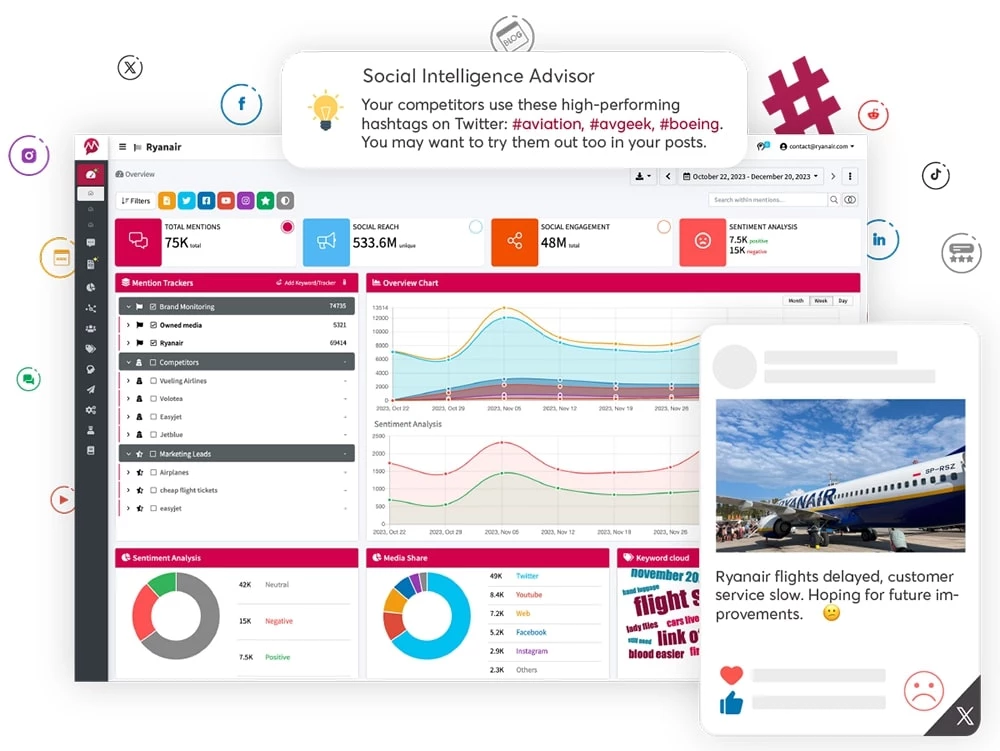
Manos explained that with Mentionlytics, you can track whether your actions to address a crisis are effective by observing changes in the volume and sentiment of mentions.
If the negative mentions decrease, it indicates that your actions are working, and you can determine when the crisis has been resolved, he added.
Moreover, continuous monitoring allows you to stay ahead of potential issues.
The system automatically alerts you if it detects an unusual increase in negative mentions, signaling a possible new crisis. This early warning enables you to take prompt and appropriate measures to prevent the situation from escalating, he concluded.
Handling Reputation Management with Limited Resources
Manos also shared how businesses with limited resources can handle their reputation management effectively:
“Affordable and user-friendly tools, often enhanced with AI, can help with brand reputation management, allowing you to do more with less.
First, listen and analyze using these tools to gain insights into what works best for you, your industry, and your competitors.
This approach serves as a live, daily-updated best practices manual.”
Manos also shared with me that businesses can use his platform to monitor not only their brands but also their competitors which helps identify:
- What kind of posts work for them
- Effective brand ambassadors
- Common complaints about their competitor’s products or services
“This knowledge can improve offerings and identify direct leads from dissatisfied customers,” he adds.
If you are looking for a partner to help enhance your online presence and safeguard your brand's public image, our DeisgnRush's listing of top reputation management companies is a great place to start.
Leveraging AI for Robust Features
Manos explains that his company has utilized AI technologies since its inception, starting with deep learning algorithms for Sentiment Analysis and launching the first Social Intelligence Advisor (SIA) in 2018.
Its AI Mention Clustering feature groups mentions by topic, saving users time by highlighting top trends instantly.
Mentionlytics is also upgrading its SIA to uncover deeper, actionable insights that would otherwise require extensive human analysis.
Additionally, the company recently launched its new AI Emotion Analysis and according to Manos:
“We are always exploring new, exciting ways to analyze all this data our system gathers. We have been using Sentiment Analysis for quite a while, but we have been also experimenting with other similar technologies like AI Emotion Analysis.
This adds another layer of understanding of each mention, by evaluating the underlying emotion of the post.
So, our AI algorithms try to understand if the post expresses Anger, Sadness, Joy, or Fear.
This can deepen the understanding of our mentions, and of course, by aggregating these we can see the changes in time for these emotions, or find out what triggers those.”
Google Alerts vs. Brand Reputation Monitoring Tools
How about using Google Alerts to track mentions?
Even though people still use Google Alerts today, its functionality won't let you effectively catch up with what’s happening on social media.
“Google Alerts is a great free tool that can give you a small hint of what is out there for a keyword, e.g. a brand, a name, or anything. It was a very useful tool when it was originally introduced many years ago," Manos remarks.
However, he suggested that it is certainly not very useful for professional use.
According to him, the three main limitations are:
- The amount of data it retrieves: It gets data almost exclusively from Google web results, so it misses most social media data.
- The analysis of the retrieved data: There is no analysis of the retrieved data. It simply sends you emails with mentions of your keyword at irregular intervals, making it nearly impossible to draw meaningful conclusions.
- Coverage: With Google Alerts, you may only capture 1% or less of the mentions, missing the vast majority of relevant data.
So, while Google Alerts provides a basic level of monitoring, businesses serious about their online reputation should consider more comprehensive tools to capture the full scope of online mentions and perform detailed analysis.
Tracking Businesses' Market Standing
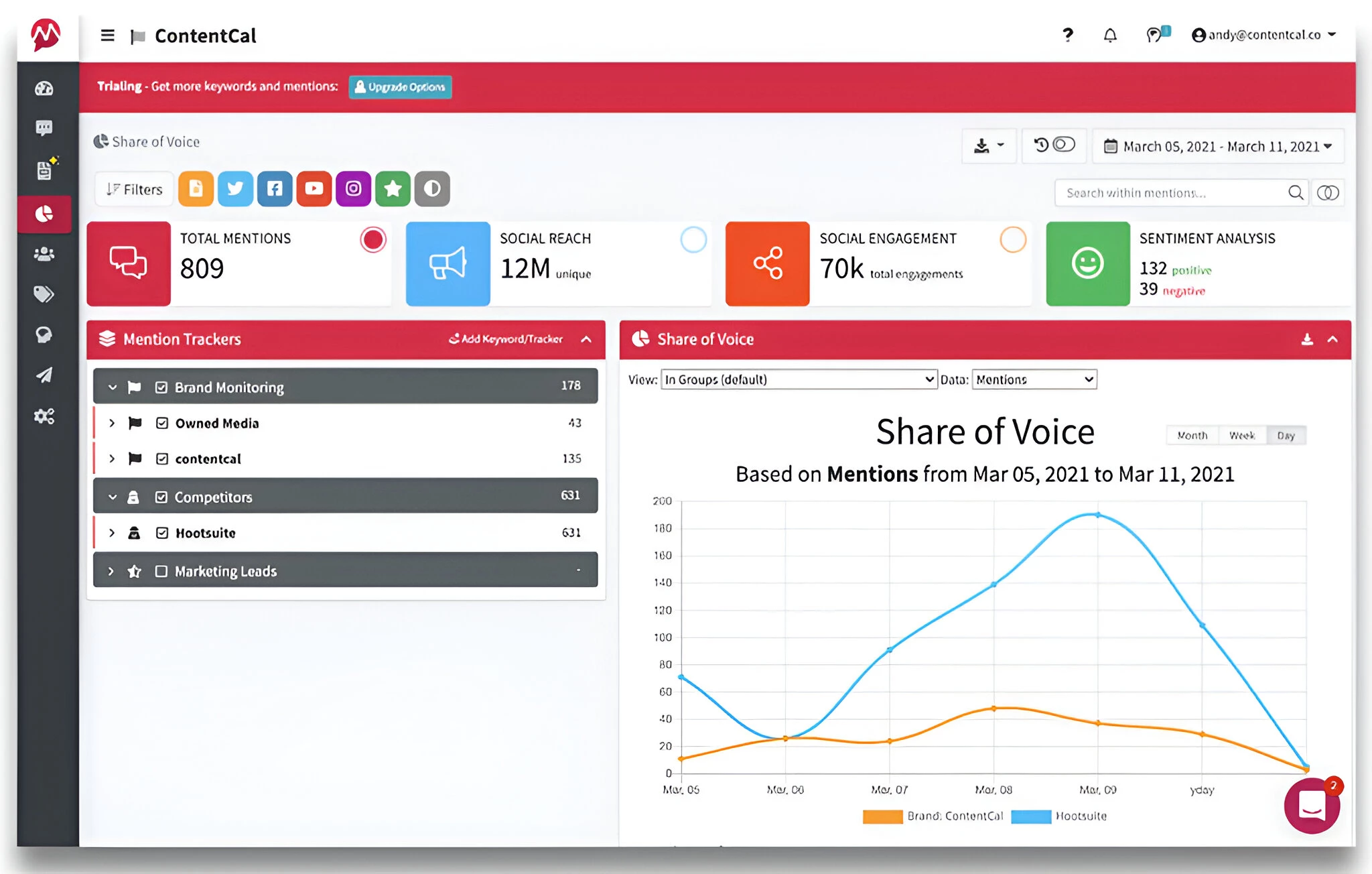
Discussing how small and large businesses leverage Mentionlytics, Manos shared their case study on ContentCal, which uses the platform to enhance social media monitoring and engagement.
With Mentionlytics' comprehensive tracking, sentiment analysis tools, and share of voice metrics, ContentCal gained valuable insights into its brand mentions across various platforms.
This led to more effective engagement strategies and significant improvement in their online reputation management.
The company boosted customer interactions, identified key areas for content improvement, and drove overall business growth resulting in a $100 million acquisition by Adobe.
“It was after they measured this metric through Mentionlytics, that they could easily showcase their position on the market to their investors, and decide on their next steps, which eventually led to the successful acquisition by Adobe,” Manos says.