
Paramount x Warner Bros. Discovery: Key Findings
- WBD is considering reopening negotiations with Paramount after receiving an enhanced $108.4 billion offer that addresses financing concerns.
- Paramount agreed to pay the $2.8 billion Netflix breakup fee and offer shareholders $650 million quarterly in cash starting 2027 until deal closure.
- This could still trigger a competing bid from Netflix under contract terms, allowing WBD to pursue superior offers.
Warner Bros. Discovery is weighing whether to reopen deal talks with Paramount after the rival studio submitted an improved hostile bid addressing key concerns that led to the initial rejection.
In December, Warner Bros. Discovery agreed to sell its streaming and studios business to Netflix for $83 billion.
It then rejected Paramount's $108.4 billion offer for the entire company, including cable assets.
Warner Bros is considering restarting sales talks with Paramount after their latest offer.
— DiscussingFilm (@DiscussingFilm) February 16, 2026
(Source: https://t.co/vFzyrgg2zl) pic.twitter.com/GcO3dNYZlo
Warner Bros. Discovery cited the Netflix deal as less risky despite Paramount's higher valuation.
Paramount has since taken its bid directly to shareholders and filed a Delaware lawsuit forcing a proxy fight over the Netflix transaction.
Last week, Paramount addressed WBD's financing concerns by agreeing to pay the $2.8 billion breakup fee owed to Netflix if the deal is terminated.
The enhanced offer also includes backing WBD's debt costs and paying shareholders approximately $650 million quarterly in cash.
Board Evaluates Superior Offer Provision
WBD board members are now discussing whether Paramount's enhanced bid could constitute a superior offer under the terms of allowing the pursuit of better deals.
The Netflix contract includes a stipulation permitting WBD to evaluate competing proposals that may lead to superior transactions.
If the board decides to reopen talks with Paramount, it must notify Netflix according to the deal terms, giving the streaming giant an opportunity to improve its own offer.
Warner Bros. Discovery has until February 25 to respond to Paramount's latest proposal.
This comes as investment firm Ancora publicly opposed the Netflix deal last week, citing concerns about the carved-out cable business valuation and regulatory approval prospects.
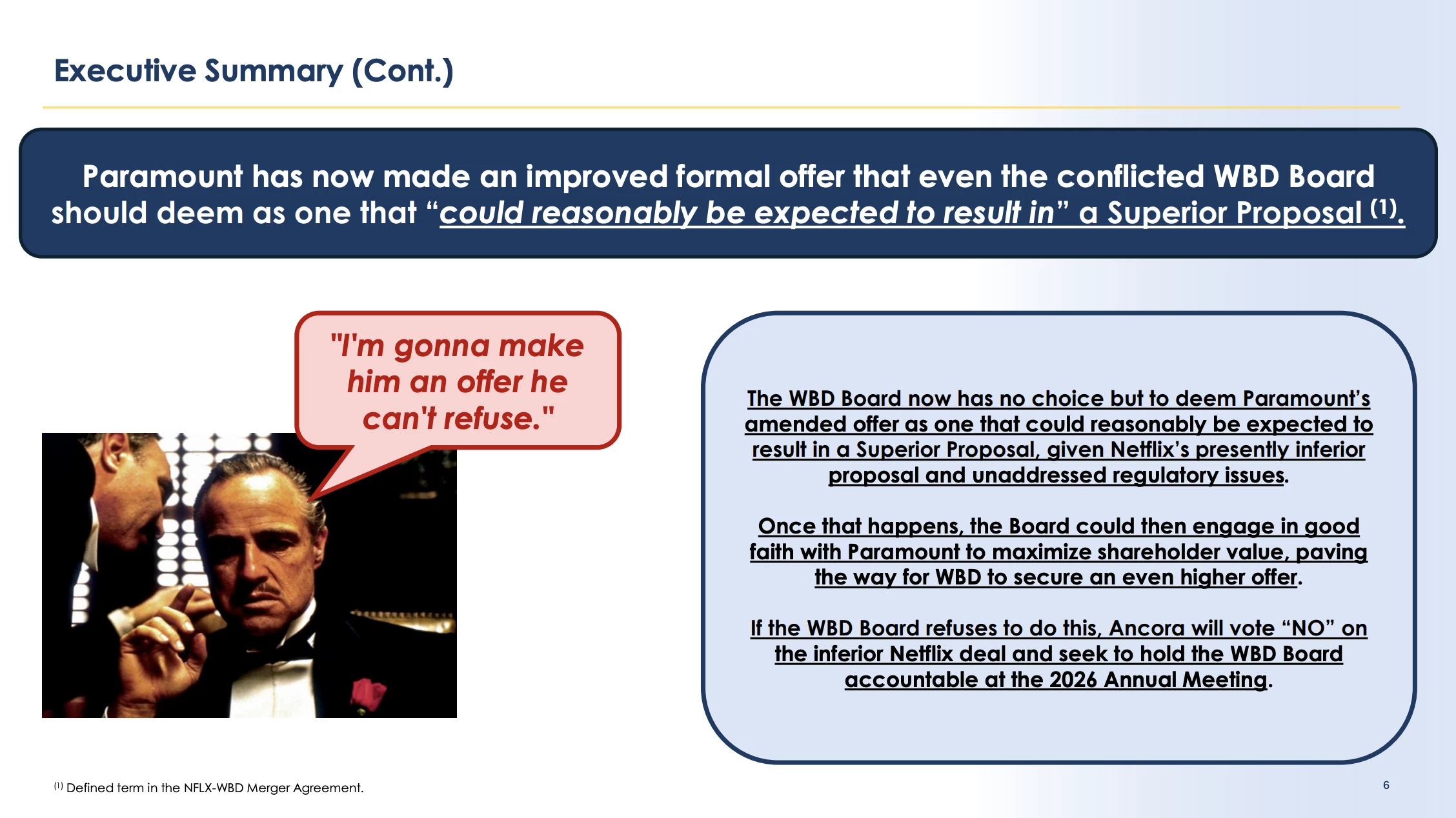
Ancora used imagery from Paramount's "The Godfather" in a publicly-accessible presentation.
The firm also argued that WBD should consider the Paramount offer, with an image of Marlon Brando declaring, "I'm gonna make him an offer he can't refuse."
What's at stake here is more than price, as the board’s decision will signal how the company values long-term brand positioning, competitive leverage, and investor confidence.
Ownership Changes Create Platform Uncertainty for Brands
The extended deal timeline and competing bids create uncertainty for brands planning long-term advertising strategies across WBD's platforms.
Regulatory approval remains a key factor, with both Netflix and Paramount requiring clearance from U.S. and international authorities before any transaction can close.
WBD shares have fallen approximately 1.8% since the start of 2026, while Netflix shares have dropped about 15% amid deal uncertainty.
The volatility affects brands with existing advertising commitments across HBO, Max, and Discovery+, as well as Warner Bros. theatrical releases.
The company awaits SEC approval of filings that would allow scheduling a shareholder vote on the Netflix deal, potentially occurring by mid-March if the board proceeds with that transaction.
The deal uncertainty has already impacted investor confidence, with TD Cowen cutting its Netflix price target from $140 to $120 following the Warner Bros. Discovery announcement.
It also shows how brands must evaluate how ownership transitions could affect content pipelines, ad inventory availability, and partnership terms across these platforms.
The Paramount-Warner Bros. saga offers lessons for brands involved in media consolidation, whether directly or indirectly:
- Build flexibility into media plans to adapt to changing ownership and approval timelines.
- Diversify platform partnerships to reduce exposure to any single corporate transaction.
- Assess how structural changes may affect commercial fundamentals across content, pricing, and partnerships.
Media consolidation changes who controls inventory and distribution, so growth strategies need to factor in ownership risk from the outset.
Our Take: Does Paramount's Persistence Pay Off?
I think Paramount's enhanced bid creates complications for brands invested in WBD's platforms.
The quarterly cash payments and breakup fee coverage address board concerns, but the extended timeline means another 12-18 months before ownership clarity emerges.
Brands with commitments across HBO, Max, or CNN face uncertainty about future partnership terms and content strategies.
The competition between Netflix and Paramount benefits shareholders, but it will delay decisions affecting many other aspects, like production and partnerships.
In light of this, I think brands planning major campaigns across these properties need contingency plans for either ownership outcome.
In other news, MrBeast's Beast Industries acquired fintech app Step, demonstrating how creators can build long-term infrastructure beyond content and merchandise.
Brands managing media investments during major industry consolidation need agencies that understand how ownership changes affect advertising partnerships and content strategy.
Explore the top media buying agencies in our directory.