
Increasing AI Citations: Key Findings
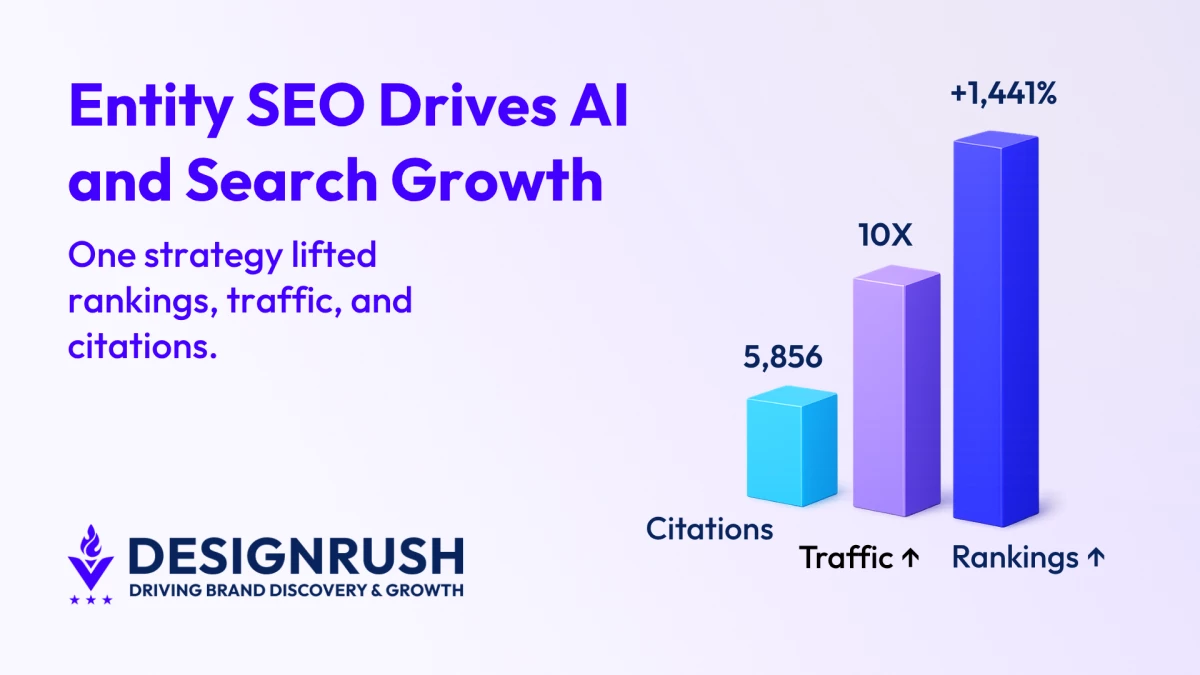
- Victorious helped a global cybersecurity leader grow monthly organic traffic 10x and top-3 keyword rankings by 1,441 percent through a coordinated entity authority strategy.
- The campaign produced 5,856 AI Overview citations, making the client the primary source AI platforms cite for OT security topics.
- Content structured to answer specific, high-intent questions and interlinked to build an OT security content hub drove citation performance across both AI and traditional search.
Zero-click searches are becoming more and more common nowadays.
According to research by Bain & Company, 80% of consumers rely on AI summaries, including Google’s AI Overviews, in at least 40% of the searches they initiate.
Given this, increasing brand citations on AI Overviews and other AI search platforms is quickly becoming the best way to maintain online visibility.
This is exactly what Victorious, a five-time SEO Agency of the Year, achieved for a global cybersecurity company, helping them become the source AI platforms cited for operational technology (OT) security.
The campaign produced:
- 5,856 AI Overview citations
- 10x monthly organic traffic growth
- 1,441% increase in top-3 keyword rankings
Why Traditional SEO Was Not Enough for OT Security Visibility
The client needed to improve search visibility in the competitive OT security space, a niche but fast-growing vertical where established players held years of content equity.
Compounding that, search behavior was shifting.
AI-generated answers were increasingly mediating how technical buyers find and evaluate security vendors, raising the bar for what search systems recognize as authoritative.
Ranking well in traditional search was no longer sufficient. The client needed both search engines and AI systems to treat their site as a credible, go-to source for OT security topics.
How Victorious Built Entity Authority for AI and Search Systems
Victorious applied its entity authority framework, which integrates SEO and AEO principles, to the engagement.
Rather than optimizing individual pages in isolation, the agency treated content depth, internal linking, and question-based structure as coordinated signals pointing toward the same authority target, the OT security entity cluster.
The framework operates on three dimensions that AI systems use to evaluate a source's authority.
- Recognition asks whether the system can identify which entities the content addresses.
- Relationships ask whether it understands how those entities connect.
- Corroboration asks whether external sources validate those representations.
To build recognition, Victorious structured content to directly answer high-intent questions.
Pages targeting queries like "How does VPN work" and "What is a DDoS attack" gave AI systems clear, parseable signals about which entities the site covers and what it knows about them.
To build relationships, the agency interlinked content to create an OT security content hub.
Connecting related entities across the site produced the relationship signals that tell AI systems the brand's authority spans a coherent subject area, not just a single page or topic.
Depth and clarity addressed the third dimension.
Content that answers questions with precision earns the external validation signals that confirm authority to AI systems. Both the structure and the substance had to hold up.
"Content structured to directly answer questions like 'How does VPN work' and 'What is a DDoS attack' earned 5,856 AI Overview citations, making this brand the definitive source AI platforms cite for OT security topics," said Victorious Content Strategy Manager Lang Ploszek.
How Victorious Drove 5,856 AI Citations and 10x Traffic Growth
The strategy transformed the client's site from an overlooked resource into an authoritative destination recognized by both search engines and AI systems.
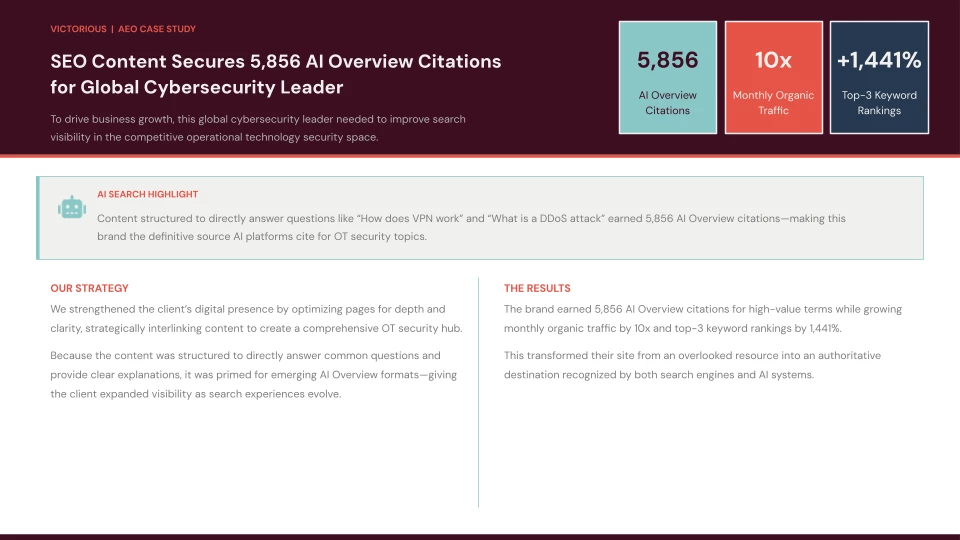
On the AI search side, the client earned 5,856 AI Overview citations for high-value OT security terms, a result Victorious attributes directly to the question-based content structure and hub architecture the agency put in place.
Results of Victorious’ Campaign for a Global Cybersecurity Company
Traditional search metrics reflected the same momentum. Monthly organic traffic grew 10x. Meanwhile, top-3 keyword rankings increased by 1,441%.
The parallel performance across both AI and conventional search metrics is consistent with how Victorious describes its entity framework in practice.
The same signals that make content retrievable for AI, including topical depth, clear entity coverage, and structured interlinking, also strengthen conventional ranking performance.
The two outcomes are not separate goals. They follow from the same underlying work.
Why It Matters
The cybersecurity engagement illustrates what AI search visibility actually requires.
AI search does not distribute citations randomly. It favors sources that have built deep, structured authority for specific entities.
For brands in technical verticals where AI-generated answers are becoming a primary discovery surface, that authority infrastructure is not a future consideration.
The brands capturing AI citation share now are those that treated entity authority as a deliberate strategy, as AI Overviews have become an increasingly dominant search surface.
Victorious' results with the cybersecurity client demonstrate that the path to AI citation is the same as the path to search authority generally: deep content coverage, deliberate structure, and coordinated signals pointing toward the same entity targets.