
Healthcare AI Development: Key Findings
- Less than 10% of nations have clear AI liability standards, leaving hospitals, vendors, and AI developers exposed to legal risk.
- Governance-first development reduces deployment friction, making auditability and explainability competitive requirements.
- Early compliance design accelerates long-term scale, helping teams avoid costly rebuilds and regulatory delays.
Healthcare has always balanced innovation with caution.
Now, artificial intelligence is testing that balance at industrial speed.
A new report from the United Nations warns that AI adoption in healthcare is accelerating faster than legal, ethical, and liability frameworks can keep up.
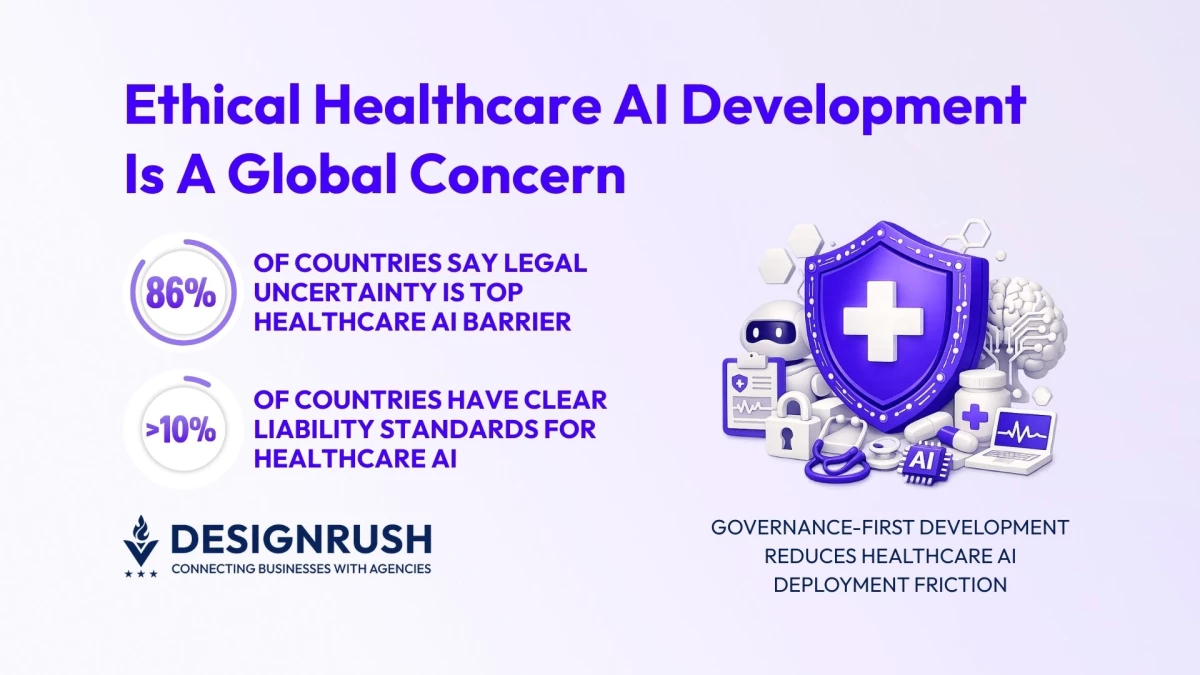
Out of 53 countries surveyed, 43 of them, or 86%, cite legal uncertainty as the top barrier to deploying healthcare AI.
More concerning is the fact that less than 10% of the surveyed countries report having clear liability standards for AI-driven medical systems.
This matters because hospitals, research institutions, and private enterprises are no longer experimenting at the margins.
Healthcare AI is already being used for diagnostics, patient triage, drug discovery, and administrative automation.
In many cases, these systems are being introduced without shared guardrails or consistent oversight structures.
In light of this, leading enterprise AI software development experts, like Kanda Software’s CTO Dan Kogan say the UN’s warning marks a shift in expectations:
“This is the inflection point where healthcare AI stops being an experiment and starts being infrastructure,” says Kogan.
“At this stage, governance isn’t a feature you add later, it’s part of the system design. Organizations that treat compliance and trust as afterthoughts will be forced into expensive rewrites under regulatory pressure, while those who build it in early will scale with confidence.”
Why Healthcare AI Faces Unique Ethical and Legal Risks
Healthcare does not offer providers the luxury of low-stakes failure. After all, a flawed diagnostic model can alter treatment decisions and patient outcomes.
Experts at Kanda Software have identified three main risk areas that make healthcare AI especially sensitive:
Liability Gaps Stall Adoption
When an AI system makes a wrong call, it’s often unclear who’s responsible.
That legal uncertainty makes hospitals and vendors cautious, delaying projects and limiting the impact AI could have in clinical settings.
Skewed Data Leads to Uneven Care
If an AI model is trained on data that underrepresents certain patient groups, it won’t perform equally for everyone.
This can result in missed diagnoses or flawed recommendations for the populations that are already underserved.
Automation Isn’t the Same as Oversight
Automation can quietly shift clinical judgment.
When AI outputs are treated as defaults instead of decision aids, human oversight weakens, and error detection slows, which may lead to disastrous consequences.
“Ethical failures in healthcare AI don’t remain local,” Kogan adds.
“They cascade, triggering regulatory intervention, undermining public trust, and slowing adoption across the entire ecosystem. The cost is paid not just by the company, but by providers, developers, and patients downstream.”
Align AI Development With Emerging Global Standards
For healthcare AI to succeed, trust and accountability need to be part of the build (rather than being treated as an afterthought).
The UN report doesn’t just point out existing gaps. It also clarifies what’s expected.
The following four principles offer a clear path for teams that want to scale responsibly and stay ahead of regulation.
1. Build Governance Into the Development Lifecycle
One of the UN’s central concerns is blurred responsibility when AI influences medical outcomes.
This is why AI software development teams must embed audit trails, model explainability layers, and transparent decision logs directly into development workflows.
High-risk outputs should pass through human review checkpoints, especially in diagnostic or triage scenarios where the stakes are highest.
2. Design for Regulatory Adaptability
Healthcare regulation may evolve slowly, but they definitely arrive decisively.
Rather than waiting for laws to stabilize, developers must assume that standards will evolve and design accordingly.
Modular system architectures allow organizations to adjust compliance requirements without rebuilding entire platforms.
Separating data ingestion, model training, and deployment environments makes it easier to update privacy rules, reporting standards, and audit requirements as laws change.
3. Strengthen Data Ethics and Consent Practices
The UN report highlighted patient data protection as a primary risk area. Addressing this requires operational safeguards, not just ethical statements.
Privacy-by-design frameworks should limit unnecessary data exposure from the outset.
Additionally, training data must be ethically sourced, properly anonymized, and clearly documented so organizations can demonstrate compliance under scrutiny.
4. Prepare for Cross-Border Regulatory Alignment
Healthcare AI increasingly crosses national boundaries through cloud platforms and multinational deployments.
Systems must anticipate overlapping regulatory regimes while aligning with international standards.
Designing for interoperability and consistent documentation reduces friction when entering new markets.
Future-Proof Healthcare AI With Responsibility
If there’s one big takeaway from the UN report, it’s that healthcare AI cannot scale sustainably without trust built into its foundation.
As such, AI development cycles must integrate governance safeguards early.
And while that may seem like it would lead to delays in project timelines, the truth is that the organizations that integrate governance early actually gain speed later on.
After all, they encounter fewer deployment delays, face less regulatory friction, and earn credibility with hospitals, research institutions, and oversight bodies.
Because in healthcare, the companies that rush past caution often discover that trust, unlike software, is not something you can simply patch later.