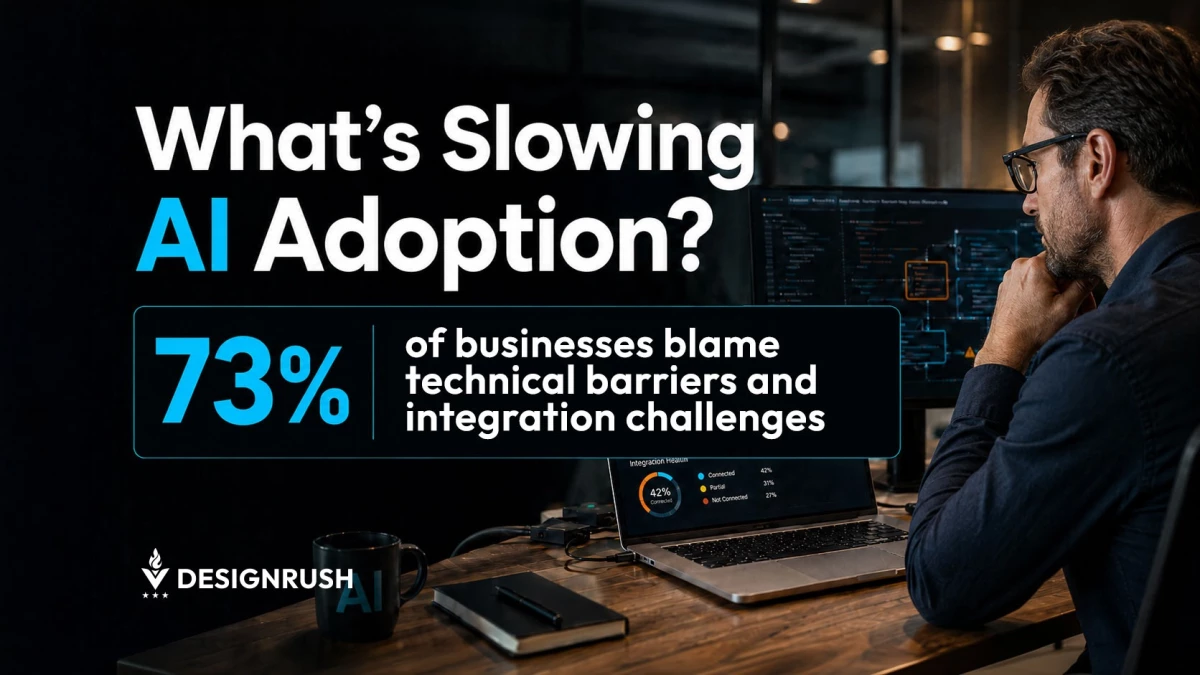

As many as 73% of businesses say technical barriers and integration challenges are slowing AI adoption, according to Webflow's 2026 State of the Website report.
The problem is that most businesses don't need more AI tools. They need the technology behind those tools to work together.
That pressure is building across digital teams. Marketing wants faster campaigns. Developers are juggling increasingly complex requests. Leadership expects AI to improve efficiency and deliver measurable results.
But outdated websites, disconnected platforms, and years of technical debt are making all three harder to achieve.
And as organizations start to rethink the technology behind their digital experiences, companies like Quixta are helping modernize the foundations those experiences depend on.
For the company’s founder and Director, Anand Ashok, the conversation has moved from simply adding more technology toward making existing systems work together.
"Many businesses assume AI is the challenge. More often, the challenge is everything behind it. When websites, internal systems, and customer data aren't connected, every new tool adds complexity instead of reducing it."
YouTuber, ForrestKnight, delves into what technical debt means for software engineers:
Why AI Adoption Is Slowing
Getting AI into everyday business operations has proved far more difficult than buying access to it.
As many as 92% of technical leaders expect AI to play a major role in website innovation over the next two years, per the same Webflow report.
But even with that level of confidence, technical barriers continue to slow adoption.
Every new AI tool depends on information flowing between websites, customer platforms, analytics, content management systems, and internal software.
When those systems have been built over years using different technologies, connecting them becomes slow, expensive, and difficult to maintain.
The challenge grows with every new platform.
Older systems rarely disappear. New ones are layered on top, adding more integrations, more maintenance, and more opportunities for something to break.
The addition of AI into the mix doesn't create those pressures. It just exposes them faster.
"Businesses don't fall behind because AI evolves quickly. They fall behind because their technology can't keep up," Ashok says.
"Those making the strongest progress are removing those bottlenecks before they become barriers to growth."
IBM tells us about the key risks associated with technical debt and the adoption of AI:
Technical Debt Is Holding Businesses Back
Technical debt builds quietly in the background.
A plugin solves one problem. A custom integration fixes another. A new platform is added to meet an immediate need.
But fast forward a few years and every change takes longer because every system depends on another one.
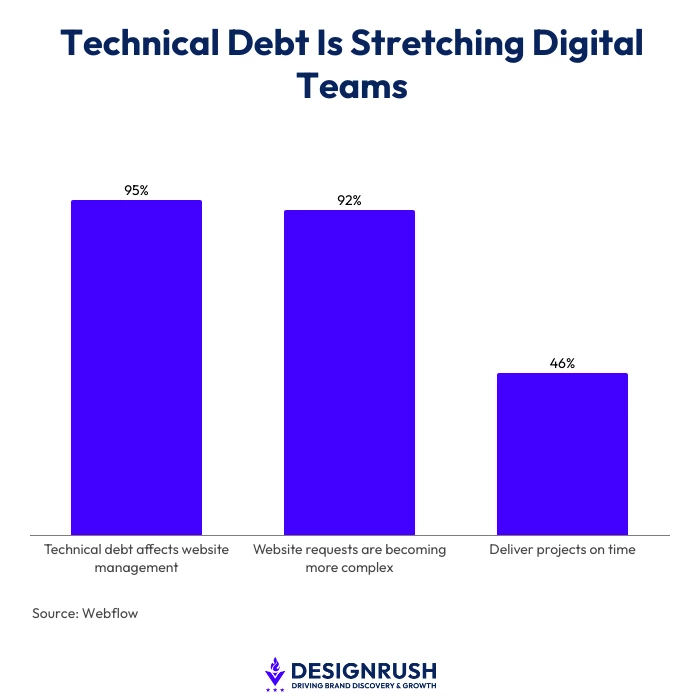
So much so that the same Webflow report found that 95% of technical leaders say technical debt is affecting website management.
What’s even more worrying is that 92% report that website requests have become larger and more complex where only 46% can deliver projects on time.
 As a result, development teams spend more time maintaining existing systems than building new features, while new projects wait in line while teams deal with issues that should have been rectified years ago.
The smartest approach is to simplify what’s already there.
Modernization, in this instance, means implementing cleaner architecture, stronger API integrations, and custom software built around how the business works.
By doing so will make it easier to roll out future updates, reduce maintenance, and keep projects moving.
"Technical debt isn't measured by the age of a website, but by how much effort it takes to make even simple improvements," Ashok says.
"When every update becomes a major project, it's usually the foundation asking for attention."
Modern Software Engineering breaks down why technical debt is a business challenge that needs to be addressed:
Why Website Modernization Matters
AI may be attracting the investment, but the hard work starts long before the first AI feature reaches customers.
Automated workflows, personalized experiences, and intelligent search all rely on systems that exchange information quickly and reliably.
When those connections break down, progress slows regardless of how advanced the technology appears on paper.
Here, delayed approvals, disconnected platforms, and slow development cycles don't just postpone updates. They reduce a business's ability to respond when new opportunities appear.
That's why many organizations are rethinking how they build digital platforms.
API-first development allows websites, customer platforms, analytics, content management systems, and AI services to exchange information without creating unnecessary manual work.
Modular architecture, on the other hand, makes it easier to introduce new functionality without rebuilding the entire platform.
Likewise, custom software gives businesses the technology that reflects the way they operate instead of forcing teams to adapt to rigid systems.
The result isn't simply faster website development but a platform that can evolve alongside changing customer expectations, new technologies, and future business priorities.
"Businesses often ask whether they're ready for AI," Ashok says.
"A better question is whether the systems behind their website are ready for it. That's usually where the real work begins."
Accenture shares how it’s working with SAP to help modernize enterprises with embedded AI, Joule, and custom AI adoption on SAP’s Business Technology Platform:
Turning AI Investment Into Results
For years, organizations have managed to work around disconnected systems, growing technical debt, and slow development cycles.
But the introduction of AI has made those workarounds far more difficult to ignore.
Essentially, the next stage of digital investment won't be defined by who adopts the most AI tools, but by who can support those tools with modern websites, connected systems, and software designed to evolve instead of becoming another legacy platform.
"Technology changes faster every year," Ashok adds.
"And while there’s no way businesses can predict every tool they'll use five years from now, they can build systems that make adapting to those changes far easier. For me, that's where long-term value is created."