
When development teams discuss the risks of AI coding tools, hallucinations dominate the conversation. Fabricated APIs, nonexistent package references, incorrect logic disguised as functional code.
These failures are real, visible, and easy to point to. But they are also increasingly solvable.
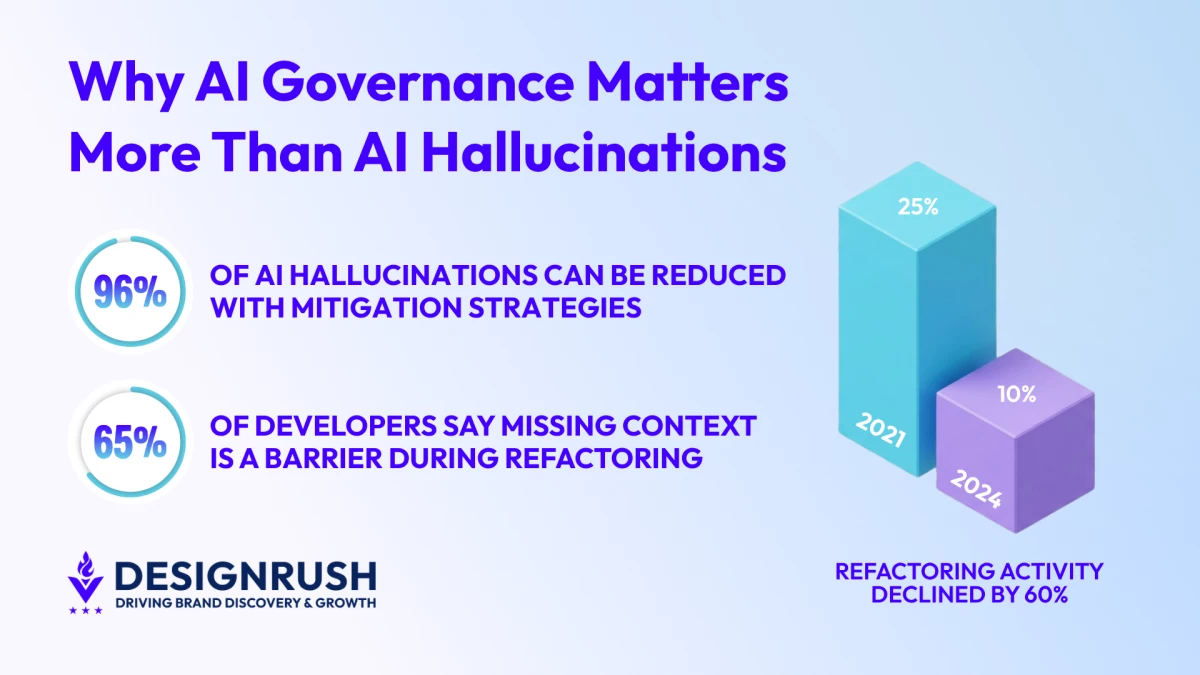
Research by Diffray found that 2024 and 2025 mitigation strategies can reduce AI hallucinations by up to 96% through retrieval-augmented generation, static analysis, and structured review.
The more dangerous risk is quieter.
It accumulates slowly across hundreds of pull requests, through the everyday behavior of a development team with no shared standards for how AI tools get used.
YouTube channel, Modern Software Engineering, explains why AI coding risks extend beyond hallucinations to include maintainability, oversight, and long-term code quality:
The Problem That Does Not Show Up in Dashboards
Workflow drift happens when developers on the same team use AI tools in fundamentally different ways.
One prompts for verbose, fully commented functions. Another prompts for brevity. A third generates code that solves the immediate problem without referencing existing patterns in the codebase.
Each output is functional, and not a single one is wrong.
But the accumulated result is a codebase where similar problems are solved in five different ways, naming conventions shift between modules, and no single developer holds a clear mental model of the whole.
According to Spec-driven development research published in BCMS 2026 identified "intent drift" as one of the primary failure modes of LLM-based coding, where underspecified prompts cause the AI to select defaults that rarely match what a team actually wanted.
On the other hand, "context decay" causes the model to silently contradict earlier architectural decisions as a codebase grows.
Packmind's analysis confirmed that a React codebase with no defined React guidelines represents a systematic source of AI output inconsistency that no amount of per-session prompting can fully compensate for.
IBM explains why shared specifications and development standards are essential for preventing workflow drift, intent drift, and inconsistent AI-generated code across engineering teams:
Refactoring Collapses as Code Volume Grows
One of the most documented consequences of unstructured AI-assisted development is the erosion of refactoring behavior across teams.
GitClear analyzed 211 million lines of code changes across repositories owned by Google, Microsoft, Meta, and enterprise organizations spanning 2020 to 2024.
Moved lines, the metric signaling developers consolidating code into reusable modules, dropped from 25% of all code changes in 2021 to under 10% by 2024, representing a 60% decline.
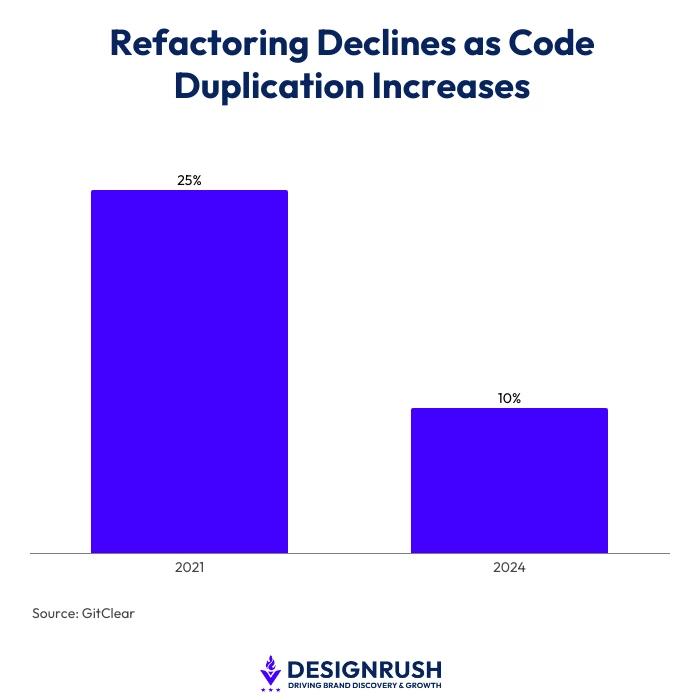
Copy-pasted code blocks increased eightfold, and 2024 was the first year duplicated code exceeded refactored code.
Ox Security's analysis of 300 repositories, as reported in DEV Community, identified ten recurring anti-patterns in 80 to 100% of AI-generated code, with systematic avoidance of refactoring and duplicated bug patterns across files among the top findings.
Their conclusion is that AI-generated code is highly functional but systematically lacking in architectural judgment.
Larridin's analysis describes this as "silent architectural drift."
This is where no single pull request is a problem, but after six months of AI-assisted development, the gap between how a system was designed and how it actually works becomes a chasm that is exponentially harder to refactor than it would have been to prevent.
The Documentation Problem Nobody Is Tracking
When a developer accepts AI output without understanding its design decisions, that code cannot be accurately documented. The knowledge gap actually becomes a gap in comprehension.
A real-world case study documented by Of Ash and Fire illustrates the cost.
An eCommerce company adopted GitHub Copilot in early 2023 and saw feature velocity increase by 40%.
Within six months, production bugs increased, checkout-related support tickets tripled, and a code audit found payment processing logic scattered across seven modules.
The company spent three months and $400,000 remediating technical debt introduced in six months of AI-assisted development.
Modern Software Engineering delves into how reliance on AI-generated code can create knowledge gaps that affect code comprehension, documentation, and long-term maintainability:
Review Capacity Is Not Scaling with Output
A 2025 study by Faros AI tracking 1,255 engineering teams found that teams with high AI adoption merged 98% more pull requests, but PR review time increased 91%.
More code is entering the main branch faster than human reviewers can assess its architectural implications, not just its functional correctness.
Functional correctness and architectural soundness are different measures. Code that compiles, passes tests, and closes a ticket can still erode the structural integrity of the system it enters.
When review processes assess only whether code works, drift compounds with every merged request.
Qodo's State of AI Code Quality report found that 65% of developers identify missing context as the leading barrier during refactoring.
As AI-generated code accumulates without codebase context, the cost of future changes grows because every modification requires reconstructing the intent behind code that was never fully understood.
Google Cloud's Abhi Das explores how rising AI-generated code volumes are outpacing review capacity, forcing teams to balance development speed with architectural consistency and maintainability:
Governance Is the Missing Layer
The teams reporting the best outcomes from AI-assisted development in 2026 share a consistent operational pattern, where they treat AI usage as a workflow to govern rather than a tool to deploy.
That means shared context files encoding team conventions and architecture decisions, prompt standards that give every developer a common baseline, and review criteria that evaluate architectural fit alongside functional correctness.
It also means measuring code health metrics, such as duplication rates, refactoring frequency, and churn, not just output volume and merge rates.
AI tools generate code faster than teams have historically been able to write it. Without governance, that speed advantage is temporary. But the debt it introduces is not.