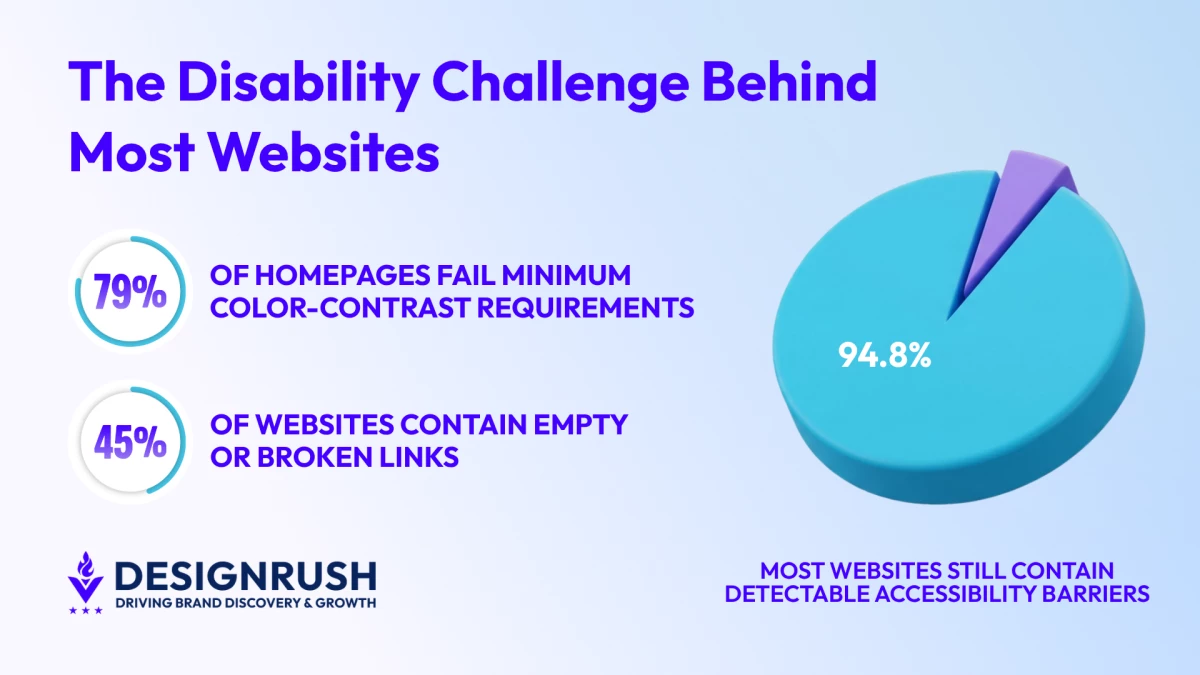

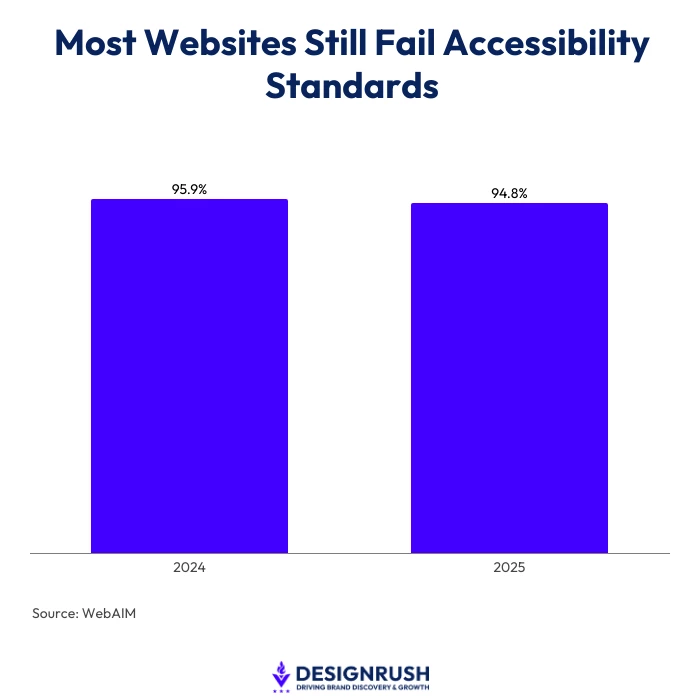
Nearly 94.8% of the world's most-visited websites still contain detectable accessibility barriers, according to WebAIM's latest Million Report.
And while that's an improvement from 95.9% in 2024, the broader picture hasn't changed much.
Experts estimate that 1.6 billion people worldwide live with a disability, as reported by Return on Disability.
Together with their families and support networks, they represent $18.3 trillion in annual spending power.
Yet for a group with that level of economic influence, running into barriers online remains surprisingly common.
For a long time, accessibility was treated as something businesses addressed to meet requirements or avoid complaints.
That conversation is starting to shift as more brands recognize how many potential customers struggle with everyday digital experiences.
Washington DC-based web design and development agency, Design In DC, has seen that gap play out across websites and customer journeys.
According to the agency's CEO and founder, Ziad Foty, many businesses don't realize there's a problem until customers have already given up and gone elsewhere.
"The biggest accessibility risk today isn't a lawsuit. If customers can't use your website, they can't buy from you.”
“This is even worse than accessibility since the frustration the customer feels can easily harm your brand’s reputation.”
In his TED Talk below, website accessibility advocate, Clive Loseby, sheds light on why many parts of the web are still limited to those with disabilities, and how brands can make a meaningful change:
The Disability Market Hiding In Plain Sight
The spending power behind the disability market becomes even clearer at a regional level.
Experts estimate that people with disabilities control roughly $2.6 trillion in disposable income across North America and Europe, per the same Return on Disability report.
In the United States alone, the market exceeds $1.3 trillion.
And it’s not just those with disabilities that make these decisions.
Family members, caregivers, partners, and friends often play a role in purchases, and when accessibilities becomes a problem, they just move on.
"Businesses underestimate how many purchasing decisions are influenced by accessibility,” Foty says. “Even the smallest hiccup can result in entire networks sharing poor experiences and giving negative reviews.”
ABC27 News breaks down why visually-impaired Americans abandon online shopping carts to the value of $1trillion due to lack of accessibility:
Why Inaccessible Websites Cost Companies Billions
Despite some progress being made, the basics of web development and design are still broken.
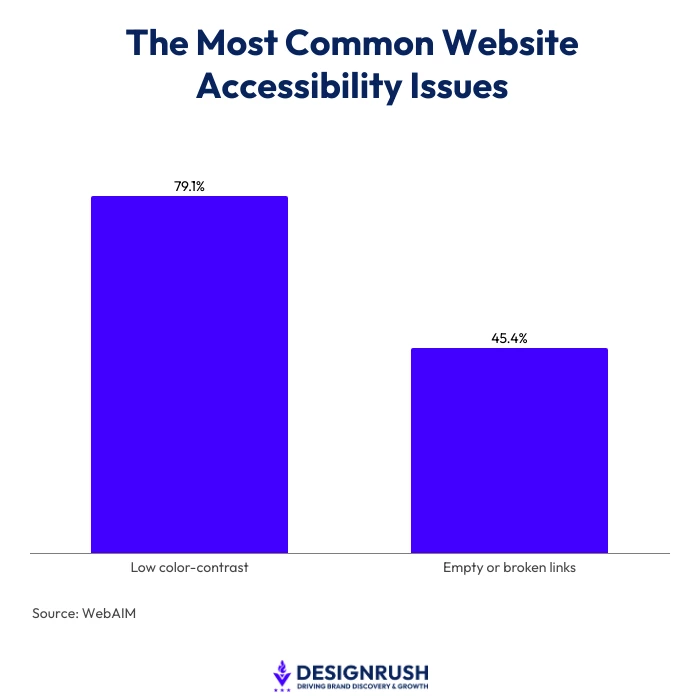
As many as 79.1% of homepages still fail minimum color-contrast requirements, while as many as 45.4% contain empty or broken links, according to research by WebAIM.
"If a customer can't complete a purchase, sign up for a service, or access critical information, they don't blame the code. They blame the brand,” Foty says.
“That's why accessibility often becomes a customer experience issue long before it becomes anything else.”
Apart from the potential financial losses, Action News 2 reports that some consumers have taken legal action against businesses that don't have accessible websites:
Peak 65 And The Future Of Accessibility
Accessibility isn't only about disability. It also addresses demographics.
More than 4 million Americans will turn 65 each year between 2024 and 2027, part of what researchers have called the "Peak 65" phenomenon and the largest wave of people reaching retirement age in U.S. history, according to Kiplinger.
Technology use changes with age. What's effortless at 35 like skimming a page, filling out a form, or following a link, can become a real obstacle at 65 or older.
The likes of captions, voice controls, speech recognition, and predictive text didn’t start out as everyday tools. They were built for specific needs, by people solving specific accessibility problems.
"Most people don't think of themselves as accessibility users. Then they start turning on captions, increasing text size, or relying on voice commands. That's usually when accessibility becomes relevant to them," Foty says.
The following course presented at the University of Ottawa's School of Information Studies delves into the criteria to keep in mind to meet the needs of the older generation:
How Microsoft, Apple, And Nike Turned Accessibility Into Better Products
Accessibility has shaped some of the most-used products on the market, and not always intentionally.
Microsoft's Xbox Adaptive Controller was built for gamers with limited mobility. Seeing AI, also from Microsoft, uses artificial intelligence to help people with visual impairments make sense of their surroundings.
Apple's approach was less about single features and more about depth. VoiceOver, AssistiveTouch, Live Speech, and eye tracking features were all built in over years until they just became part of how the products worked.
Nike's GO FlyEase is the one that catches people off guard. Hands-free shoes, originally designed with disability in mind. Turns out a lot of people wanted that, disability or not.
"What's striking about these products is how many people ended up using them beyond the audience they were originally designed to serve," Foty says.
“The lesson isn't that accessibility creates niche products. It's that solving a real problem often leads to better products overall.”
Apple’s VoiceOver helps those who are blind or have low vision by telling them what’s happening on their iPhone:
What Business Leaders Can Learn From Accessibility
For businesses looking to strengthen loyalty, improve usability, and reach more consumers, Foty offers three practical takeaways.
1. Start With the Moments That Matter Most
Checkout flows, forms, navigation, and account creation often have the greatest impact on whether customers stay or leave. Small improvements in these areas can remove barriers for a wide range of users.
2. Plan for the Customers You'll Serve Tomorrow
The disability economy is growing, populations are aging, and digital experiences continue to shape how people buy. Accessibility is becoming relevant to a larger share of consumers every year.
3. Look at Accessibility as a Product Opportunity
The examples from Microsoft, Apple, and Nike show that accessibility can reveal unmet needs that lead to stronger products and better experiences.
“Every company wants to know where customers experience friction, and accessibility challenges can quickly expose those moments,” Foty says.
“The people running into those barriers aren't strangers to the brand. In many cases, they've already arrived, clicked through, and started engaging.”
The irony is that businesses spend enormous amounts of time and money trying to reach new audiences while one of the world's largest consumer groups continues to run into obstacles online.
Many of those customers aren't waiting to be discovered. They're already there. The question is how many brands are still making it harder than it needs to be?