
Many companies only think about public relations when they want immediate attention.
Whether a product launch is looming, sales need support, or a competitor just landed a massive feature, founders and executives suddenly want the company in the press.
That timing creates a fundamental disconnect.
Cision’s 2026 State of the Media Report states a staggering 72% of journalists say that fewer than a quarter of the pitches they receive are actually relevant to their audience.
Journalists hardly reward the brands that show up only when they need free exposure.
Instead, they respond to compelling narratives, verifiable expertise, hard proof, and market commentators who actually respect their audience’s time. For leaders, this transforms PR from a simple marketing tactic into a core business issue.
A company can boast a strong offer, a great team, and real customer value, but media coverage only hits the mark when the brand can clearly articulate what makes it relevant, credible, and worth covering.
Turner says fixing that disconnect starts with long-term groundwork, not transactional pitches.
“It’s about relationship building, getting out, meeting people, letting them know who you are and what you’re doing,” he says.
Steve Turner is Co-Owner and Principal of Solomon Turner PR, a St. Louis public relations agency. He says that companies earning the most media traction always do the heavy lifting long before asking for coverage.
“But it all starts with building a relationship and doing good work. I mean, you have to prove that you can do what you say.”
In episode No. 143 of the DesignRush Podcast, Turner breaks down why sustainable PR relies on a refined company narrative, precise media alignment, spokesperson readiness, and the strategic follow-up work that makes a press win into a business asset.
Watch the full episode now on YouTube or listen on Spotify.

Who Is Steve Turner?
Steve Turner is the Co-Owner and Principal of Solomon Turner PR, a St. Louis-based agency focused on media relations, brand communications, and corporate reputation strategy. He is also the author of PR THAT WORKS: Real Strategies. Real Campaigns. Real Results.
The Media Readiness Gap Behind PR Results
For many organizations, the PR conversation only begins when the top decision-makers decide they want coverage. Turner argues that the real strategy must start much earlier.
Before a single pitch is sent, a company needs a crystal-clear story, a well-targeted media list, concrete proof of value, and a compelling reason for a journalist to care.
That process begins with defining the organization’s ultimate trajectory.
“You have to put down what your objective is and what your long-term goals are,” Turner says.
A management team usually knows its revenue targets, hiring plans, product roadmaps, and target accounts. Yet, many still struggle to explain exactly why their company deserves the attention of the press, prospects, or their local business community.
Turner says, “What are we doing differently? Why aren’t we differentiating our company?”
Teams rush to approve a press release, hire an agency for outreach, or chase TV spots before answering basic questions:
- What is the story
- Why now
- Who cares
- What proof backs it up
- Which outlet fits
Turner notes that true media readiness hinges on a brand’s ability to match its narrative to the correct format.
“Everything is customized for the client.”
A business with striking visuals or physical products naturally suits television. A B2B firm with deep technical expertise may fit trade publications, LinkedIn thought leadership, podcasts, or local business journals.
Success requires foundational research.
“You need to figure out what they’re covering, how they’re covering it and who’s covering it,” Turner says.
Flooding inboxes with more pitches will never salvage a weak or poorly targeted story.
Long before outreach begins, a brand must pinpoint what makes its insights timely, who needs to hear them, and which media channel can deliver that message with maximum clarity.
DesignRush’s guide on how to build a brand explains why companies need clear identity, values, positioning, and messaging before they can earn recognition.
1. Treating PR Like a Last-Minute Sales Fix
Public relations is too often treated as a reactive band-aid for organizational pressure.
When sales dip, a launch approaches, or a competitor gets featured, executives suddenly look to the media to fill the gap.
Turner explains that this transactional approach bypasses the exact foundational work that makes earned media effective. A brand needs established goals, a distinct market position, and validated proof long before the press can support business growth.
For CEOs, this raises public relations from simple press outreach into a larger exercise in corporate identity. The business must decide what it wants to own in the public eye, who it needs to influence, and what evidence supports those claims.
Without that groundwork, pitching the media is entirely premature.
Turner notes that sustainable market growth demands continuous pressure-testing.
“If you’re not continually growing, you are going to start slipping backwards.”
This does not imply that every brand belongs in national headlines. A founder-led business might maximize its impact through regional business journals. B2B enterprises often find their ideal buyers through niche trade media, podcasts, or industry commentary, while visible consumer brands lean into TV.
The story and the audience dictate the channel.
For CEOs and CMOs, early PR planning must answer what the campaign supports, why the story is worth covering now, and what proof backs the claims.
The execution starts with variables executives can control: corporate positioning, founder narrative, case studies, spokesperson coaching, media mapping, and a concrete plan to use press wins across sales once they go live.
2. Asking for Coverage Before the Story Is Ready
When brand awareness is low, the default corporate reaction is to ask for press.
However, Turner points out that this overlooks a central hurdle: the business likely has not translated its raw corporate value into an actual, executable news hook.
“We’ve been around long enough now, we know if they have a good story or not.”
Turner points to a classic car dealership in St. Louis that commanded impressive international sales but suffered from virtually zero local awareness.
After touring its six-showroom facility, the media angle became obvious: strong visuals, a local economic footprint, and a daily operation that thousands of commuters passed without understanding.
For smaller or emerging enterprises, the strongest narrative typically lives within the founder’s original catalyst for building the company.
“Small businesses have a good story to tell, too. You have to think about why did you go into business in the first place?” Turner says.
A founder may have identified a broken legacy model, pioneered an untested product, or delivered a standard service with unusual speed, efficiency, or specialized expertise.
Those raw operational details can become the story.
“Well, we have an idea that’s different. We’re either focusing on a new product that nobody’s ever tried before or seen before, which is why we’re doing this.”
For executives, story readiness is an ongoing corporate responsibility.
The management team must organize internal proof points for public use, including founder histories, customer outcomes, local economic impact, job creation, corporate philanthropy, or industry accolades.
More often than not, these compelling angles are already sitting unutilized inside the company.
“Anything that you think about, you know, within a business, there’s always a great story there somewhere,” Turner says.
Once uncovered, that story must be paired with its ideal medium. Visual stories fit television, technical insights fit trade journals, and strong founder opinions fit podcasts or editorial columns.
Before approving outreach, CEOs and CMOs should ask:
- What does the company have that competitors do not
- What proof supports it
- Which channel fits the story
- Who can explain it under pressure
Chasing media attention without these answers can burn through pitches while the real issue sits inside the narrative.
DesignRush’s guide to brand awareness strategies also lists PR and executive thought leadership among the ways companies can build visibility and recognition over time.
3. Winning Coverage, Then Letting It Go Quiet
Securing a headline or a prime TV segment is only half the battle.
Turner warns that a recurring PR failure occurs after the media coverage goes live.
Many businesses celebrate a press win briefly, post it once on social media, and move on, abandoning the long-term commercial value of the asset. Earned media should serve sales teams, recruitment, prospect nurturing, and local market validation.
“These become great sales tools. So your salespeople get a third-party endorsement.”
Objective, third-party validation carries weight in complex sales cycles. When prospects compare similar vendor claims, an independent media feature, broadcast interview, or industry award can help separate a brand.
That is why press wins need a distribution strategy. A broadcast feature should not languish on a local news archive, and a trade profile should not be shared once on LinkedIn and forgotten.
When it comes to corporate milestones or industry awards, Turner advises executives to look inward first.
He says, “We tell people think first internally.”
Internal rollout means validating the teams who drove the success and showing employees how their work contributes to market recognition.
“I’ve been in situations where people win awards and they get a plaque or something and they just put it on their shelf in their office.”
His assessment of that approach is blunt.
“What’s the point?”
Once the internal team is aligned, the coverage should be integrated across client updates, prospect pipelines, regional press, newsletters, website pages, and social media.
“Promote the heck out of it,” Turner says.
“Don’t keep it a secret. Make it a big deal.”
Failing to maximize these wins exposes three gaps:
- Are sales teams using the asset
- Do employees understand the achievement
- Is marketing distributing it where the audience already spends time
The headline is a great start, but its true ROI comes from carrying third-party proof into business conversations that drive revenue.
What CEOs Should Fix Before Asking for Coverage
CEOs frequently demand weekly press releases, sales teams clamor for more market presence, and founders often eye a competitor’s media coverage with frustration.
Turner cautions executives against rushing to publish unvalidated updates.
“I would say just stop firing out press releases for the sake of doing it.”
Instead, corporate officers must analyze where their communication process is underperforming, starting with baseline relevance.
“What is relevant? What are they covering and how do we fit into that?”
This audit establishes whether the brand has a usable journalistic hook, an audience that will benefit, and an executive spokesperson who can deliver the message with precision.
The second variable is narrative substance.
Routine revenue milestones, minor internal updates, or dry corporate announcements may matter internally, but they rarely move external reporters.
Turner’s advice is to give media outlets a more compelling reason to engage.
“Give me something exciting,” he says.
Excitement in a corporate context can mean a community initiative, a solution to a widespread customer problem, a local economic angle, a founder view on breaking news, or an award with market implications.
Finally, organizations must secure the right support. Many mid-market firms avoid PR because they lack a communications team or the budget for a large agency retainer.
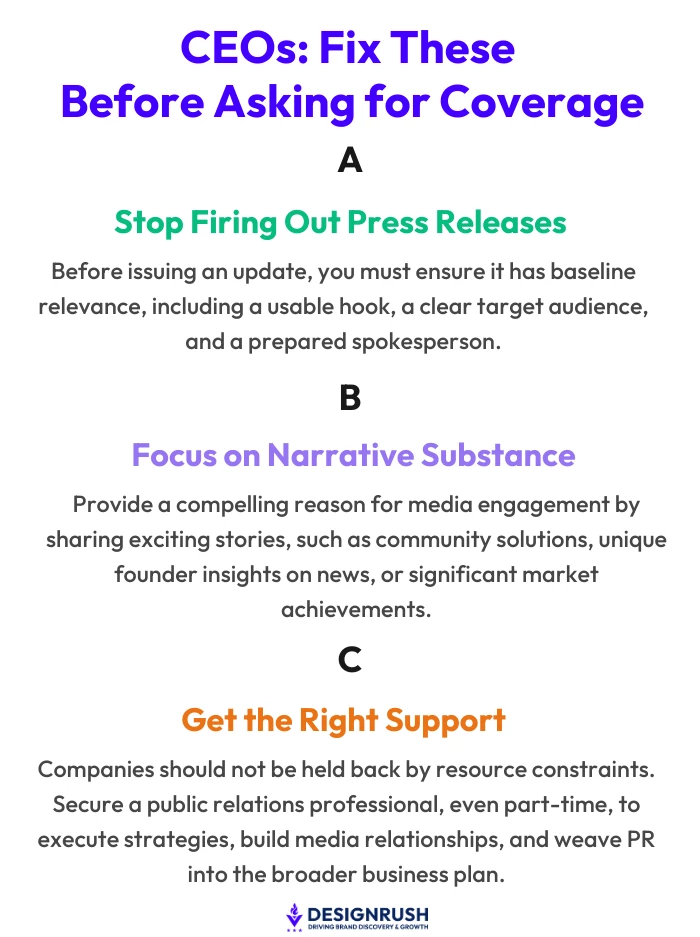
Turner emphasizes that these resource constraints should not prevent a company from executing basic PR strategies.
“You don’t need the best to start with, but just get somebody that understands the game a little bit that could quarterback you through some of these things.”
True public relations readiness requires clear execution before the next press release is drafted.
Leaders must clarify the company’s main differentiator, prove why the story matters, align stories with the right outlets, prepare speakers, use every press win across sales and recruiting, and cultivate media relationships before urgent coverage is required.
Ultimately, PR cannot exist as an isolated series of sporadic announcements.
It must be woven into business planning, sales enablement, executive branding, internal culture, and how the company builds authority with first-time buyers.
Companies that need help with media strategy, press outreach, and public communications can compare experienced public relations agencies on DesignRush before asking for coverage.