
Starbucks had proof the Unicorn Frappuccino would sell before it announced the comeback.
The coffee chain poured the blended drink at Coachella in April, three months ahead of any menu announcement.
The drink had been gone for nine years by then, since its original five-day run in April 2017.
The two-day return that followed became the biggest Starbucks North America-operated sales weekend in company history.
Starbucks Chairman and CEO Brian Niccol put a number on the weekend in a note to employees.
"Over the weekend, we sold more than 2 million Unicorn Frappuccino Blended Beverages in our North America company-operated coffeehouses," Niccol wrote.
"It was a terrific cultural moment for Starbucks that every partner helped bring to life."
August 15 became the single biggest Saturday the North America business has ever logged, and none of it caught Starbucks off guard.
One customer posted that they had "waited 9 years for this exact moment," and the line spread across social feeds before the official announcement.
Starbucks watched that chatter build for almost a decade without paying for any of it.
Most brands run social listening to find a signal this loud, and Starbucks got handed one every April for free.
Nine Years of Demand, One Festival Preview
Starbucks served as the official coffee, tea, and Refreshers sponsor at Coachella 2026.
The Unicorn Frappuccino ran at the festival's Starbucks Coffeehouse for a few hours a day across both weekends, April 10 to 12 and April 17 to 19.
Festivalgoers were the only people in the world who could buy one.
On July 20, Starbucks announced a two-day global return for August 15 and 16, sold in a grande cup with limited customizations.
The drink went out across the U.S., Canada, Mexico, Europe, Asia Pacific, the Middle East, and North Africa.
The short runway did some work that the ads didn't have to, and three months separated the festival pour from the announcement.
Baristas spotted spirulina and sparkle topping on inventory lists during this gap and predicted the return on social media before Starbucks said a word.
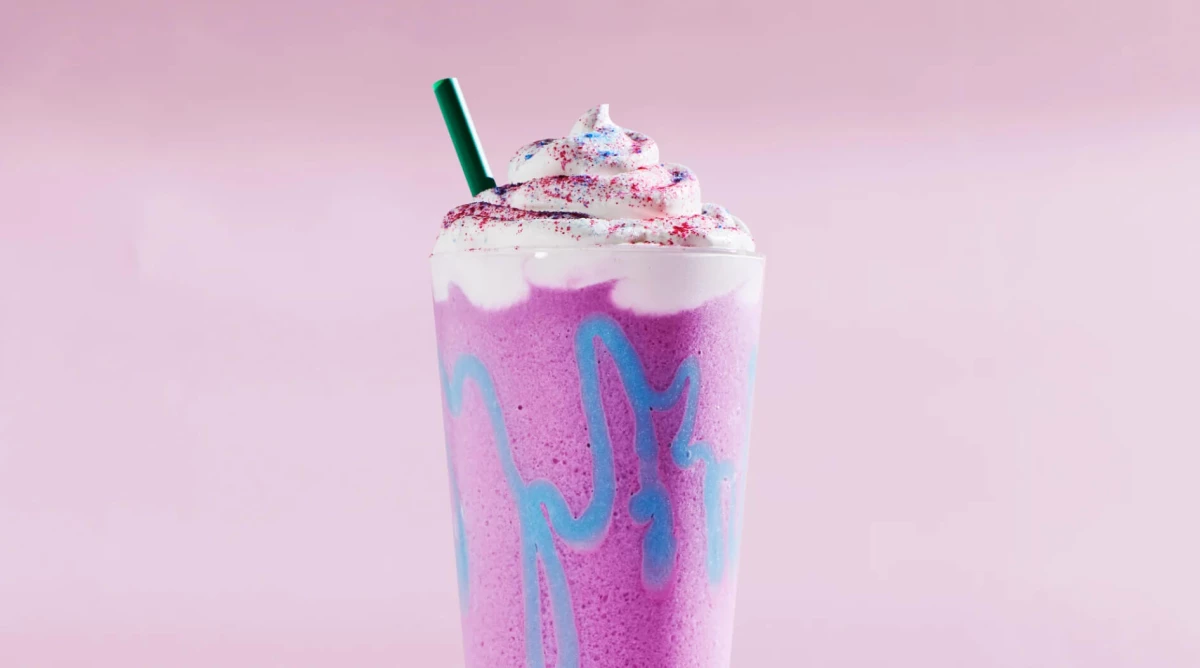
The mango flavoring, blue drizzle, and pink-and-blue topping did most of the advertising work on their own.
A two-day window handled the rest, and baristas absorbed the surge.
One employee posted on TikTok that they made "at least 200" of the drinks during a single shift.
Store-level throughput is the part of a limited-time offer that most brands underestimate, and Starbucks made sure to staff for it.
Two Days, 2 Million Drinks
Limited runs work because purchase decisions are time-bound.
A deadline only converts people who already want the product, which is where the drink's original 2017 audience came in.
In fact, roughly 81% of Gen Z consumers say they enjoy revived childhood products.
The teenagers who lined up for the first Unicorn Frappuccino are that group now.
Nine years of accumulated memory had already done the persuasion, and the two-day limit supplied the deadline.
- Sell the memory, not the menu item: When the audience already knows the product, the campaign's job is reminding them it's back, not teaching them what it is.
- Shrink the window to grow demand: A two-day run turns a maybe into a today, converting casual interest into a same-day trip.
- Let frontline staff carry marketing and proof of scale: Baristas racing to social media to post their creations signaled real demand.
Product marketing gets cheaper every year a brand keeps something worth missing off the shelf.
The Unicorn weekend sat one day behind another Starbucks activation.
Its Marriott Bonvoy partnership, which turned a Myles Smith concert into a members-only reward, worked by creating new access around a loyalty account.
The Unicorn Frappuccino did the opposite, reviving interest in old, coveted products.
Both sit inside the $1 billion restructuring that Niccol announced last September.
Most of that money covers store closures and severance, with the coffeehouse uplifts funded separately.
Where most marketing efforts give customers a reason to stay loyal, the Unicorn return gives them areason to walk back in.
Our Take: Does Nostalgia Ever Expire?
We believe that nostalgia doesn't expire; it just gets spent.
And Starbucks just proved how to spend it the right way.
You don't need a fancy new product. You just need to make customers miss an old one.
Nine years is a long time to let a drink sit on the shelf of someone's memory, and Starbucks let it sit there on purpose.
Every year the drink stayed off the menu made the return worth more.
What interests us isn't the sugar or the color but the patience and willingness to let the craving marinate.
We'd like to see more brands treat their old hits this way.
Looking to build campaigns that don’t rely on starting from scratch?
Explore these top brand strategy agencies in our directory to turn existing equity into something that still lands.