
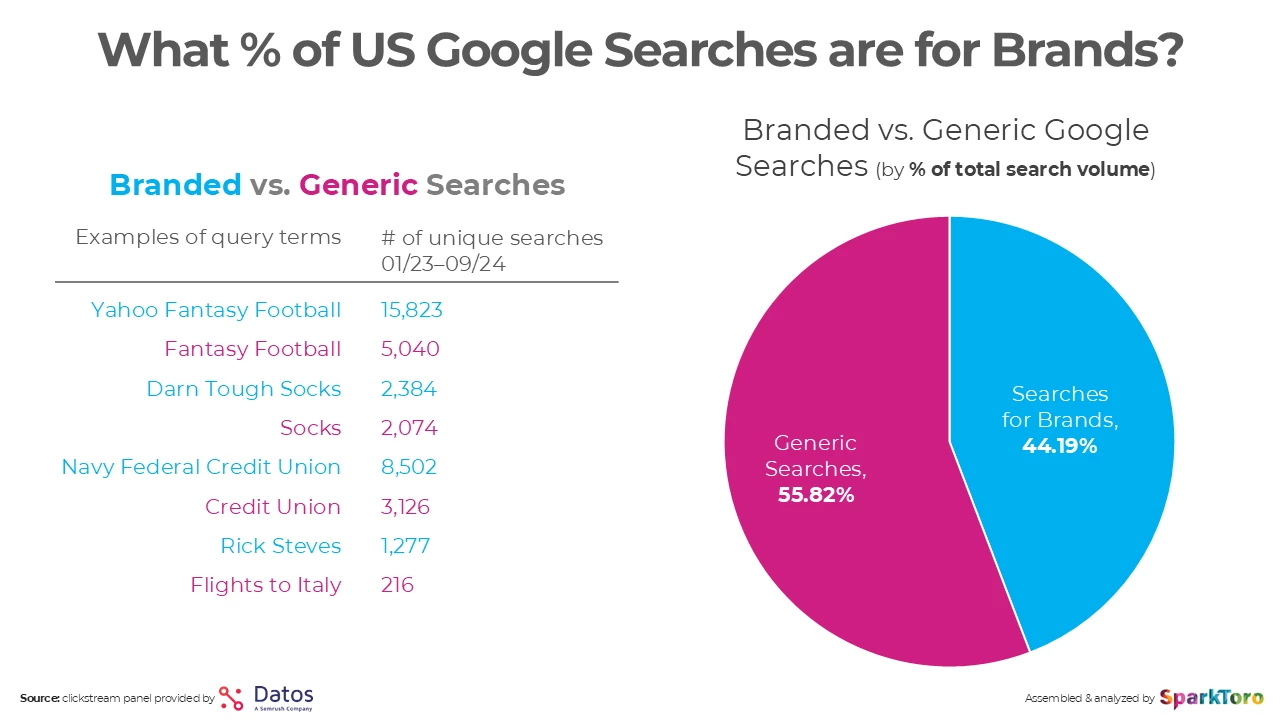
Software company SparkToro has revealed that 44% of Google searches in the U.S. are related to brands.
Based on an analysis of 332 million Google search queries, the data provides valuable insights into the growing dominance of branded searches and the distribution of search intent.
The findings offer key takeaways for businesses, such as how to successfully target audiences and adapt to shifts in search trends.
The data was compiled by Datos, a Semrush company and global clickstream data provider.
In his latest blog, Rand Fishkin took Datos clickstream data from 332 million searches and got down to the very basic question of: What are people looking for when they search the web?
— Datos, A Semrush Company (@LiveDatos) December 3, 2024
Read the blog here: https://t.co/XACHzYmLxj#Search#RandFishkin#ClickstreamData#AltDatapic.twitter.com/J5e1XGZBEi
Datos provided Google search data from a subset of their multi-million-person panel, which includes about 130,000 U.S. devices, mobile and desktop, for the period between January 2023 and September 2024.
Sparktoro then used ChatGPT’s 4o-mini API to analyze and classify more than 320,000 query terms according to brand versus generic, navigational/informational/commercial/transactional, and 24 topic categories of human interest.
In addition, AI expert DataSci101’s Britney Muller provided insight to unlock more descriptive classification categories, resulting in 96% accuracy. For this study, multiple searches from the same device were excluded.
What This Means for Brands
While the majority of query terms (46% of all search demand of the top 10,000 query terms) accounted for mostly general searches, like YouTube, Gmail, Amazon, Facebook, and ChatGPT, Sparktoro’s study found that 44% of Google searches are for specific branded terms.
However, the study also found that the balance between branded and unbranded is closer to 50/50 because branded terms tend to have more volume per query than unbranded searches.
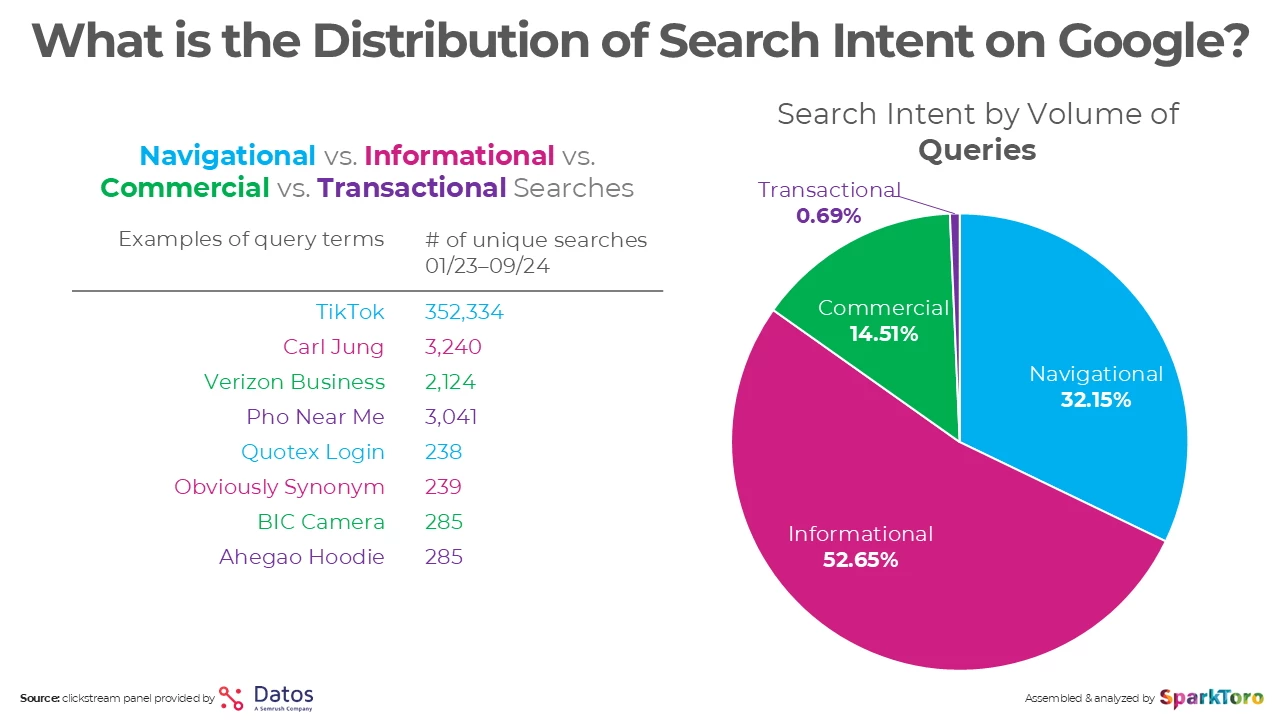
In total, the distribution of search intent on Google is as follows:
- 52.65% is informational
- 32.15% is navigational
- 14.51% is commercial, though not necessarily transactional
- 0.69% of all searches are transactional and indicate intent to purchase, sign up, or otherwise engage
Armed with this data, businesses can implement crucial SEO content strategies, such as optimizing to increase brand recognition and diversifying marketing channels to avoid over-reliance on traditional search tactics.
Sparktoro also provided five key takeaways from the study:
- Your brand’s Google search results are likely the first and biggest impact impression as one-third of the search engine's usage is navigational.
- Google’s zero-click answers and AI overviews have started to dominate results pages.
- Only a few thousand query terms account for all Google searches, meaning big brands are winning.
- It is more effective to build a brand that people would actually search for than to rely on SEO or PPC alone.
- People use Google after they realize they need something, rather than a place where they discover brands and services. Instead, people discover them in places like social media, YouTube, podcasts, industry news sites, Google Discover, and Apple News, email newsletters, and conferences/events.
With 44% of Google searches now targeting specific brands, it has become clear that businesses must adapt their SEO marketing strategies, focus on brand recognition, and diversify their digital presence to remain competitive.
One company that has been at the forefront of remaining relevant is Google itself.
The tech giant has long diversified its presence in the industry, including hosting inclusive events such as the "Black-Owned Friday" campaign.
And despite U.S. government sanctions due to its monopoly of the search market, Google recently unveiled Willow, its fastest and most advanced quantum computer chip to date.