
Data & Partnership-Driven Growth: Key Findings
- 65% of B2B sales orgs are moving to data-driven decisions, underscoring the need for localized GTM strategies that go beyond generic metrics.
- Localized compliance increased conversion in Germany, demonstrating how agencies can tailor campaigns to regulatory norms and build trust faster.
- Conversion-stage optimization offers the highest ROI, showing how agencies can stretch budgets by aligning insights, messaging, and buyer behavior.
Many global growth strategies fail for the same reason: they assume markets behave the same.
That assumption is getting exposed.
Gartner estimates that 65% of B2B sales organizations will move from intuition-led to data-driven decision-making by 2026.
Leaders are being asked to show what works in culturally distinct and nuanced markets.
But data on its own is not the fix. Teams still roll out the same messaging and compliance approach across markets that operate under different legal standards and buyer expectations.
Many global growth strategies fail because they assume markets behave the same.
In complex markets, guesswork gets expensive.
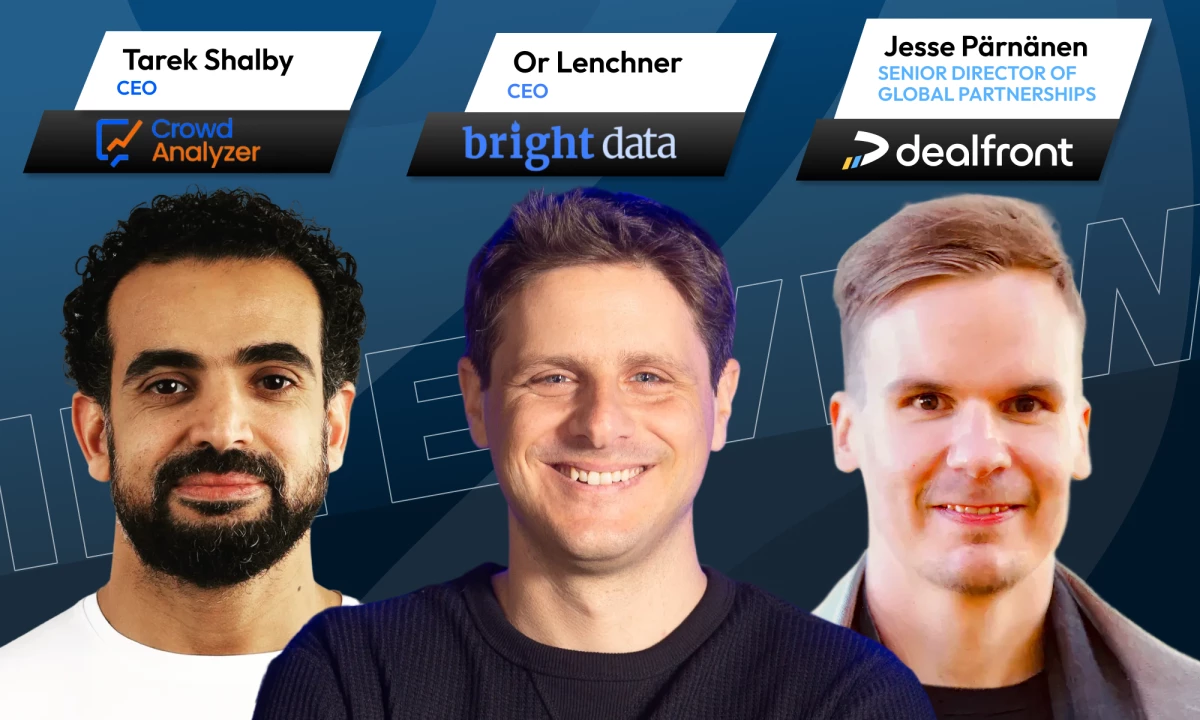
In this roundtable interview with DesignRush, Jesse Pärnänen of Dealfront, Tarek Shalby of Crowd Analyzer, and Or Lenchner of Bright Data share how leading companies are using data, compliance, and partnerships to scale responsibly.

Who are the Guests?
Jesse Pärnänen is VP of Partnerships at Dealfront, where he drives ecosystem growth for a Europe-first go-to-market platform. He brings over a decade of experience scaling SaaS companies across European and global markets through compliant, data-driven partnerships.
Tarek Shalby is CEO of Crowd Analyzer, an AI-powered media intelligence platform serving leading MENA brands. With more than 20 years of experience, he is known for turning insights into executive-level decisions and leading high-impact SaaS transformations across the region.
Or Lenchner is CEO of Bright Data, the world’s largest web data platform. Under his leadership, Bright Data has become a critical infrastructure layer for ethical, compliant AI training and real-time data access at global scale.
Why Market Context and Compliance Drive GTM Success in Europe
Europe is often treated as a single market, but in reality, it’s a patchwork of regulatory interpretations, buyer expectations, and risk tolerance.
For B2B SaaS companies, overlooking those nuances can quietly derail otherwise strong GTM strategies.
Jesse Pärnänen emphasizes that many external partners underestimate how deeply regulation shapes execution across Europe.
“Understanding the European market context is absolutely critical. Regulations here are fundamentally different compared to the US, which is something many outside partners don’t initially realize.”
Even within the EU, GDPR enforcement varies significantly. Germany applies the regulation conservatively, while Nordic countries tend to be more pragmatic.
According to Pärnänen, this variance directly impacts messaging, data usage, and conversion performance.
“I’ve seen projects succeed precisely because partners localized their approach. Tailoring messaging and compliance processes for the German market immediately built trust and increased conversion compared to a one‑size‑fits‑all strategy.”
For European buyers, compliance signals credibility. Partners who build regulatory understanding into their execution are not just minimizing risk, they're earning trust earlier in the buying process.
That same emphasis on data integrity is now shaping the AI ecosystem more broadly.
According to Or Lenchner, regulation is beginning to move upstream, focusing less on outputs and more on how data is sourced in the first place.
“There isn’t a whole lot of regulation, but it's coming, and once it's in place AI companies will need to be able to show details about their data collection,” Lenchner explains.
Together, these perspectives point to a clear shift: compliance has become a growth catalyst.
Accuracy Drives Impact in MENA
If Europe challenges companies with regulatory complexity, the MENA region tests their ability to understand the nuances of language, culture, and context at scale.
According to Tarek Shalby, most brands fail because their insights don’t reflect reality.
Leading MENA brands, he explains, prioritize three things when choosing insight partners: accuracy, actionability, and scalability.
“Too many providers promise global capability yet fail to capture the nuances of our region’s language and culture. For leading brands, if the insights don’t reflect their reality on the ground, the value disappears instantly.”
Crowd Analyzer’s work with ARASCO, a major Saudi agri‑food company, demonstrates how insight becomes strategic when it’s localized and timely.
Instead of starting with a pitch, the team analyzed a live issue affecting food sustainability and delivered an insight snapshot aligned with ARASCO’s KPIs and Vision 2030 priorities.
“What made the difference was tying our insights directly to their KPIs: public trust, policy alignment, and the strength of their brand narrative. By embedding our team with theirs in the early phase, we ensured they could act on insights in real time, not just read them in reports,” Shalby says.
The lesson here is clear: clients value decision clarity, not data volume.
Why Compliant Data Infrastructure Is the Bedrock of Scalable AI
As AI adoption accelerates, the conversation around data is changing just as fast. Lenchner sees three challenges consistently holding companies back: legal compliance, scale uncertainty, and data freshness.
AI models are only as strong as the data they’re trained on. Without real‑time, compliant access to public web data, agents break, insights degrade, and automation stalls.
Bright Data positions itself as the infrastructure layer that enables AI to function reliably, and that's without cutting ethical or legal corners.
“There are some simple rules to follow that have been reinforced by US courts, mainly collecting only public data, meaning data that is visible without a log in,” Lenchner says.
This focus on ethical collection aligns closely with the trust‑first mindset emphasized by both Dealfront and Crowd Analyzer.
Whether fueling AI models or informing GTM strategy, data integrity is now inseparable from brand credibility.
When It’s Time to Bring in Outside Expertise
All three experts reached the same conclusions. Brands should seek external partners when:
- Pipeline activity isn’t converting into revenue
- Local markets feel opaque or resistant
- Regulatory complexity slows execution
- Data infrastructure limits AI or insight maturity
In complex markets, respecting the rules, realities, and nuances on the ground is no longer optional.
Looking for a trusted partner to accelerate results? Explore top B2B marketing agencies on DesignRush.