
Key Takeaways:
- Salesforce launched Marketing Cloud Next, a full-funnel solution that replaces static campaigns with AI-powered two-way customer conversations.
- Its new Unified Retail Bundlespromise to replace 40+ fragmented systems with a fully integrated AI and data-powered platform for real-time personalization across channels.
- Salesforce’s Data Cloud + AI suite surpassed $1B in run-rate revenue, up 120% YoY, signaling strong early adoption of its AI-first approach.
- Summer ‘25 Commerce Cloud release unifies B2C Commerce, Order Management, and POS into one solution, enabling agentic commerce with lower costs and faster time-to-value.
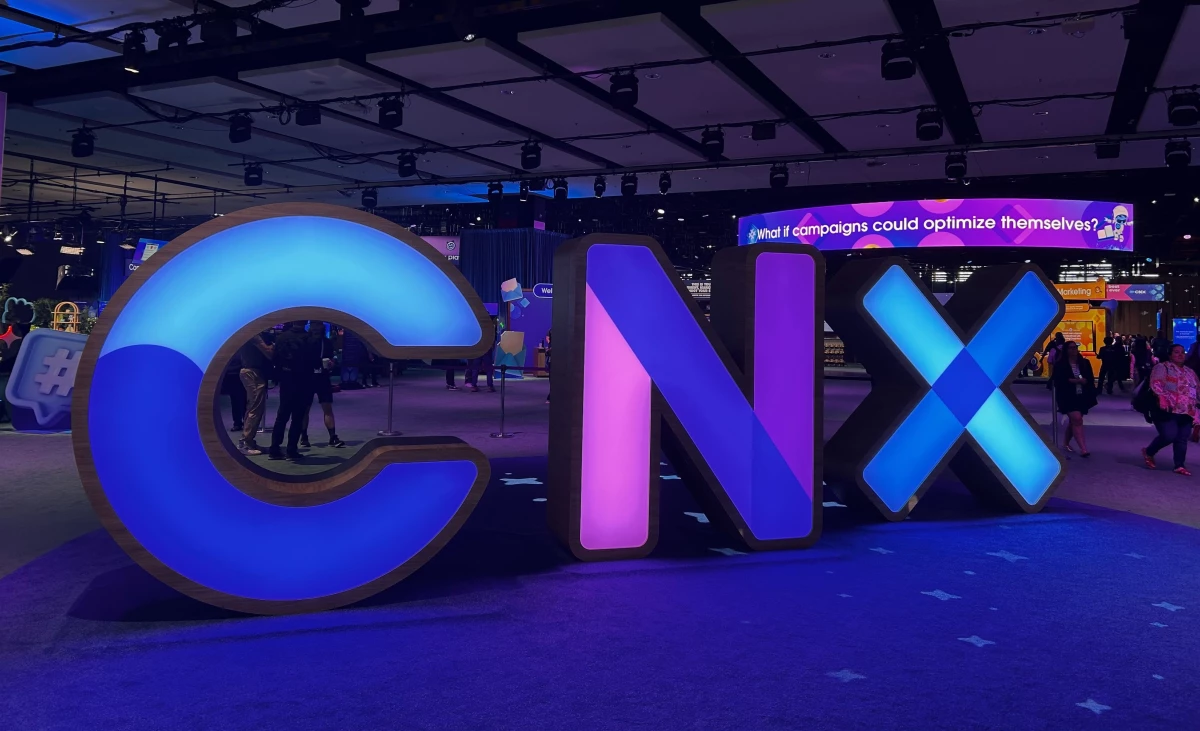
At this year’s Connections (CNX) conference in Chicago, Salesforce introduced a fully integrated vision for retail and engagement.
This moves the brand away from its tools and toward a unified, all-in-one platform that delivers a smoother, more connected user experience.
The company presented new features that embed automation throughout the customer journey, supported by real-time data and AI assistants designed for different workflows.
These tools are designed to support campaign planning, customer interactions, and business operations, working within a single platform instead of isolated applications.
Marketing Cloud Next was a centerpiece of the event, presented as the first platform to support “agentic marketing” across the entire funnel.
🔴 LIVE: Enter the world of agentic marketing at #CNX25. https://t.co/4JA7jsUz5F
— Salesforce (@salesforce) June 11, 2025
Instead of static campaigns and no-reply emails, brands can now engage in two-way communication across every channel.
This is made possible with AI agents responding to customer inquiries, optimizing creative assets, and automating testing strategies.
Salesforce’s Agentforce assistants now support marketers in:
- Generating campaign briefs, creative drafts, and audience segments using CRM data
- Coordinating cross-channel experiences informed by real-time behavior
- Managing ad campaign performance and recommending budget shifts automatically
Salesforce also previewed the summer release of Commerce Cloud, allowing businesses to manage customer interactions and backend logistics together. Key features include:
- B2C Composable Storefront Enhancements: Updated developer tooling, granular replication, and real-time personalization using Data Cloud event triggers
- Retail Cloud POS Enhancements: Mobile-first design with shared real-time shopper and inventory data for online and in-store consistency
- Order Management: Automated routing, omnichannel inventory management, and reduced fulfillment costs
One of the most significant developments is the launch of unified retail bundles, packaging ecommerce, POS, CRM, marketing, and AI capabilities into ready-to-use solutions.
These bundles are intended to replace dozens of disconnected systems commonly used by retailers.
With one connected setup, companies can create personalized offers, manage inventory visibility across channels, and track the full customer journey.
Rebuilding From the Core
Salesforce’s product architecture also reflects a deeper organizational shift.
Marketing Cloud, once a stand-alone acquisition, now runs on the Salesforce core platform.
This means marketing, sales, and commerce teams can access the same data, eliminating the need for third-party connectors and manual reconciliation between systems.
The average marketing campaign takes 7.4 weeks to launch.
— Salesforce (@salesforce) June 11, 2025
Agentforce lets you launch in days with AI agents that generate briefs, build audiences, and create journeys—taking autonomous action with your data, metadata, and workflows.
Watch how at #CNX25: https://t.co/B8eBFcWbr1pic.twitter.com/yYWXDQAr4Y
The company also rolled out two differentiated editions of Marketing Cloud:
- Marketing Cloud Growth: A simplified package for small to mid-sized teams
- Marketing Cloud Advanced: A full-featured suite for large enterprises
Salesforce’s executive team positioned these changes as foundational, not cosmetic.
Rather than adding AI to old tools, the platform has been rebuilt to support decision-making and execution through a single interface.
“We’re delivering more than AI features, we’re introducing a new way of working,” Marketing Cloud EVP and GM Steve Hammond said.
“Agentforce doesn’t replace marketers, it empowers them to do more by automating the manual work.”
Goodbye, "do-not-reply."
— Salesforce (@salesforce) June 11, 2025
👋 Hello, @MarketingCloud Next—powered by Agentforce.
Meet the first full-funnel agentic marketing solution that turns every channel into a 2-way conversation and every campaign into an intelligent engine for growth: https://t.co/RafqI2CoGA#CNX25pic.twitter.com/5gd7a9CUdj
Salesforce is aiming to replace the patchwork systems many companies rely on with a single, cohesive experience.
It's something essential for marketing and commerce teams suffering through data and channel complexity, repositioning the platform from a product vendor into a business partner.
The repositioning also plays directly to the market’s demand for accountability.
Executives want to see measurable ROI in a straightforward way.
The clearer the path from data to action, the easier it becomes to justify investment in the platform.
Our Take: Are Brands Ready to Rethink the Marketing Team Itself?
Salesforce is resetting the marketing operating model.
If AI agents are doing the tactical work, the real value from agencies and internal teams must come from creative leadership, journey architecture, and strategic oversight.
For agency leaders, this is a wake-up call to rethink service offerings.
Clients will need help making sense of new workflows and defining how humans and machines collaborate in real-time campaigns.
Offering prompt libraries, agent setup, and content quality governance could become standard services.
Are your hottest leads getting the cold shoulder?
— Salesforce (@salesforce) June 11, 2025
Probably.
Only 18% of marketers are very satisfied with lead gen ROI.
Agentforce captures, engages, and nurtures leads 24/7—autonomously qualifying pipeline and handing off opportunities.
Demo: https://t.co/jakACiHG5H#CNX25pic.twitter.com/CwW31N1L3s
For CMOs, the challenge is focus. With so many tools now under one platform, it’s tempting to throw AI at everything.
But real results will come from identifying a few high-impact customer journeys and building around those.
Sales, marketing, service, and commerce leaders will need to meet at the same table, something this unified platform finally makes possible.
It’s not about racing to adopt every new feature. It’s about knowing which ones solve a real problem for your team or customer, and getting them right.
Meanwhile, Salesforce recently completed its acquisition of Convergence.ai, solidifying its position as an AI leader in the CRM space.
Need a better handle on customer data, retention, and pipeline visibility? Explore top CRM consulting firms here: