

Retab Platform: Key Findings
- Retab raised $3.5M to launch a document AI platform focused on accuracy, cost-efficiency, and real-world readiness.
- Its platform auto-selects top-performing models and verifies results with guided reasoning and multi-LLM consensus.
- Early customers in logistics, finance, and healthcare are using Retab to streamline high-volume, document-heavy workflows.
Quick listen: Can devs finally trust document AI in production? Find out in under 2 minutes.
Retab wants to fix the invisible problem that breaks most AI workflows: documents.
The San Francisco-based startup just came out of stealth with $3.5 million in pre-seed funding and the official launch of its document AI platform.
Backed by VentureFriends, Kima Ventures, K5 Global, and notable angel investors like Eric Schmidt and the CEOs of Dataiku and Datadog, Retab promises to turn messy documents into structured data.
All with minimal developer friction.
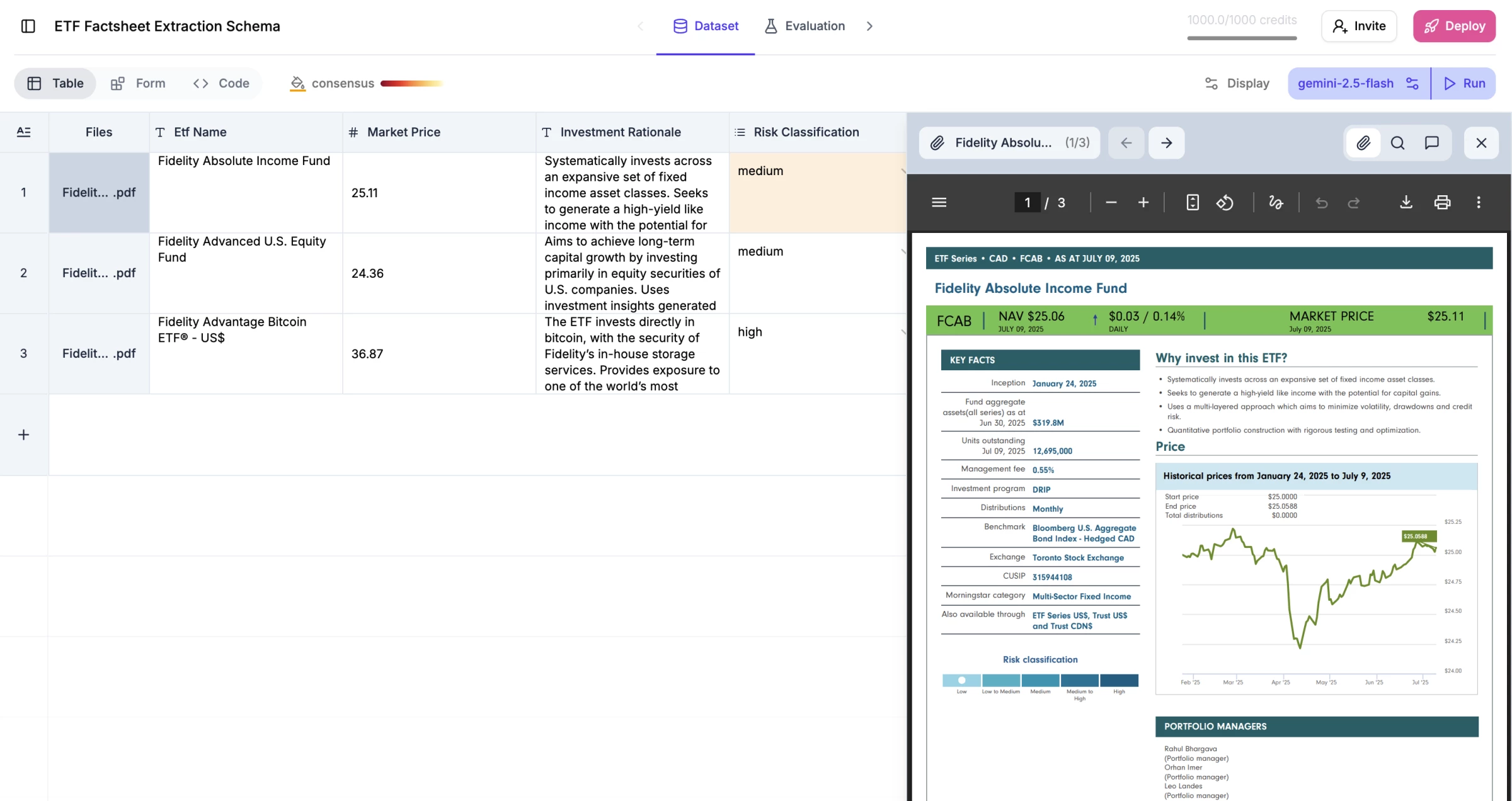
At its core, Retab offers a developer-first toolkit that automates schema design, prompt engineering, and model selection for any document-processing use case.
It separates itself from LLMs by being the orchestration layer that helps existing models from providers like OpenAI, Google, and Anthropic actually function in production settings.
“People keep building demos that look like magic, but break the moment you put them into production,” said Louis de Benoist, co-founder and CEO of Retab.
“We lived that pain ourselves. Wiring up fragile pipelines just to extract a few fields from a PDF. We built Retab because it’s the developer-first platform we always wished we had.”
Before Retab, de Benoist and his co-founders built internal tools for document-heavy workflows in logistics.
What started as a scrappy solution to extract structured data soon evolved into the framework that underpins Retab: a full-stack system for handling real-world documents with verifiable accuracy.
Built to Work Where Demos Break
Rather than betting on one model, Retab’s platform automatically tests multiple ones to find the best performer for a task.
Whether the priority is cost, speed, or precision.
A self-optimizing schema system refines inputs before go-live, and a consensus mechanism among multiple large models flags uncertainty in outputs.
According to the company's press release, a trucking company using Retab was able to slash costs by identifying the smallest and fastest model that still hit 99% accuracy.
Meanwhile, a financial firm used it to pull key figures from 200-page earnings reports, shaving days off their analysis cycle.
In both cases, the AI tool helped simplify high-stakes, high-volume work that had traditionally required human analysts.
As vertical AI startups proliferate, Retab sees itself as a foundational player, or what it calls the “OS for reliably extracting structured data.”
With integrations underway for Zapier, n8n, and Dify, the platform aims to become the go-to backend for automating everything from claims and compliance to customs paperwork.
Investor and Dataiku CEO Florian Douetteau put this bluntly.
"The AI-fication of the economy depends on the capability to convert operations based on millions of documents into verified, structured data," Douetteau shared.
Overall, the platform's long-term bet is to become the default middleware between unstructured data and the artificial intelligence systems that depend on it.
Our Take: Can Developers Finally Trust Document AI?
At a time when everyone's obsessed with speed, hype, and productivity, Retab doubles down on verification, structure, and reliability.
It's the kind of stuff that makes or breaks automation at scale.
Document AI has long felt like an afterthought, but Retab reframes it as essential infrastructure.
If vertical AI companies are going to thrive, they’ll need tools like this to scale responsibly and cost-effectively.
In other news, OpenAI’s latest agent shows how far workflow automation has come.