
AI Personalization in Fintech: Key Findings
- OpenAI acqui-hires Roi, underscoring the growing industry expectation that personalization will become a baseline feature for consumer fintech products.
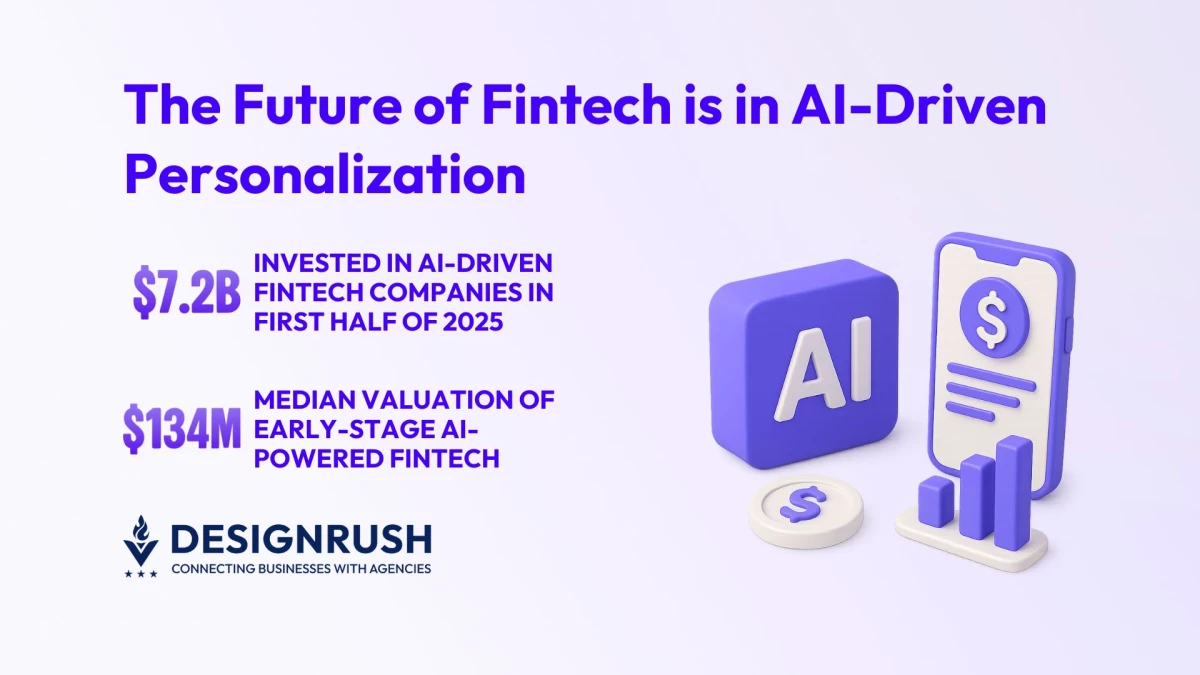
- AI-driven fintechs raised $7.2 billion in the first half of 2025, nearly matching all of 2024, signaling the rapid rise of personalized financial services.
- Real-time personalization allows for adaptive risk scoring, individualized fraud detection, and smarter recommendations.
AI-powered personalization has always been a hot topic as companies race to maximize the technology’s capabilities.
Leading the way, of course, is OpenAI.
The company behind ChatGPT recently acquired Roi, an AI-powered personal finance app that aims to make investing accessible to everyone through personalized financial analysis and advice.
RIP to the engineer testing this feature 💀 pic.twitter.com/W6qD5lGxE3
— Roi (@investwithroi) February 3, 2025
The announcement was made in a post on X by Roi Co-founder and CEO Sujith Vishwajith, who will be the only member of the Roi team to join OpenAI.
I’m excited to announce that Roi has been acquired by OpenAI!
— suje (@aka_suje) October 3, 2025
We started Roi 3 years ago to make investing accessible to everyone by building the most personalized financial experience. Along the way we realized personalization isn’t just the future of finance. It’s the future… pic.twitter.com/KL8HJbFuSj
This move isn’t surprising as OpenAI has launched several consumer-focused initiatives, including Pulse, the Sora app, and Instant Checkout.
While acqui-hiring Roi offers OpenAI a significant advantage, what does this move mean for businesses, especially those in the fintech industry?
The straightforward interpretation is that OpenAI purchased talent and technology.
The more interesting interpretation is that the company continues to recruit people who know how to turn personalization into something intimate and frictionless.
This is where fintech leaders should pay closer attention.
Personalization demands are rising much faster than the legacy architectures that power many financial platforms. Yet, AI-powered personalization in fintech is already beginning to disrupt this.
According to KPMG’s Pulse of Fintech report, AI-driven fintechs attracted $7.2 billion in investments in the first half of 2025. This nearly matches the entire total invested in 2024.
Moreover, early-stage AI fintechs also posted a median valuation of $134 million, which is far ahead of non-AI-driven fintechs.
This acceleration has created an awkward dilemma.
The industry wants individualized experiences, but many of the systems still in use were built in a time when the world expected uniformity.
As such, even the most agile fintech startups are discovering that the infrastructure required for real-time personalization resembles a constantly evolving ecosystem rather than a stable stack.
This is an unfortunate scenario that development agencies like Shakuro see often:
“Personalized AI behaves like a participant in the user’s financial life. That shifts the entire burden of performance. A product that reacts in real time has to be engineered for continuous adaptation, not periodic upgrades,” said Aleksey Gureiev, Technical Lead at Shakuro.
This presents fintech teams with a clear question: if personalization is becoming the defining feature of modern financial products, how should AI development redesign systems to support it before the market outgrows them?
The Rise of Personalized AI and What It Means for Fintech
OpenAI’s acqui-hire of Roi reflects an expectation that personalized AI will become the baseline for interactions across all consumer-facing products.
The gap between a static model and a responsive one is widening, and users are growing far less patient with platforms that cannot read context or anticipate needs.
In the fintech industry, in particular, AI-powered personalization enables:
- Real-time risk scoring that adjusts to user behavior
- Financial insights shaped by day-to-day habits
- Fraud detection that responds to individual patterns instead of large categories
- Recommendations that reflect real financial life rather than broad demographic assumptions
However, these opportunities don’t come without a cost. Personalization introduces high-volume data flows, constant retraining loops, and privacy obligations that create both architectural and operational strain.
The question is whether fintech systems can orchestrate the data, models, and controls required to personalize responsibly.
What Teams Must Do Now
The fintech industry has reached a point where personalization cannot be treated as an add-on. It has to be baked in right from the start. This is especially true for fintech startups.
Fortunately, there are many ways to build fintech software with such foundations:
1. Build Modular Backends Built for Constant AI Evolution
Unfortunately, AI models update faster than most platforms can absorb, with every new release adding more pressure to rewire services. This means that the most sustainable path is to design fintech software with the expectation of constant change.
- Adopt model-agnostic architecture. Products should allow AI components to be replaced or combined without rewriting core systems. Routing between general and specialized models keeps the platform resilient.
- Use microservices for feature independence. AI-driven features and core financial functions should operate in separate containers to reduce failure risk and accelerate updates.
- Implement API-first orchestration. Decoupled interfaces let personalization features evolve independently. Users get stability while teams improve AI behind the scenes.
2. Structure Systems to Support Real-time Personalization
Personalized finance only works if systems can ingest, process, and respond to user signals as they happen. The problem is that many existing fintech stacks were built for batch updates and monthly reporting, not moment-to-moment interpretation.
To correct this, Shakuro recommends taking the following steps:
- Unify financial, behavioral, and transactional data. A real-time personalization loop depends on a single, coherent data environment instead of fragmented datasets.
- Prioritize low-latency infrastructure. People expect financial intelligence to move at the pace of their lives. Event-driven systems and streaming frameworks help maintain that speed.
- Strengthen compliance by design architecture. More personal data means tighter oversight. Systems need built-in transparency, auditable pipelines, and consent management that can prove its own integrity.
3. Safeguard Scalability Through Flexible AI Infrastructure
Fintech platforms often underestimate how expensive and fragile personalization becomes at scale. Model updates might work in controlled environments, but may inflate storage costs, inference loads, and privacy issues.
Scalable infrastructure ensures personalization remains fast, affordable, and reliable as data volume and user demand rise.
- Prepare for rapid model iteration. Plan for continuous deployment of models so updates do not disrupt service. Build quick rollback paths and smoke tests that validate business-critical flows after every model change.
- Build multi-region redundancy. Distribute AI workloads across regions so a model outage or cloud disruption doesn’t take down personalization features. This keeps services responsive and compliant with regional data rules.
Reframe the Architecture, Unlock the Opportunity
For fintech founders, the real cost of having the right architecture is not the effort required to modernize or maintain it.
Early architectural investment reduces the financial and performance burden of retrofitting personalization later, when the user base is larger and expectations are higher.
The fintech companies that shape the next decade will be those that treat personalization as a core discipline and not a decorative layer.
Teams that build flexible systems now will find themselves ready for whatever the next wave of AI demands.